

Key takeaways
- 1 inch: useful for high-frequency reflections and decorative treatment, but limited for lower speech frequencies.
- 2 inches: the best starting point for calls, meetings, and general home-office echo.
- 4 inches: better for recording, strong voice reflections, and more balanced room absorption.
- Air gap: mounting a panel 1–2 inches off the wall can improve absorption compared with placing it directly against the surface.
- Coverage: a smaller number of thick panels in strategic locations often works better than covering one wall with thin material.
Best Soundproofing Panels for Home Offices
The best soundproofing panels for a home office are thick, high-density acoustic panels made from mineral wool or recycled PET: use 2-inch panels for calls and echo control, 4-inch panels with an air gap for recording, and treat at least 20% to 40% of the room’s wall or ceiling area rather than covering one wall at random.
There is an important distinction behind that recommendation. Most products sold as “soundproofing panels” absorb sound inside a room; they do not stop a loud neighbor, traffic, or a television from passing through a wall. Absorption reduces reflected speech, keyboard noise, and reverberation. Blocking sound requires construction changes such as sealing gaps, adding mass, decoupling surfaces, and improving doors or windows.
Our top picks



As an Amazon Associate we earn from qualifying purchases at no extra cost to you. Ratings are shown as listed on Amazon.
Quick picks by home-office situation
| Situation | Best panel type | Useful specification | Typical coverage | General price range |
|---|---|---|---|---|
| Video calls in a small room | Fabric-wrapped fiberglass or mineral wool | 2 inches thick, NRC about 0.85–1.05 | 24–48 sq. ft. | $150–$500 |
| Shared room with noticeable echo | Recycled PET panels or fabric-wrapped mineral wool | 1–2 inches thick, NRC about 0.45–0.95 | 40–80 sq. ft. | $200–$900 |
| Voice-over or podcast recording | Mineral wool or fiberglass broadband absorbers | 4 inches thick, 2-inch air gap preferred | 48–96 sq. ft. | $400–$1,200 |
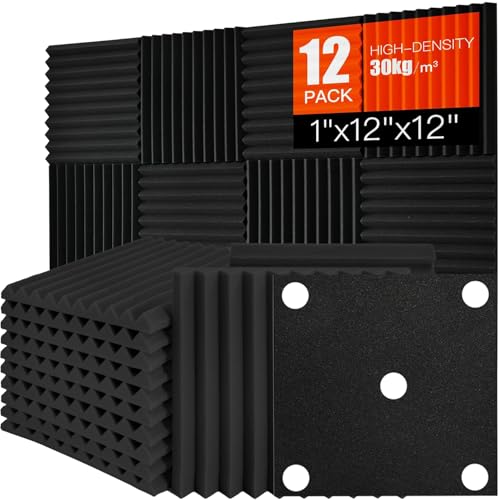
| Low-cost improvement | Acoustic foam tiles | 2–3 inches thick, NRC often about 0.40–0.75 | 24–48 sq. ft. | $40–$250 |
| Decorative treatment for a rental | Adhesive or freestanding PET panels | 0.5–1 inch thick, NRC commonly 0.20–0.60 | 24–72 sq. ft. | $150–$800 |
These are market ranges rather than quotes, and acoustic performance varies with panel size, mounting method, fabric, test method, and room placement. A listed NRC is not a guarantee of equal performance at every frequency.
Panel materials compared
Mineral wool and fiberglass
For the broadest control, fabric-wrapped mineral wool or fiberglass panels are usually the strongest choice. Their porous cores absorb mid and high frequencies, while thicker panels and an air gap improve performance lower in the voice range. This makes them suitable for speech, video calls, singing, and voice-over work.
A 2-inch panel is a practical all-purpose size. A 4-inch panel is better when the room sounds boomy or hollow, especially when mounted 1–2 inches away from the wall. The trade-off is depth, weight, and installation: a 2-by-4-foot, 2-inch panel may weigh roughly 8–15 pounds, while a comparable 4-inch panel can weigh around 15–25 pounds depending on its core and frame.
Look for a rigid, non-shedding core, a durable breathable fabric, and a mounting system rated for the panel’s weight. These panels generally cost more than foam, but they provide better broadband absorption and are less likely to deteriorate from ordinary office use.
Recycled PET panels
PET panels are made from compressed polyester fibers and are attractive when appearance, lighter weight, and easy handling matter. Brands such as Autex offer PET-based acoustic products in colors and shaped configurations, while many office-acoustics manufacturers sell similar recycled-polyester panels.
PET is particularly useful for reducing reflections around a desk, ceiling, or partition. Thin decorative PET products can improve speech clarity, but they should not be expected to absorb bass or provide the same broadband control as a 4-inch mineral-wool absorber. Check the published NRC rather than choosing by thickness alone: a dense 1-inch panel can outperform a loosely made thicker panel.
Acoustic foam
Foam tiles from manufacturers such as Auralex are inexpensive, lightweight, and easy to cut around shelves or corners. They can reduce flutter echo and harsh high-frequency reflections, making a room sound less live during calls.
Foam is a poor substitute for thick broadband panels when the problem is low-frequency buildup, room boom, or sound escaping through a wall. Covering a room almost entirely with thin foam can also make speech sound unnaturally dull while leaving bass problems largely unchanged. Use foam for targeted reflection control, not as a promise of sound isolation.
How thickness, NRC, and coverage work together
NRC, or Noise Reduction Coefficient, is a rounded average of absorption measurements at several midrange frequencies. A panel with an NRC of 0.90 absorbs much of the sound energy measured in that test range, but NRC does not fully describe bass performance, blocking ability, or the result in your specific room.
- 1 inch: useful for high-frequency reflections and decorative treatment, but limited for lower speech frequencies.
- 2 inches: the best starting point for calls, meetings, and general home-office echo.
- 4 inches: better for recording, strong voice reflections, and more balanced room absorption.
- Air gap: mounting a panel 1–2 inches off the wall can improve absorption compared with placing it directly against the surface.
- Coverage: a smaller number of thick panels in strategic locations often works better than covering one wall with thin material.
For a small office of about 100 square feet with an 8-foot ceiling, start with 32–48 square feet of 2-inch panels. For recording, increase that to approximately 48–80 square feet of 4-inch broadband absorption, while leaving some reflective surface so the room does not become excessively dead.
A practical coverage calculation
Suppose your room has 100 square feet of floor area and 8-foot walls. If the room is approximately 10 by 10 feet, its four walls contain about 320 square feet of surface area before subtracting the door and window. Treating 20% of that wall area requires about 64 square feet of panels.
Eight 2-by-4-foot panels provide 64 square feet of coverage. At a general market price of $60–$140 per panel for fabric-wrapped broadband products, the panel budget would be approximately $480–$1,120, before mounting hardware. A smaller six-panel arrangement, covering 48 square feet, may be enough for calls if panels are placed at the first-reflection points and behind the monitor or speaker.
The calculation is a planning tool, not a rigid rule. A room with carpet, curtains, bookcases, and upholstered furniture may need fewer panels. A bare room with glass, painted drywall, and a hard floor may need more.
Where to place panels for calls and recording
For video calls
Place one or two panels behind the monitor or camera, where your voice reflects toward the microphone. Add panels on the side walls near your desk, ideally around ear height. If your desk faces a bare wall, treating that wall usually produces a more noticeable improvement than placing every panel behind you.
For voice recording
Use thick panels at the first-reflection points on both side walls, behind the microphone or speaker, and behind the person speaking when practical. A ceiling cloud above the desk can control the strongest vertical reflection. Avoid putting all absorption directly around the microphone; uneven placement can create a dead-sounding area while reflections remain elsewhere.
For noise entering from outside
Panels can make the room less reverberant, so outside noise may seem less intrusive, but they will not seal a window or stop voices through a thin wall. First inspect door gaps, window seals, vents, and shared walls. Weatherstripping and a door sweep can address obvious air paths; structural sound isolation is a separate project.
Decision matrix: choosing by budget and use
| Budget and use | Recommended setup | Why it fits |
|---|---|---|
| Under $200, occasional calls | Four to eight 2-inch foam or PET panels | Reduces flutter echo with minimal installation cost |
| $300–$700, daily calls | Six to eight 2-inch broadband panels, distributed around the desk | Better speech clarity and more even absorption |
| $700–$1,500, frequent recording | Eight to twelve 4-inch broadband panels plus a ceiling cloud | Controls more of the voice spectrum and reduces room coloration |
| Rental or frequent redecorating | Lightweight PET panels, freestanding screens, or removable mounts | Lower wall damage and easier repositioning |
Ownership details that affect the decision
Fabric is usually the first visible part to show wear. Choose removable or replaceable covers if the panels will be touched often. Vacuum fabric gently with a soft brush attachment; do not saturate porous cores, since trapped moisture can cause staining or odor. PET can typically be dusted or vacuumed, but follow the maker’s cleaning instructions before using liquids.
Mounting hardware is another common failure point. Adhesive strips may work for very light foam, but heavy framed panels need mechanical anchors, cleats, or a properly rated hanging system. Leave clearance around electrical outlets, sprinklers, heaters, and ventilation. In a rented property, freestanding screens or picture-hanging systems may be safer than improvised glue.
Do not install every panel on a single wall, place thin foam over the entire room, or judge performance by hand-clapping alone. Record a short voice sample from the normal desk position before and after each stage of treatment. The most useful improvement is usually clearer speech with less room tail, not complete silence.
Bottom line
For most home offices, choose 2-inch fabric-wrapped mineral-wool, fiberglass, or high-performing PET panels with an NRC near 0.85 or higher, and cover roughly 20% of the room’s reflective wall area. Choose 4-inch broadband panels with an air gap for recording or rooms with strong echo. Choose foam only when price and lightweight installation matter more than low-frequency performance. If the real problem is noise passing through a wall, combine absorption panels with sealing and structural sound-isolation measures rather than expecting panels alone to soundproof the room.





Write Your Review
No reviews yet. Be the first to share your experience!