

Key takeaways
- Wipe vinyl or synthetic upholstery after sweaty sessions with a slightly damp cloth and a manufacturer-approved cleaner.
- Keep springs dry and inspect hooks, loops, and anchor bolts monthly.
- Tighten hardware when it loosens, but do not over-tighten joints designed to pivot.
- Replace cracked pedals, exposed foam, bent pins, or distorted springs rather than attempting improvised repairs.
- Keep the chair away from direct sunlight and heaters, which can dry upholstery and age elastic components.
The best Pilates chair for most home users is a stable, padded Wunda-style chair with adjustable resistance springs, a non-slip pedal, and a footprint no larger than about 30 by 25 inches; for frequent training, the Balanced Body EXO Chair and Merrithew Stability Chair are the strongest premium options, while a compact spring-resistance Pilates chair is the better choice for smaller budgets and rooms.
Our top picks


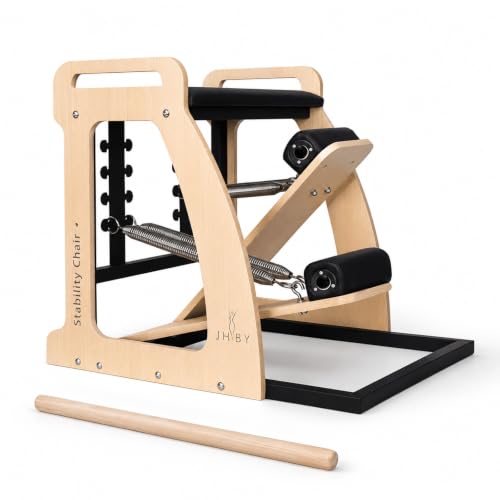
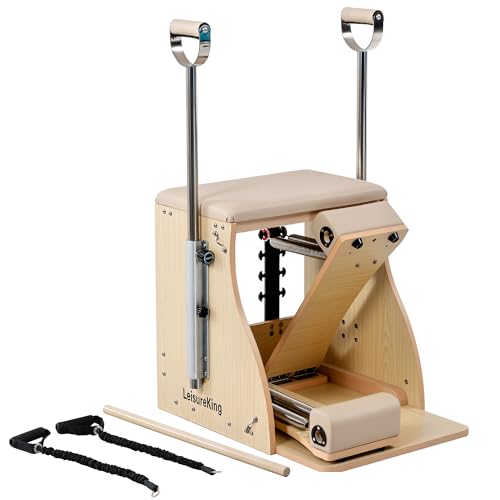
As an Amazon Associate we earn from qualifying purchases at no extra cost to you. Ratings are shown as listed on Amazon.
Best Pilates chairs by situation
| Situation | Best choice | What to prioritize | Typical 2026 price range |
|---|---|---|---|
| First Pilates chair | Adjustable Wunda-style chair | Two spring positions, 150–250 lb capacity, clear adjustment markings | $250–$600 |
| Frequent home practice | Balanced Body EXO Chair or Merrithew Stability Chair | Rigid frame, replaceable springs, dense padding, manufacturer support | $800–$1,400 |
| Small apartment | Compact folding or stackable Pilates chair | Under 26 inches wide, under 20 inches deep when stored, locking pedal | $180–$500 |
| Multiple users or stronger resistance | Commercial-style split-pedal chair | At least 300 lb capacity, independent pedal action, four spring settings | $900–$1,800 |
| Low-impact seated exercise | Wide, high-padded chair with light springs | Stable base, easy pedal reach, low starting resistance | $250–$900 |
What makes a Pilates chair worth buying?
Frame stability comes first
A chair can have excellent springs and still be unsuitable if the frame shifts during a standing or one-arm exercise. Look for a steel or hardwood frame with wide-set feet, rubber or high-friction floor pads, and a maximum user weight comfortably above your own. A stated capacity of 250 pounds is more reassuring for a 170-pound user than for a 240-pound user because dynamic movement produces more force than quiet sitting.
Try to leave at least a 50-pound margin between your body weight and the published limit. For example, a 200-pound user should favor a chair rated for 250 pounds or more, particularly if the program includes stepping onto the pedal or leaning away from the seat. Avoid lightweight chairs that rock when you press down with one foot, even if their static weight limit looks adequate.
Resistance springs should be adjustable and replaceable
Most Pilates chairs use one or more springs attached between the frame and pedal. A useful home chair lets you alter both the spring strength and the spring attachment point. Moving a spring to a higher anchor generally changes leverage, so the same spring can feel substantially different without replacing it.
For a versatile setup, look for at least two spring strengths or four clearly defined resistance positions. Light resistance helps with controlled mobility and learning pedal alignment; heavier resistance provides more challenge once technique is consistent. Springs are consumable components: they gradually lose tension, may develop surface corrosion, and should be replaced if coils separate, deform, or make a scraping sound. Confirm that replacements are available before buying an unfamiliar chair.
Pedal adjustment affects comfort and control
A split pedal allows the two sides to move independently, which expands the exercise range but demands more coordination. A single pedal is simpler and can feel more predictable for beginners. Some models allow the pedal height or starting angle to be changed; this is valuable for users with shorter legs, limited ankle mobility, or a preference for a lower starting position.
Check whether the pedal has a locking pin or safety mechanism for storage. A pedal that swings freely while the chair is being moved can catch fingers or damage nearby furniture. The pedal surface should be wide enough for your foot—approximately 12 to 16 inches is common—and covered with a textured, non-slip material rather than smooth painted wood.
Leading chair types compared
Balanced Body EXO Chair
The EXO Chair is aimed at users who want a studio-style chair in a home setting. Its appeal is the rigid construction, professional-style spring system, and broad exercise compatibility. It is a better fit for frequent practice than for someone who only wants occasional light movement. Expect a substantial purchase price and a footprint that needs a permanent or semi-permanent location. Check the current configuration carefully because accessories, pedal arrangements, and upholstery options can change the final dimensions and cost.
Merrithew Stability Chair
The Merrithew Stability Chair is another premium option with a firm frame, padded seat, and resistance system designed for structured Pilates work. It suits users who value established replacement parts and instructional support. Its substantial build improves confidence during supported standing movements, but it is not the easiest choice for a room where equipment must be moved after every session.
Adjustable Wunda-style chairs
Wunda-style chairs are the most practical category for many home buyers. They generally offer a compact padded box, a sprung pedal, and a lower price than studio equipment. Quality varies widely: some have a rigid wood or steel frame and replaceable springs, while others use thin padding, narrow feet, or hardware that loosens after repeated adjustment.
Choose one with bolted rather than lightly screwed joints, a pedal with minimal side-to-side play, and a clearly stated weight limit. An adjustable model is preferable to a fixed-resistance chair because two household members can set it up differently.
Storage and room planning
Measure the chair in use, not just the shipping carton. A typical compact chair occupies roughly 22–30 inches in width, 18–26 inches in depth, and 20–26 inches in height. Allow a clear exercise zone of at least 6 by 8 feet for arm and leg movements. More demanding standing exercises may require additional room beside and behind the chair.
For a closet or under-bed storage plan, calculate the stored volume:
Example: a chair measuring 24 inches wide, 20 inches deep, and 24 inches high occupies about 6,912 cubic inches, or 4 cubic feet. If it folds to 24 by 20 by 10 inches, its stored volume falls to about 2.8 cubic feet. That reduction matters in a small apartment, but a folding mechanism also adds hinges and locking points that need inspection.
Do not store a chair upright unless the manufacturer permits it. The frame can tip, and a loose pedal may swing into a wall. Use a rubber mat on hard flooring to reduce sliding and protect the floor finish.
Padding, fit, and user limits
The seat should feel supportive rather than deeply soft. Dense foam around 2–3 inches thick usually provides a better balance of comfort and stability than a plush cushion that lets the pelvis sink during seated work. Upholstery should be wipeable, tightly attached, and free of seams directly under the main pressure points.
Seat height commonly falls around 18–24 inches. A taller chair can make mounting easier for some users but may increase the challenge of getting the feet securely to the floor. A shorter chair may improve reach to the pedal while making certain standing transitions more demanding. Compare the seat height with an ordinary dining chair before ordering.
For users above average height, seat width and pedal reach matter as much as the weight limit. A narrow chair can restrict hip positioning, while a pedal that sits too far forward may encourage the heel to lift. If the manufacturer does not publish seat dimensions, ask for them rather than relying on product photographs.
How to choose resistance safely
- Place the chair on a level, non-slip surface and confirm that every foot touches the floor.
- Begin with the lightest spring setting and test the pedal through its full range without loading your body weight onto it.
- Keep the pedal controlled in both directions; a spring that snaps the pedal upward is too strong for that exercise or setup.
- Increase resistance one setting at a time only after you can maintain stable knee, ankle, and pelvic alignment.
- Stop if the frame shifts, the spring rubs, or the pedal develops unusual side play.
People with pain, balance limitations, recent surgery, or a condition affected by exercise should ask a qualified health professional or Pilates instructor to help select and set up equipment. A Pilates chair is exercise equipment, not a substitute for individualized medical advice.
Ownership costs and maintenance
Budget for replacement springs, floor pads, and occasional hardware tightening. Springs often cost about $20–$60 each, depending on the manufacturer and resistance rating. A simple cost-per-use calculation can clarify the purchase: a $900 chair used three times per week for three years provides about 468 sessions, or approximately $1.92 per session before maintenance. A $300 chair used once weekly for the same period provides about 156 sessions, or $1.92 per session as well. The more expensive chair makes financial sense only if its stability, adjustability, and durability lead to more consistent use.
- Wipe vinyl or synthetic upholstery after sweaty sessions with a slightly damp cloth and a manufacturer-approved cleaner.
- Keep springs dry and inspect hooks, loops, and anchor bolts monthly.
- Tighten hardware when it loosens, but do not over-tighten joints designed to pivot.
- Replace cracked pedals, exposed foam, bent pins, or distorted springs rather than attempting improvised repairs.
- Keep the chair away from direct sunlight and heaters, which can dry upholstery and age elastic components.
Bottom line
The best Pilates chairs combine a rigid frame, replaceable adjustable springs, a secure pedal, supportive padding, and dimensions that fit your actual room. Choose the Balanced Body EXO Chair or Merrithew Stability Chair for frequent, long-term home practice and studio-style construction. Choose a well-built adjustable Wunda-style chair if value, compact storage, and occasional-to-regular use matter more than premium finish. Before ordering, verify the chair’s weight limit, seat and pedal dimensions, folded size, replacement-part availability, and return policy—those details determine whether it remains useful after the novelty wears off.





Write Your Review
No reviews yet. Be the first to share your experience!