

Key takeaways
- Confirm that the sling is listed for the exact lift and attachment method.
- Choose the size from the manufacturer’s measurement chart, not clothing size alone.
- Check whether the person needs head support, elevated leg support, or extra trunk coverage.
- Inspect stitching, loops, clips, fabric, and labels before every use.
- Follow the sling’s washing and drying instructions; heat and harsh chemicals can weaken fabric.
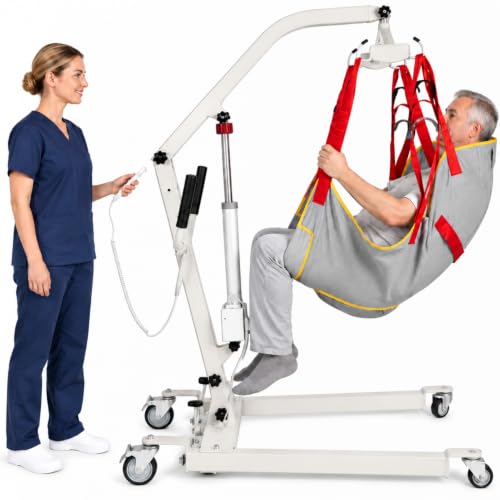
The best patient lifts for home use are usually electric mobile floor lifts for routine bed-to-chair transfers, while sit-to-stand lifts suit users who can bear some weight and ceiling lifts are the safest space-saving choice when a qualified professional can install the track.
The right choice depends less on the brand name than on four practical questions: how much assistance the person can provide, whether the lift fits through doorways and around furniture, which sling the clinician recommends, and whether the caregiver can operate it without unsafe lifting or awkward positioning. A physical or occupational therapist, nurse, or qualified equipment supplier should assess the transfer method before purchase.
Our top picks


As an Amazon Associate we earn from qualifying purchases at no extra cost to you. Ratings are shown as listed on Amazon.
Best patient lift types by home situation
| Situation | Most suitable lift | Typical capacity | Main trade-off |
|---|---|---|---|
| Person is fully dependent for transfers | Electric mobile full-body floor lift | 300–450 lb (136–204 kg) | Needs floor space and a trained caregiver |
| Person can stand briefly and follow instructions | Electric sit-to-stand lift | 300–450 lb (136–204 kg) | Not appropriate when the legs or trunk cannot support the transfer |
| Several daily transfers in a dedicated bedroom or bathroom | Ceiling track lift | Typically 300–440 lb (136–200 kg) | Higher installation cost and less portable |
| Occasional travel or backup use | Foldable or compact electric mobile lift | Usually 300–400 lb (136–181 kg) | May have a smaller base and less forgiving maneuverability |
| Very limited budget and suitable caregiver technique | Manual hydraulic floor lift | Commonly 300–450 lb (136–204 kg) | Caregiver must pump the hydraulic mechanism and still move the lift |
These are typical market ranges rather than specifications for every model. Examples of established manufacturers in this category include Invacare, Joerns Healthcare/Hoyer, Drive DeVilbiss Healthcare, Medline, and Bestcare. Verify the current capacity, warranty, sling approvals, and service arrangements for the exact model.
Electric full-body floor lifts: the safest general starting point
An electric mobile lift uses a powered actuator to raise and lower a person in a full-body sling. The caregiver normally opens the powered base around a wheelchair or bed, positions the boom, attaches the sling loops, and uses a hand control to complete the transfer. This reduces the need to manually lift the person, but it does not eliminate the need for training.
Look for a rated capacity with a useful margin. If the person weighs 250 lb, a 300-lb lift technically exceeds the load, but a 400-lb model may provide more useful headroom for clothing, positioning equipment, and future weight changes. Never exceed the manufacturer’s stated capacity, and do not assume two-person use increases it.
Base width and doorway fit
Most mobile lifts have a powered or manually adjustable U-shaped base. A narrow closed-base width may be about 22–25 inches, while an opened base may reach roughly 36–45 inches. Wider legs improve access around a large recliner or wheelchair, but they can be harder to steer through a hallway.
Measure the narrowest doorway, not just the door slab. Include the frame, trim, furniture, and the lift’s widest point while turning. A 30-inch doorway can be technically passable for a 25-inch closed base, yet a long boom and low-clearance bed may make the actual turn impossible. Mark a mock doorway on the floor with tape and practice the approach before buying.
Battery operation
Electric lifts generally use rechargeable sealed lead-acid batteries, although some newer equipment uses lithium-ion packs. Typical products provide about 20–40 lifting cycles per charge, but the real number varies with user weight, lift height, battery age, and how often the boom is adjusted.
For regular home use, choose a model with a removable battery or a second battery option. Keep one battery charging while the other is available, if the manufacturer supports that arrangement. A low-battery warning, emergency lowering feature, and manual backup lowering mechanism are more important than a fast lifting speed. Charge according to the manual rather than leaving an incompatible charger connected.
Sit-to-stand lifts: efficient, but only for the right user
A sit-to-stand lift uses a padded knee support and a foot platform, usually with a belt or standing sling. It can be easier to maneuver than a full-body lift and may make toileting transfers quicker. However, the person generally needs meaningful leg strength, some trunk control, the ability to understand instructions, and enough grip or arm stability to participate.
Do not select a stand-assist lift simply because it costs less or takes up less space. If the person’s knees buckle, the person cannot maintain a supported standing position, or fatigue varies substantially, a full-body sling lift may be more appropriate. A clinician should determine the transfer category and sling style.
Ceiling lifts: best for frequent transfers and tight rooms
A ceiling lift runs on a fixed track and does not occupy floor space between transfers. Straight tracks, room-covering tracks, and systems that connect a bedroom to a bathroom can make frequent transfers more predictable. They are particularly useful when a mobile lift cannot turn beside the bed or when the home has narrow corridors.
The trade-off is installation. The ceiling structure must be evaluated for the intended load, and some systems require structural reinforcement. Installation should be performed by a qualified contractor or the lift supplier, not improvised with ordinary drywall anchors. A ceiling lift also does not automatically solve positioning problems; the track route and sling still need to match the transfer.
Sling compatibility matters as much as lift capacity
A lift and sling are a working system. Common sling designs include full-body divided-leg slings, toileting slings, hygiene slings, standing belts, and repositioning slings. Attachment may use loop-style straps or fixed clips, depending on the equipment. These systems are not universally interchangeable.
- Confirm that the sling is listed for the exact lift and attachment method.
- Choose the size from the manufacturer’s measurement chart, not clothing size alone.
- Check whether the person needs head support, elevated leg support, or extra trunk coverage.
- Inspect stitching, loops, clips, fabric, and labels before every use.
- Follow the sling’s washing and drying instructions; heat and harsh chemicals can weaken fabric.
A sling that is too large can allow poor positioning or sliding, while one that is too small can cause pressure and discomfort. If the person has fragile skin, recent surgery, contractures, or unusual body shape, obtain professional guidance before choosing a sling.
Decision matrix for choosing a home lift
| Your priority | Prefer | Check before purchase |
|---|---|---|
| Lowest initial cost | Manual hydraulic mobile lift | Caregiver pumping effort, service condition, and used-equipment inspection |
| One caregiver performing frequent transfers | Electric mobile lift with powered base and rechargeable battery | Steering effort, emergency lowering, and battery replacement cost |
| Small bedroom or narrow bathroom | Ceiling lift or compact mobile lift | Track feasibility, closed-base width, turning radius, and bed clearance |
| User can partially stand | Sit-to-stand lift | Weight-bearing ability, knee stability, cognition, and fatigue |
| Different users share the equipment | Full-body lift with several approved sling sizes | Cleaning process, adjustment range, and each user’s transfer plan |
Ownership costs and maintenance that listings often omit
Plan for more than the lift’s purchase price. General market pricing can range from roughly $700–$1,500 for basic manual units, $1,200–$3,500 for many electric mobile lifts, and $3,000–$8,000 or more for installed ceiling systems, depending on configuration and installation. Slings commonly add about $80–$300 each. Rental or refurbished equipment may reduce the initial cost but requires careful inspection and confirmation that replacement parts remain available.
The components that commonly wear first are sling fabric and stitching, casters, battery packs, hand controls, actuator seals, and base-opening mechanisms. Keep casters free of hair and debris, inspect fasteners and boom hardware, and look for unusual noise, jerky motion, fluid leakage, or a battery that loses charge quickly. Do not use equipment with a damaged sling or a failed safety feature.
A practical battery calculation
Suppose a lift is rated for 30 cycles per charge and the household needs six complete transfers per day. The theoretical runtime is five days: 30 ÷ 6 = 5. In practice, battery aging and heavier loads reduce that figure, so a weekly charging routine alone is risky. Charging after daily use, keeping the lift near its charger, and having a backup plan for a low battery are safer operating habits.
Caregiver requirements and safe setup
A caregiver should receive hands-on instruction for the specific lift and sling, including positioning, attachment, emergency lowering, charging, and what to do if the lift stops mid-transfer. The caregiver also needs enough space to operate the controls and steer without twisting, pulling the person by the arms, or rushing.
- Clear the route, lock the wheelchair, and set the bed to a workable height.
- Inspect the lift, sling, attachment points, battery indicator, and casters.
- Use the approved sling size and attachment configuration.
- Raise only as high as needed, keep the person centered, and move slowly.
- Lower fully before disconnecting the sling, then store and charge the equipment as directed.
In short, an electric full-body mobile lift is the most versatile starting point for many homes, a sit-to-stand lift is appropriate only for a participating user with adequate support, and a ceiling lift deserves consideration when transfers are frequent and floor space is limited. Have a qualified professional match the lift, sling, room layout, and caregiver ability before making the final decision.





Write Your Review
No reviews yet. Be the first to share your experience!