

Key takeaways
- Tank fill: Pour water into the reservoir for each cycle. This is the easiest option for renters and incompatible faucets, but it adds setup time.
- Faucet connection: Attach an inlet hose to a faucet adapter and place the drain hose in the sink. It is faster for repeated use but requires compatible threads and an accessible faucet.
- Permanent plumbing: Some portable units can be adapted, but this may defeat their purpose and can affect rental agreements or warranty coverage. Do not modify hoses or electrical parts without following the manufacturer’s instructions.
The best portable dishwashers for small kitchens are countertop models when you need the smallest footprint and simplest installation, while freestanding 18-inch models are the better choice for households that wash a full day’s dishes at once.
Our top picks

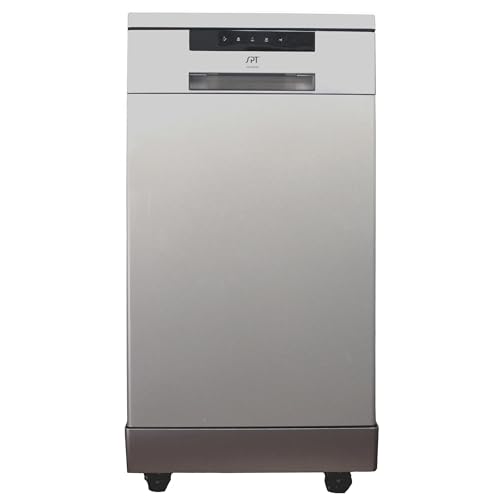

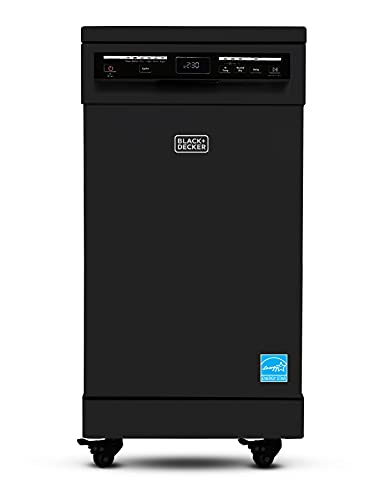
As an Amazon Associate we earn from qualifying purchases at no extra cost to you. Ratings are shown as listed on Amazon.
Countertop vs. freestanding: the short answer
A countertop dishwasher normally holds two to six place settings, connects to a faucet or fills through a tank, and can be stored between uses. It is the practical choice for renters, studio apartments, offices, and kitchens without a dishwasher opening.
A portable freestanding dishwasher is closer to a built-in dishwasher in capacity. Most hold around eight to 12 place settings, roll on casters, and connect to the kitchen faucet with a quick-connect hose. They clean more dishes per cycle but need a permanent parking position and enough floor space to open the door safely.
| Design | Typical capacity | Typical dimensions | Water hookup | Typical noise | Best for |
|---|---|---|---|---|---|
| Compact countertop | 2–4 place settings | 17–22 in. wide; 17–20 in. deep; 17–20 in. high | Built-in tank or faucet adapter | 49–55 dBA | One or two people, renters, very small kitchens |
| Large countertop | 4–6 place settings | 21–24 in. wide; 19–24 in. deep; 17–20 in. high | Usually tank plus faucet connection | 50–55 dBA | Frequent use without floor space |
| Portable freestanding | 8–12 place settings | 18 in. wide; about 24 in. deep; 34–36 in. high | Faucet quick-connect and drain hose | 54–60 dBA | Families and full-size loads |
Dimensions and noise ratings vary by model. Measure the appliance, hose route, faucet clearance, and door swing rather than relying only on the advertised width.
Best portable dishwashers by situation
Best for the smallest kitchen: a tank-fill countertop dishwasher
Choose a countertop model with a built-in water reservoir if you cannot remove the faucet aerator or share the sink with the dishwasher. Tank filling is slower than a direct connection, but it avoids plumbing compatibility problems. Many compact units use roughly 2 to 3 gallons of water per cycle, although heavy cycles may use more.
Farberware countertop models, including the FDW05ASBWHA line, are examples of the tank-and-faucet design. Comparable units are sold by Danby, BLACK+DECKER, and hOmeLabs. Look for a clear or visible water tank, a supplied pitcher, and a drain hose that can reach the sink without kinking.
Best for regular family use: an 18-inch portable dishwasher
An 18-inch freestanding portable dishwasher is the better decision when you routinely wash cookware, plates, glasses, and utensils together. Its larger racks reduce the number of cycles, and its lower spray arm generally gives bulky items more usable space than a tiny countertop tub.
Models such as the GE GPT145SSLSS represent this category. They need a faucet connection during operation and are too large to store conveniently in most apartments. Check whether your faucet has a removable aerator and compatible threads; pull-out and spray faucets may require a different adapter or may not work with the supplied connector.
Best for occasional use: a storable countertop unit
If you wash dishes by hand most days but want help after entertaining, choose a unit under about 45 pounds with a tank and a short drain hose. A lighter countertop dishwasher can be moved to a closet or utility shelf, but leave room for ventilation and allow the interior to dry before storing it.
Head-to-head comparison: what matters in daily use
Capacity and loading
Place-setting numbers are useful but incomplete. A countertop dishwasher may fit several dinner plates and cups yet struggle with a large skillet, cutting board, or tall travel mug. Measure your most awkward item and compare it with the manufacturer’s maximum dish height.
Freestanding portable models usually accept larger plates and more cookware, but their racks can still be less flexible than those in a full-size built-in dishwasher. If you cook from scratch, prioritize rack height and a removable or adjustable upper rack over an extra wash program.
Water hookup options
- Tank fill: Pour water into the reservoir for each cycle. This is the easiest option for renters and incompatible faucets, but it adds setup time.
- Faucet connection: Attach an inlet hose to a faucet adapter and place the drain hose in the sink. It is faster for repeated use but requires compatible threads and an accessible faucet.
- Permanent plumbing: Some portable units can be adapted, but this may defeat their purpose and can affect rental agreements or warranty coverage. Do not modify hoses or electrical parts without following the manufacturer’s instructions.
Cycle performance
Compact dishwashers can handle normal plates, cups, and lightly soiled utensils well when the spray arms are not blocked. Their main limitation is space, not necessarily wash temperature. Heavily baked-on pans may require soaking or a second cycle.
Useful programs include normal, heavy, quick, glass, and sanitize or high-temperature options. A quick cycle is convenient for lightly soiled dishes but may use less drying time and leave plastic items wet. Heated drying improves results but increases energy use and can lengthen the cycle.
Noise
A rating around 50 dBA is relatively quiet for a portable dishwasher; 55 to 60 dBA is more noticeable in a studio apartment or open-plan room. A countertop machine placed directly on a hollow counter may sound louder because vibration transfers into the surface. A thin rubber isolation mat can reduce rattling, provided it does not block ventilation or make the machine unstable.
Dimensions and storage
Before buying, measure three areas: the operating position, the storage position, and the route between them. A unit that fits under a cabinet may still be impossible to fill because the door, tank opening, or controls collide with the cabinet above.
For a countertop model, leave several inches around ventilation openings where the manual requires it. For a freestanding model, measure the full depth with the door open and keep the drain hose from forming a sharp bend. Never run a dishwasher from an extension cord unless the manufacturer specifically permits it.
Decision matrix
| Your situation | Recommended type | Why | Main compromise |
|---|---|---|---|
| One person, limited counter space, occasional use | Small tank-fill countertop | Lowest installation burden and easiest storage | Small load and limited cookware space |
| Two people, no dishwasher opening, daily use | Large countertop with faucet connection | Good balance of capacity and footprint | Counter space remains occupied |
| Three or more people or frequent cooking | 18-inch freestanding portable | Fewer cycles and better accommodation for plates and pans | Needs floor space and a compatible faucet |
| Rental with an unusual or fixed faucet | Tank-fill countertop | Works without plumbing changes | Manual filling before every cycle |
| Quiet open-plan living space | Lower-dBA countertop or portable model | Less intrusive during operation | Quiet models may cost more or have smaller capacity |
A simple capacity calculation
Suppose two people create six place settings of dishes per day and a countertop unit holds four place settings. Running it once daily leaves two settings for hand washing; running it twice uses two cycles. An 18-inch unit rated for eight to 12 place settings could handle the same dishes in one cycle, assuming the cookware does not displace the plates.
This is why the cheaper-looking countertop option can become inconvenient for frequent cooks. If a cycle takes approximately 90 minutes and loading and unloading take five minutes each, two cycles add about 100 minutes of daily handling compared with one larger cycle. The extra time may matter more than the purchase price.
Setup and maintenance that prevent common problems
- Check the faucet first. Remove the aerator and compare its thread size with the supplied adapter before unpacking the machine permanently.
- Use the correct detergent. Dishwasher detergent is formulated for low-foam machines. Hand dish soap can create excessive suds and leaks.
- Scrape, do not fully pre-rinse. Remove bones, labels, and large food particles, but excessive rinsing wastes water without improving every load.
- Keep spray paths clear. Tall pans and cutting boards can block the spray arm, leaving an entire section poorly washed.
- Clean the filter weekly when used often. Food residue is one of the first things to cause odor, slow drainage, and redepositing on dishes.
- Dry the tub between uses. Leave the door ajar after the cycle if safe to do so. This reduces stale smells and mildew-like buildup.
- Inspect hoses and seals. Replace cracked inlet hoses or flattened door gaskets promptly; these parts commonly wear before the motor or tub.
What to expect to replace or repair
The most failure-prone ownership points are faucet adapters, drain and inlet hoses, door seals, racks, and filters. Hard water can leave mineral deposits on spray holes and heating elements, so follow the manual’s descaling guidance and use dishwasher cleaner when buildup appears. Do not assume a “sanitize” program removes every type of residue; it does not replace routine cleaning.
For most small kitchens, buy a tank-fill countertop dishwasher if installation flexibility and storage matter most. Choose a faucet-connected countertop model for the best compromise between capacity and footprint. Choose an 18-inch freestanding portable dishwasher when washing a full day’s dishes in one load is worth giving up permanent floor space.
Frequently asked questions
Can a portable dishwasher sit on the floor?
Only if the model is designed for floor use. Countertop units should sit on a stable, level, water-resistant surface that can support their filled weight. A full tank and load can add substantial weight to a lightweight counter.
Do portable dishwashers need hot water?
Many models accept water from the faucet and heat it internally, while some instructions recommend starting with hot tap water for better results. Follow the specific manual and avoid water temperatures that exceed its stated limit.
Are portable dishwashers worth it without a garbage disposal?
Yes. They drain into the sink, so a garbage disposal is not required. Keep the drain hose secured above the sink basin or at the prescribed height to prevent dirty water from flowing back into the machine.





Write Your Review
No reviews yet. Be the first to share your experience!