

Key takeaways
- Tablet connector or magnetic contact: Usually the simplest option. It avoids Bluetooth pairing and often draws power from the tablet. The keyboard cannot normally be used with another device.
- Bluetooth: The most versatile choice for a standalone keyboard. It avoids cables but adds pairing, battery, and interference considerations.
- USB wired: Rare for portable tablet typing, but useful at a fixed desk. It may require a USB-C adapter and does not suit a tablet being held or used on a lap.
The best tablet keyboards depend on whether you prioritize a laptop-like typing position, low travel weight, protection, or compatibility across several devices: choose a detachable case keyboard for daily work, a compact Bluetooth keyboard for travel, and a first-party keyboard cover when perfect tablet integration matters most.
Our top picks
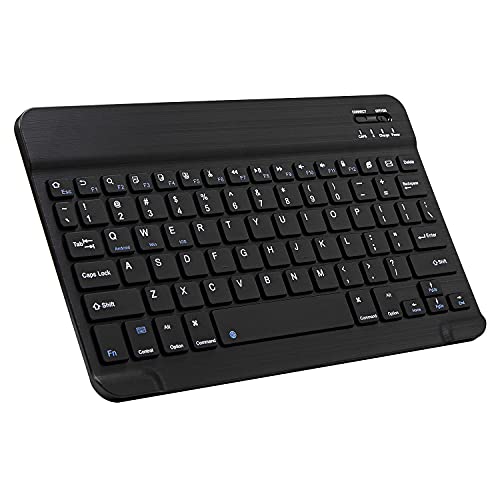


As an Amazon Associate we earn from qualifying purchases at no extra cost to you. Ratings are shown as listed on Amazon.
Quick picks by situation
| Situation | Best fit | Why it works | Main compromise |
|---|---|---|---|
| Daily iPad work | Logitech Combo Touch | Full-size-style layout, trackpad, kickstand, and edge protection | Bulkier than a keyboard cover |
| Lightest laptop-like iPad setup | Apple Magic Keyboard for iPad | Excellent shortcut row, integrated trackpad, and clean magnetic attachment | High general market price and limited protection around the tablet edges |
| Travel with several devices | Logitech Keys-To-Go 2 | About 222 g, Bluetooth, and a slim standalone design | No trackpad or tablet protection |
| Surface Pro as a laptop replacement | Microsoft Surface Pro Flex Keyboard | Detachable keyboard, touchpad, and wireless use away from the tablet | Costs more than a basic Bluetooth keyboard |
| Samsung Galaxy Tab productivity | Samsung Book Cover Keyboard | Tablet-specific shortcuts, integrated cover, and DeX-friendly layout | Compatibility is tied closely to the exact Galaxy Tab generation |
What to look for in the best tablet keyboards
1. Layout and key size
A keyboard can have a familiar QWERTY arrangement and still feel cramped. Compare the letter-key width with a standard laptop: approximately 18 to 19 mm is comfortable for sustained typing, while compact travel keyboards often reduce spacing or narrow the right-side modifier keys.
Look for a dedicated number row if you write spreadsheets, enter prices, or use keyboard shortcuts frequently. A separate function row is also useful, although tablet keyboards often replace traditional F-keys with controls for brightness, media, search, multitasking, and screen locking.
Pay attention to the right Shift, Backspace, and arrow keys. These are common places for compact layouts to shrink keys or move punctuation. If you regularly type symbols, code, or formulas, confirm the regional layout before buying; US, UK, and other layouts do not place every symbol in the same position.
2. Tablet compatibility
Compatibility is more specific than “works with iPad” or “works with Android.” A case keyboard must match the tablet’s exact screen size, camera position, connector, magnet arrangement, and generation. An 11-inch iPad Pro keyboard may not fit an 11-inch iPad Air, even when the diagonal measurement is similar.
Standalone Bluetooth keyboards are more flexible. They can usually pair with iPadOS, Android, Windows, macOS, and ChromeOS, but operating-system shortcuts may differ. Before buying, check whether the keyboard supports the number of devices you need and whether switching uses a dedicated key or requires entering pairing mode again.
First-party covers generally provide the best automatic wake, charging, shortcut, and trackpad behavior. Third-party Bluetooth models provide broader compatibility but may require occasional troubleshooting after a tablet update.
3. Connection method
- Tablet connector or magnetic contact: Usually the simplest option. It avoids Bluetooth pairing and often draws power from the tablet. The keyboard cannot normally be used with another device.
- Bluetooth: The most versatile choice for a standalone keyboard. It avoids cables but adds pairing, battery, and interference considerations.
- USB wired: Rare for portable tablet typing, but useful at a fixed desk. It may require a USB-C adapter and does not suit a tablet being held or used on a lap.
For travel, Bluetooth multipoint is particularly valuable. A keyboard that stores three device profiles can serve a tablet, phone, and laptop without repeating the setup process. Verify whether it switches reliably between operating systems; some models remember devices but do not provide equally complete shortcut support on each platform.
Head-to-head: keyboard case or standalone keyboard?
Keyboard cases: protection and instant setup
A keyboard case keeps the keyboard attached, protects at least some surfaces, and gives the tablet a built-in viewing angle. This is the better arrangement when you type in cafés, classrooms, trains, or shared workspaces and do not want to manage two separate pieces.
The trade-off is weight. A tablet plus keyboard case can approach or exceed the weight of a small laptop. Cases also make a tablet less comfortable to hold in portrait mode, and the hinge or kickstand becomes a likely wear point. Some designs protect the corners and back well but leave the tablet’s sides exposed; others offer stronger coverage but make ports and buttons harder to access.
Standalone keyboards: lighter and more universal
A compact Bluetooth keyboard is preferable when you already use a protective tablet case or want one keyboard for multiple devices. It can be placed at a comfortable distance from the screen, which is useful on a hotel desk or cramped workstation. You can also use the tablet in portrait orientation without removing a bulky keyboard cover.
The disadvantages are easy to underestimate: you need a separate stand, the keyboard can slide around, and there is no integrated pointing device. A folding tablet stand adds roughly 150–300 g, so compare the complete travel kit rather than the keyboard alone.
Battery life, charging, and portability
| Keyboard type | Typical weight | Typical battery or power behavior | Travel implication |
|---|---|---|---|
| Compact Bluetooth keyboard | 180–300 g | 3–36 months, depending on rechargeable or replaceable batteries | Smallest independent option; carry a stand separately |
| Tablet keyboard cover | 450–800 g | Usually powered by the tablet or a rechargeable internal battery | Fastest setup, but increases the tablet’s packed weight substantially |
| Full-size wireless keyboard | 500–900 g | Several weeks to multiple years | Best typing comfort, poor choice for small bags |
| Detachable wireless tablet keyboard | 300–600 g | Often around 40–100 hours of active use per charge | Can be used away from the tablet, but needs regular charging |
Battery claims need context. A keyboard advertised for a year may assume short daily use, while a rechargeable model’s active-hours claim may exclude backlight use. Backlighting is convenient on a plane or dim room, but it can reduce runtime considerably. If you travel often, choose USB-C charging, check whether the keyboard can type while charging, and carry the same cable used by your tablet where possible.
A simple runtime check can prevent disappointment. If a keyboard promises 80 active hours and you type for two hours per day, five days per week, that is 10 hours weekly, or approximately eight weeks of stated active use. Real-world standby time may extend the calendar period, while heavy backlight use can shorten it.
Durability and ownership realities
The first parts to show wear are usually the key legends, scissor mechanisms, hinge fabric, kickstand friction points, and magnetic attachment areas. A keyboard case that repeatedly folds backward can develop a loose hinge or crease in its covering material. Dust and crumbs can make low-profile keys feel inconsistent, especially when the keyboard is carried without a sleeve.
Clean the surface with a soft, barely damp microfiber cloth while the keyboard is disconnected or switched off. Do not spray liquid directly onto the keys, and do not force compressed air into a tablet connector. For a removable Bluetooth keyboard, inspect the charging port and keep it free of lint before connecting a cable.
Common mistakes include buying by screen size alone, assuming every USB-C keyboard supports wired tablet data, and overlooking the viewing angle. A keyboard cover may be excellent on a desk but unstable on a lap. Test whether the bottom edge has enough friction and whether the screen stays upright when you tap or drag on the trackpad.
How to choose by frequency and workspace
- Occasional email and notes: Use a compact Bluetooth keyboard or the tablet’s on-screen keyboard. Avoid paying for a heavy case if typing is limited to a few minutes at a time.
- Several hours of writing each week: Choose near-full-size key spacing, a firm hinge or stand, and a rechargeable battery. A modestly heavier keyboard is often more comfortable than an ultra-thin model.
- Daily documents and spreadsheets: Prioritize a trackpad, dedicated shortcut row, stable base, and tablet-specific compatibility. A keyboard case usually beats a loose keyboard-and-stand combination.
- Small desk or airplane tray: Choose a compact layout, but retain full-size letter keys if possible. Check the keyboard’s depth and the tablet’s viewing angle together.
- Multiple operating systems: Select Bluetooth multipoint with clearly labeled switching keys. Avoid a connector-only keyboard unless the tablet is your only device.
Bottom line
The best tablet keyboards are not defined by the thinnest profile alone. For an iPad used as a primary work device, Logitech Combo Touch emphasizes protection and adjustability, while Apple Magic Keyboard emphasizes a lighter, more integrated laptop-style experience. For a Surface Pro, Microsoft’s detachable Flex Keyboard suits users who want a wireless typing option away from the screen. For Galaxy Tab owners, Samsung’s Book Cover Keyboard offers the most tablet-specific integration. If you move among a tablet, phone, and laptop, a compact multi-device Bluetooth keyboard such as Logitech Keys-To-Go 2 is usually the more practical long-term purchase.
Before ordering, confirm the exact tablet model, measure the packed weight of the complete setup, check the regional layout, and decide whether you need a trackpad. Those four checks matter more to everyday satisfaction than a small difference in battery claims or thickness.





Write Your Review
No reviews yet. Be the first to share your experience!