

The best soccer cleats for grip and comfort depend first on your playing surface: choose firm-ground (FG) for natural grass, artificial-ground (AG) for modern synthetic turf, turf (TF) for short carpet-like fields, and indoor court (IN) for flat gym floors; then match the upper and fit to how much touch, lockdown, and cushioning you prefer.
Our top picks
 DREAM PAIRS Men's High Tops Lace Up
- Stable & Grippy: Designed for high performance, these…
- Durable & Lightweight: Made from synthetic leather and…
- Enhanced Support: These men’s high-top soccer shoes feature…
 Puma Men's Future Match Firm
- Soft, lightweight mesh upper with a stretchy knitted…
- Innovative stud design, orientation, and placement for quick…
- Support tape across the midfoot for lockdown and…
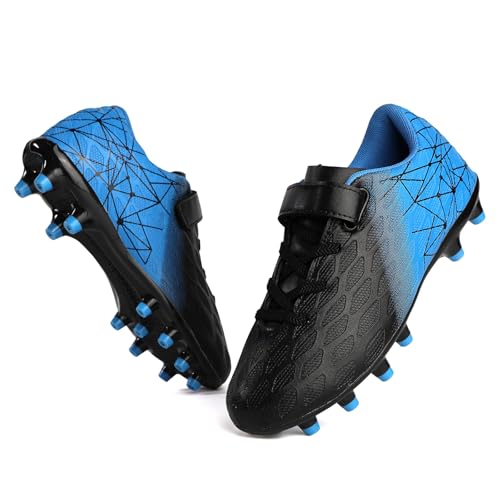 Skerxut Soccer Cleats
- Suitable for both boys and girls, these soccer…
- Strategically placed cleats provide optimal grip and stability…
- Engineered for young athletes, these cleats enhance agility…
As an Amazon Associate we earn from qualifying purchases at no extra cost to you.
Quick picks by playing situation
| Situation | Best cleat type or example | Why it fits | Typical market range |
|---|---|---|---|
| Natural grass, maximum traction | FG cleat such as Nike Mercurial Vapor 16 or adidas Predator Elite | Bladed or mixed studs bite into firm ground; lightweight builds suit quick movement | $150–$280 |
| Artificial grass used frequently | AG model with many short conical studs | Spreads pressure across more contact points and reduces excessive penetration | $90–$250 |
| One pair for occasional play | Multi-ground (MG) or rotational FG/MG soleplate | More versatile than a specialist FG plate, though less optimized on either surface | $80–$180 |
| Comfort and soft-touch priority | Leather-like or padded synthetic upper, such as Nike Tiempo Legend 10 | More forgiving shaping and cushioning than an ultra-thin speed boot | $100–$230 |
| Indoor soccer | IN shoe with flat rubber outsole | Non-marking rubber grips a polished court without studs | $50–$120 |
Surface comes before brand
Firm ground: natural grass
FG cleats typically use six to 12 molded studs, often combining conical and bladed shapes. They are designed for relatively dry, firm natural grass. Blades can provide strong forward push-off, while conical studs release more easily during turns. If your field becomes muddy, an FG soleplate may clog and lose traction; replaceable-stud soft-ground boots are more suitable where permitted.
Artificial grass: AG versus FG
AG cleats use more, shorter studs—commonly around 13 to 25—so your weight is distributed over a larger area. That design is better suited to the abrasive, tightly packed fibers of many soccer-specific turf fields. An FG boot can feel grippy on AG, but its longer or more aggressive studs may catch too firmly, increase pressure under the foot, and wear faster.
Do not confuse soccer-specific AG with older, short-pile “turf.” On short carpet-like surfaces, use TF shoes with many tiny rubber nubs. They provide broad contact and predictable grip rather than the penetration of a molded-stud cleat.
Wet or soft grass
Soft-ground boots use fewer, longer removable studs, commonly metal-tipped or screw-in. They can be excellent in heavy conditions but are uncomfortable and potentially hazardous on hard ground. Check league rules before choosing metal tips, and do not use an SG soleplate merely because the forecast predicts rain.
Head-to-head: upper materials and playing feel
| Upper construction | Touch and fit | Weather behavior | Break-in expectation | Best for |
|---|---|---|---|---|
| Thin knitted or coated synthetic | Close, responsive, usually narrow through the midfoot | Absorbs little water; coating can stiffen or crack if neglected | 0–2 sessions | Speed players and close ball control |
| Soft polyurethane synthetic | Consistent touch with moderate structure | Generally easy to clean and less affected by damp conditions | 1–3 sessions | Players wanting a practical all-rounder |
| Leather or leather-like padded upper | More forgiving across the forefoot; often comfortable immediately | Can absorb water and become heavier unless treated and dried correctly | 2–5 sessions | Wide feet, touch-focused players, and comfort seekers |
| Textured control upper | Added friction for passing and shooting; may feel less clean at first | Usually synthetic and relatively weather resistant | 1–3 sessions | Players who prioritize ball manipulation |
Strong choices in the main categories
Nike Mercurial Vapor 16: speed-oriented FG
The Mercurial Vapor 16 is aimed at players who prefer a light, close-fitting boot and an aggressive sprinting feel. Its thin synthetic upper and speed-focused soleplate favor responsiveness over plush cushioning. It is a good choice for narrow-to-average feet that dislike excess material. Allow room for toe movement, however: a tight sensation around the midfoot is useful for lockdown, while pinching at the toes is a sizing error rather than something to “break in.”
adidas Predator Elite: traction and control
The Predator Elite emphasizes a structured upper and grip-oriented striking zones. It suits players who want a more substantial feel when receiving, passing, and shooting. The traction setup is best matched to firm natural grass unless the specific version is marked AG or MG. Expect more upper structure than a speed boot, and check the heel hold carefully because the snug front fit can feel different from the rear shape.
Nike Tiempo Legend 10: comfort-focused synthetic
The Tiempo Legend 10 uses a soft synthetic construction designed to reproduce some of the forgiving feel associated with leather while avoiding leather’s water absorption. It is a sensible option for players who want touch and comfort without an especially minimal upper. Its fit is commonly more accommodating than a pure speed boot, but feet vary; try it with soccer socks and after warming up, when feet are slightly larger.
adidas Copa Pure: cushioned, touch-first option
The Copa Pure line is built around a softer, more relaxed touch and a comfortable upper. It is appealing for midfielders and recreational players who spend more time passing and receiving than sprinting repeatedly. Choose an FG version for natural grass, AG for synthetic turf, and avoid assuming that a soft upper compensates for the wrong soleplate.
How to choose the right fit without guessing
- Measure both feet late in the day. Stand in the socks you play in and measure heel-to-longest-toe length. Use the larger foot to select a size.
- Leave functional toe room. About 5–10 mm beyond the longest toe allows swelling and prevents the toe from striking the front while running. More than roughly 15 mm can make the foot slide.
- Check the width at the ball of the foot. The upper should touch without creating a sharp pressure point. Do not expect a narrow synthetic boot to expand substantially.
- Test heel lockdown. Walk, jog, and make a few controlled cuts. The heel should not lift noticeably, but numbness or tingling means the boot is too tight.
- Compare both feet and both socks. Insoles and sock thickness can change the fit more than half a size. If one foot differs significantly, prioritize the larger foot and use lacing adjustments for the smaller one.
Cushioning, weight, and break-in trade-offs
Light boots can feel quick, but low weight does not automatically mean better performance. A thin sole and minimal padding may transmit more impact and provide less comfort during long sessions. A slightly heavier, cushioned model can be the better choice for a player training three or four times weekly, especially when sessions last 90 minutes or more.
As a practical benchmark, many adult soccer cleats fall roughly between 180 and 260 grams per shoe in a mid-size sample, while padded or leather-like models may be heavier. Published weights vary by size and production version, so treat them as comparisons within a brand rather than laboratory constants.
Break in new cleats over two or three short sessions. Wear them for 20–30 minutes at first, then increase time if there are no hot spots. Do not soak them to soften the upper: excess water can weaken adhesives, distort the shape, and encourage odor.
Ownership realities: what wears first
- Stud tips and edges: Artificial surfaces abrade sharp edges quickly. Rounded or visibly shortened studs reduce traction and are a reason to retire the soleplate.
- Toe box: Dragging the toe, striking hard ground, and repeated bending can separate the upper from the outsole. A small cosmetic scuff is different from an opening seam.
- Heel lining: Slipping caused by poor sizing or loose lacing can wear through the lining before the rest of the boot.
- Insole: It compresses and loses cushioning before the upper fails. A replacement insole can refresh comfort if the boot still holds the foot securely.
After each use, remove loose dirt with a soft brush, wipe the upper with lukewarm water, and remove the insole to air separately. Dry at room temperature away from radiators and direct sunlight. Never store damp cleats in a sealed sports bag. For leather, use only a compatible conditioner; for coated synthetics, a damp cloth is usually safer than oily products.
Bottom line
For fast play on natural grass, start with an FG speed boot such as the Mercurial Vapor 16. For a structured control feel, consider the Predator Elite. For comfort and a forgiving touch, compare the Tiempo Legend 10 or Copa Pure. If you play mainly on artificial grass, prioritize a true AG soleplate over a familiar brand name, and if your sessions move between surfaces, an MG model is usually a more sensible compromise than using FG cleats everywhere.







Write Your Review
No reviews yet. Be the first to share your experience!