

Best Walk-In Greenhouses for Every Garden
The best walk-in greenhouse depends mainly on your available footprint, local wind and snow, and whether you need a few shelves for seedlings or enough headroom for full-size tomatoes and cucumbers.
For most home gardeners, a 6-by-8-foot greenhouse is the best balance of usable growing space and manageable cost. Choose a compact 4-by-6-foot model for a small yard or patio, a reinforced 8-by-12-foot structure for serious production, and a galvanized steel or aluminum frame with polycarbonate panels if weather resistance matters more than the lowest initial price.
Our top picks
 56x56x78 Large Walk-in Greenhouse for Outdoors
- Keep Ideal Heat and Humidity: The 2 Windows…
- Large Space: Outdoor greenhouse on both sides with…
- Sturdy & Long-lasting: Greenhouses for outside winter structured…
 Outvita Walk-in Greenhouse
- 【BETTER ENVIRONMENT FOR YOUR PLANTS】High-quality PE material provide…
- 【RUST RESISTANT & STURDY FRAME】The gardening essential is…
- 【LARGE SPACE】The overall size of the portable greenhouse…
 Walk in Greenhouses
- Large walk-in greenhouse- offers ample space with 17.5…
- Additional Features-Along with our outside portable greenhouses, you…
- Portable greenhouse- features a high-quality steel frame with…
| Product | Key specs | |
|---|---|---|
| 56x56x78 Large Walk-in Greenhouse for Outdoors | Keep Ideal Heat and Humidity: The 2 Windows… Large Space: Outdoor greenhouse on both sides with… Sturdy & Long-lasting: Greenhouses for outside winter structured… | Check price |
| Outvita Walk-in Greenhouse | 【BETTER ENVIRONMENT FOR YOUR PLANTS】High-quality PE material provide… 【RUST RESISTANT & STURDY FRAME】The gardening essential is… 【LARGE SPACE】The overall size of the portable greenhouse… | Check price |
| Walk in Greenhouses | Large walk-in greenhouse- offers ample space with 17.5… Additional Features-Along with our outside portable greenhouses, you… Portable greenhouse- features a high-quality steel frame with… | Check price |
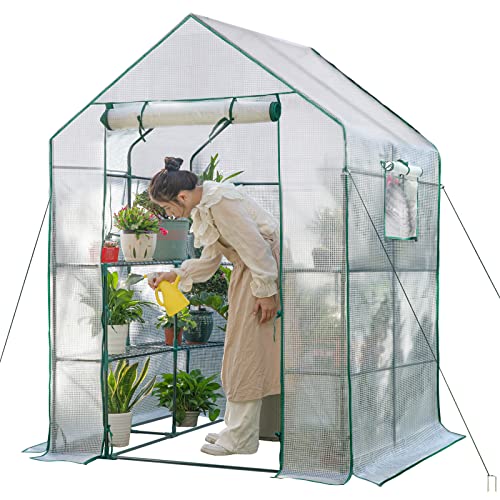 56x55x78 Walk-in Greenhouse for Outdoors 56x55x78 Walk-in Greenhouse for Outdoors | Over Winter: Green houses for outside can create… Stable: High-strength connector link 16mm diameter steel pipe… UV Plastic Cover: Greenhouse kit uses thickened waterproof… | Check price |
As an Amazon Associate we earn from qualifying purchases at no extra cost to you.
Quick picks by garden situation
| Garden situation | Best greenhouse type | Recommended footprint | Key specification | Typical market range |
|---|---|---|---|---|
| Balcony, small yard, or first greenhouse | Compact shelf-style walk-in | 4 x 6 ft | Zippered cover or twin-wall panels; two roll-up vents | $120–$450 |
| General vegetable growing | Mid-size polycarbonate greenhouse | 6 x 8 ft | Aluminum frame, 4–6 mm twin-wall panels, roof vent | $700–$1,800 |
| Cold, snowy, or windy climate | Reinforced rigid-panel greenhouse | 6 x 8 ft or 8 x 12 ft | Galvanized steel or heavy aluminum frame; anchored base; braced roof | $1,500–$4,000 |
| Seedlings and high plant density | Greenhouse with integrated staging | 6 x 8 ft | Three-tier shelving, 30–36 inch central path, adjustable roof vent | $900–$2,500 |
| Large collection or year-round growing | Heavy-duty hobby greenhouse | 8 x 12 ft or larger | Rigid panels, automatic vents, guttering, substantial foundation | $2,500–$8,000+ |
What separates the best walk-in greenhouses
Footprint and usable interior space
Greenhouse dimensions describe the outside, not the area available for plants. A 6-by-8-foot structure has 48 square feet of floor area, but a central path, shelving, and door clearance may leave only 28–34 square feet for containers and beds.
Width matters more than many buyers expect. A 4-foot-wide greenhouse can provide a useful growing environment, but it usually allows only a narrow path and one planting bench. A 6-foot width can accommodate a central walkway with benches on both sides. An 8-foot-wide greenhouse is more comfortable for reaching plants, moving a watering can, and keeping tall crops away from the panels.
Measure the proposed site with the door fully open, then leave at least 24 inches around the structure for maintenance. Avoid placing the greenhouse directly under trees: falling branches, shade, leaves, and blocked gutters create more problems than the compact location solves.
Frame materials: aluminum, galvanized steel, or wood
- Aluminum: Lightweight, rust-resistant, and common on hobby greenhouses. It is suitable for most moderate climates, but thin extrusions can flex in strong wind unless the base is anchored and the frame is cross-braced.
- Galvanized steel: Stronger for large spans and exposed sites, though heavier and more vulnerable to corrosion where the coating is scratched or cut. Look for protected fasteners and a well-finished base.
- Wood: Attractive and easy to modify for shelves or raised beds. It needs periodic sealing and careful attention to damp joints, especially at the ground line.
For a windy or snowy garden, frame thickness and connection design matter more than the material name alone. A greenhouse with a secure base track, diagonal bracing, closely spaced roof supports, and panels held by continuous channels will generally outperform a lighter structure with the same advertised footprint.
Glazing and weather resistance
Twin-wall polycarbonate is the most practical glazing for many home gardeners. Its air channels reduce heat loss, diffuse sunlight, and resist impact better than ordinary glass. Panels around 4 mm thick are common on mid-range models; 6 mm or thicker panels provide better insulation and rigidity for colder or more exposed locations.
Single-layer polyethylene covers are inexpensive and quick to replace, making them sensible for temporary or seasonal growing. However, covers eventually become cloudy, brittle, or torn by wind. Treat the cover as a consumable rather than expecting the frame to last indefinitely. A replacement cover may cost $40–$200 depending on size and fabric quality.
Hardened or horticultural glass offers excellent light transmission and a permanent appearance, but it is heavy and can break from impact or frame movement. It is best suited to a properly founded structure rather than a lightweight kit placed directly on soil.
Ventilation is the feature that protects plants
Many greenhouse problems are caused by overheating rather than cold. On a sunny day, the inside temperature can rise rapidly even when outdoor air feels mild. A greenhouse should have a roof vent or high-level opening for hot air to escape, plus a low-level opening or louver to admit replacement air.
For a small 4-by-6-foot greenhouse, one roof vent and a door that can be partly opened may be adequate. A 6-by-8-foot model is better with two roof vents, while larger structures benefit from vents at both ends or an exhaust fan paired with an intake vent.
- Choose automatic wax-cylinder vent openers if you cannot check the greenhouse during the day.
- Prefer adjustable vents over fixed decorative windows.
- Use shade cloth in hot climates; ventilation alone may not prevent leaf scorch.
- Do not rely on a sealed greenhouse for frost protection without a suitable heater and thermostat.
Shelving, paths, and the capacity calculation
Included shelving can increase usable growing area, but it can also make a greenhouse difficult to move around in. Keep a central path at least 24–30 inches wide. Put lower shelves on the north side where possible so they cast less shade on shorter plants.
Consider a 6-by-8-foot greenhouse with two 18-inch-deep benches along the long sides. The benches use 3 feet of the 6-foot width, leaving approximately 3 feet for a central path. If each bench is 7 feet long, the total bench surface is:
2 benches × 7 feet × 1.5 feet = 21 square feet of growing surface.
Three-tier shelves can increase tray capacity, but they are not equally suitable for mature crops. Seedling trays and small herbs benefit from tiers; tomatoes, peppers, and cucumbers need vertical clearance and should occupy floor beds or tall containers. Check the shelf’s load rating as well: a watered propagation tray can weigh 20–30 pounds.
Decision matrix: which type fits you?
| Your priority | Choose | Avoid | Why |
|---|---|---|---|
| Lowest entry cost | Seasonal polyethylene-covered frame | Large glass structure | Lower purchase cost and simple seasonal setup, but the cover will need replacement |
| Beginner-friendly ownership | 6 x 8 ft polycarbonate kit with a roof vent | Unbraced oversized greenhouse | Moderate space without excessive foundation, ventilation, or heating demands |
| Frequent daily use | Rigid panels, full-height door, 30-inch path | Low tunnel or narrow 4-foot layout | More comfortable access and less repeated bending or dismantling |
| High wind or snow | Anchored reinforced frame with 6 mm panels | Lightweight cover-only kit | Better resistance to uplift, impact, and accumulated snow |
| Very hot summers | Multiple roof vents, shade option, insect-screened openings | Sealed dark-colored greenhouse | Ventilation and shading are essential for temperature control |
Setup details that determine long-term performance
Do not place a walk-in greenhouse directly on loose soil unless the manufacturer specifically permits it and the location is exceptionally sheltered. A level foundation prevents door binding and frame twisting. Options include a treated timber perimeter, compacted gravel with a base frame, paving slabs, or a concrete pad. The foundation should be square, level, and anchored according to the instructions.
Use more anchors than the minimum if the greenhouse is exposed, but do not improvise attachment points that deform the frame. Seal or cap drilled metal edges to reduce corrosion. Install the door so prevailing wind does not routinely force it open, and verify that rainwater drains away from the foundation.
Ownership realities: what wears out first
- Polyethylene covers: Usually the first major consumable. UV exposure, chafing against the frame, and wind tension shorten their life.
- Door rollers and hinges: Dirt and misalignment can make sliding doors stick. Clean tracks and lubricate compatible hardware periodically.
- Panel seals: Loose caps or deteriorated glazing strips allow water and insects into the panel channels.
- Vent openers: Automatic openers eventually lose spring or cylinder performance and are usually replaceable without replacing the greenhouse.
- Fasteners: Cheap or incompatible screws may corrode first. Replace damaged hardware with outdoor-rated parts that match the frame.
Wash panels with mild soapy water at the start and end of the growing season. Avoid abrasive pads, strong solvents, and pressure washing, which can scratch surfaces or force water into seals. Remove snow promptly when safe, keep gutters clear, and never assume a greenhouse rated for normal weather can withstand an exceptional storm without temporary support or a professional assessment.
Final recommendation
The best all-purpose choice for most gardens is a 6-by-8-foot walk-in greenhouse with a rigid aluminum frame, 4–6 mm twin-wall polycarbonate, two roof vents, a secure base, and enough interior width for a 24–30-inch path. Choose a 4-by-6-foot model when space or budget is tight, but prioritize ventilation over extra shelves. For exposed, snowy, or coastal sites, spend more on anchoring, bracing, corrosion-resistant hardware, and thicker panels rather than on decorative accessories.
A greenhouse is only as useful as its access and climate control. Before comparing shelves or appearance, confirm that the footprint fits the site, the foundation can be secured, and the ventilation matches your local summer temperatures. Those decisions have a larger effect on plant health and service life than small differences in included accessories.







Write Your Review
No reviews yet. Be the first to share your experience!