

The best footrest for a desk is an adjustable model that lets your knees sit at roughly 90 degrees with your feet fully supported, and for most people that means a tilt-adjustable platform about 4-6 inches high. If you fidget or want gentle movement, a rocking footrest like the Humanscale FM300 is the premium choice; if you want a simple budget fix, a fixed foam or plastic foot support does the job. Footrests help mainly when your feet cannot rest flat on the floor after the chair and desk heights are set correctly.
Our top picks



As an Amazon Associate we earn from qualifying purchases at no extra cost to you.
Quick Comparison of the Best Footrest Types
| Pick | Best for | Typical height / angle | Typical platform size | Price range |
|---|---|---|---|---|
| Rocking footrest (e.g. Humanscale FM300) | Best premium and best for movement | Rocks with foot movement, one fixed height | Wide platform, check spec sheet | Upper-mid to premium |
| Height-adjustable tilt footrest | Best overall | 3-6 in high, 0-30 degree tilt | 14-18 x 10-14 in | Mid-range |
| Fixed foam foot cushion | Best budget | 4-6 in high, fixed | 12-18 x 8-12 in | Budget |
| Memory foam ergonomic footrest | Best for comfort | 4-6 in high, slight slope | 16-18 x 11-13 in | Budget to mid-range |
| Under-desk hammock footrest | Best for tight legroom | Hangs from desk, adjustable | Fabric sling 12-14 in wide | Budget |
| Footrest with massage rollers | Best for foot relief | Fixed, 4-6 in | 14-17 x 10-12 in | Budget to mid-range |
Best Premium and Best for Movement: Rocking Footrest
The Humanscale FM300 Foot Machine is a well-known rocking footrest with a platform that tilts as you shift. Per the manufacturer’s information, it is intended to encourage small movements and reduce time spent in a static posture. Similar rocking designs are available from Fellowes and Kensington at different price points. Choose a rocking model if you tend to cross your legs or tap your feet.
The trade-off is cost and height: the platform has one fixed height, so people who need a taller lift may need an extra pad. Rocking can also be a distraction if you prefer a stable base.
Best Overall: Height-Adjustable Tilt Footrest
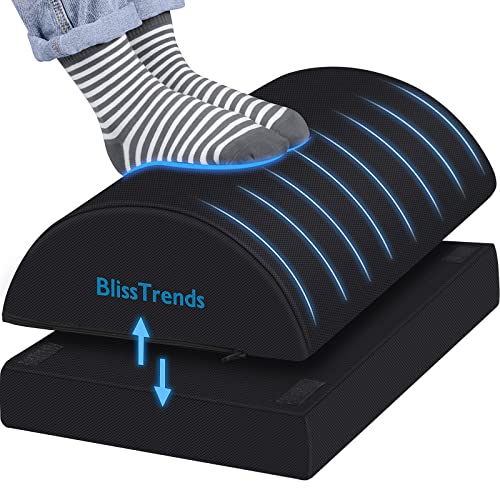
An adjustable footrest, such as the Kensington SoleMate series or Fellowes adjustable foot supports, lets you set the height and tilt to your desk and chair. These generally offer several height settings between 3 and 6 inches, and a tilt that you can lock in place. They give the best chance of finding a comfortable position for different users in a shared office.
Trade-off: plastic adjustment levers can loosen. Look for non-slip rubber pads on the base and a textured top that grips shoe soles or bare feet.
Best Budget: Fixed Foam Foot Cushion
A fixed-height foam block or molded plastic footrest costs far less than an adjustable one and works well if the height is right for you. These are common as basic ergonomic foot supports from brands like Fellowes and Everlasting Comfort. If your chair height is correct and your feet just need a small lift, a fixed 4 inch support is enough.
Trade-off: you cannot adjust it later. If you change desks or shoes, the support may feel too tall or too short.
Best for Comfort: Memory Foam Footrest
Memory foam models cushion the feet and can feel good through socks or bare feet. Look for a washable cover and a dense foam that does not collapse flat after a few months. Cheap, low-density foam compresses and loses height, so check that the product states its density or includes a firm base.
Best for Tight Legroom: Under-Desk Hammock
A hammock footrest hangs from the underside of the desk and lets you rest your feet in a sling. It takes no floor space and swings gently. Many have an adjustable strap length. The limitation is attachment: it needs a strong mounting point and may not work with glass desks or desks with thin edges. Verify clamp or screw compatibility.
Best for Foot Relief: Massage Roller Footrest
Footrests with textured rollers or massage nodes let you roll your feet gently. They are best for people who work barefoot or in socks. Keep expectations modest: these are comfort accessories, not medical devices. If you have foot or circulation concerns, speak with a healthcare professional.
How to Choose a Desk Footrest
Check Whether You Need One
If your feet rest flat on the floor with your thighs roughly parallel to the floor, you may not need a footrest. If you must raise your chair to reach the desk and your feet dangle, a footrest fills the gap. Ergonomic guidance from groups like the Occupational Safety and Health Administration notes that feet should be supported either on the floor or a footrest.
Measure the Gap: A Worked Example
Sit with your hips and knees at about 90 degrees. If the chair seat is 19 inches from the floor but your lower leg (floor to the back of the knee) measures 16 inches, you have a 3 inch gap. A footrest around 3-4 inches high with a slight tilt is the match. For a 6 inch gap, look for an adjustable model that reaches 6 inches.
| Gap between foot and floor | Footrest height to look for | Type |
|---|---|---|
| 1-2 in | 2-3 in | Low fixed cushion |
| 3-4 in | 3-5 in | Fixed or adjustable tilt |
| 5-6 in | 5-6 in | Adjustable, high setting |
| 7+ in | Adjust chair or desk first | Consider a taller footrest only if needed |
Platform Size and Grip
A platform at least 14 inches wide gives room to shift your feet. A textured surface keeps shoes from sliding. Avoid slick plastic if you wear dress shoes.
Material and Cleaning
- Molded plastic: Easy to wipe, durable, less cushioned.
- Foam: Comfortable, may compress over time and hold odor.
- Wood: Sturdy but heavy and may slide on hard floors.
- Fabric hammocks: Lightweight, need strong mounting points.
Common Mistakes
- Using a footrest to fix a desk that is too high instead of adjusting the chair and desk first.
- Choosing a footrest that pushes your knees above your hips.
- Buying a rocker when you need stability for a task like drawing or precise mouse work.
- Leaving a foam footrest in direct sunlight, which can deform it.
Frequently Asked Questions
Do I really need a footrest at my desk?
Only if your feet cannot rest flat on the floor with your thighs level after adjusting your chair and desk. Shorter users and fixed-height desks are the most common cases.
How high should a footrest be?
Typically 3-6 inches, depending on your height and chair. Pick the height that lets your thighs stay level and your knees at about 90 degrees.
Is a rocking footrest better than a fixed one?
A rocking footrest encourages small movements, which some people find comfortable. A fixed one gives a steady base. Choose based on whether you want motion or stability.
Can I use a footrest with a standing desk?
Yes, in the seated position. Some people also use a low footrest while standing to shift weight between feet, but an anti-fatigue mat is the more common choice for standing.
What is the best footrest for a small desk?
An under-desk hammock or a compact adjustable footrest with a footprint of about 14 x 10 inches fits most small desks. Measure your legroom before buying.







Write Your Review
No reviews yet. Be the first to share your experience!