

Key takeaways
- Monitor: 6.2 kg
- VESA adapter and webcam: 0.6 kg
- Total load: 6.8 kg
- Recommended arm capacity: at least 8 kg, preferably with a published working range that includes 6.8 kg
Best Monitor Arms for a Cleaner, Flexible Desk
The best monitor arms are the ones that match your monitor’s weight, VESA pattern, desk thickness, and preferred range of movement—not simply the arm with the most advertised adjustment.
For most single-monitor home offices, a gas-spring arm with a clamp mount, 75 × 75 mm or 100 × 100 mm VESA support, a 2–9 kg capacity, and at least 35 cm of height adjustment offers the best balance of flexibility and price. Choose a grommet mount instead when you want a more permanent, less visible installation or your desk edge cannot accept a clamp.
Our top picks




As an Amazon Associate we earn from qualifying purchases at no extra cost to you. Ratings are shown as listed on Amazon.
Quick picks by situation
| Desk or monitor situation | Best arm type | Useful target specifications | Typical market range |
|---|---|---|---|
| One 24–32-inch monitor and a conventional desk | Single gas-spring clamp arm | 2–9 kg capacity, 75/100 VESA, 35–45 cm height range | $35–$120 |
| Heavy 34-inch ultrawide or curved display | Heavy-duty single arm | 3–19 kg capacity, reinforced clamp, 75/100 VESA | $100–$250 |
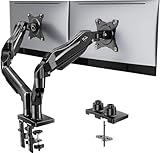
| Two monitors of similar size and weight | Dual arm with independent adjustment | 2–9 kg per monitor, separate tilt joints | $70–$220 |
| Thick, fragile, or rear-access-restricted desk | Grommet-mounted arm | Desk hole of roughly 8–60 mm, through-bolt hardware | $50–$180 |
| Monitor used for frequent portrait and landscape switching | Gas-spring arm with 360-degree rotation | Tool-free rotation or a lockable VESA head | $80–$250 |
Clamp versus grommet mounting
Clamp mounts: easiest for most renters
A clamp attaches to the rear edge of the desk and usually fits desks about 10–100 mm thick, depending on the model. Installation requires no drilling, and the arm can be repositioned or removed later. A wide steel clamp plate spreads pressure over a larger area and is preferable to a small, narrow clamp on laminated or particleboard furniture.
The limitation is leverage. A monitor arm places the display several inches behind the desk edge, so a heavy screen can make a thin desktop flex or cause the clamp to creep. Do not rely on the arm’s published maximum thickness alone. Check whether your desk has a solid rear edge, a cable trough, or a beveled underside that prevents the clamp from sitting flat.
Grommet mounts: cleaner and more secure
A grommet mount passes through an existing cable hole or a hole drilled through the desktop. A large plate and bolt hold the arm from below, reducing the chance of sideways movement. This is often the better choice for a permanent workstation, a standing desk with a sturdy top, or a desk whose rear edge cannot accept a clamp.
Measure the hole before buying. Many grommet systems accept holes between approximately 8 and 60 mm, but the bolt length and clearance beneath the desk matter just as much. A cable-management opening may be too shallow or may contain a metal frame that blocks the mounting plate.
Grommet mounting is not automatically suitable for every desk. Drilling a hole in a hollow-core desktop can weaken the surface unless the hole is reinforced. If you are unsure how the desktop is constructed, use a clamp with a protective reinforcement plate instead.
Weight capacity is more complicated than monitor weight
Use the monitor’s weight without its original stand, then add the weight of any adapter plate or webcam mounted to the display. A monitor listed at 7 kg may approach the limit once accessories are attached.
Gas-spring arms also have a practical operating range. An arm rated for 2–9 kg may not hold a 1.5 kg display reliably, even though the monitor is “under” the maximum. Conversely, a 7 kg monitor may sag when the arm is extended fully forward, because the farther the load sits from the mounting post, the greater the torque.
A useful rule is to leave at least 15–20% capacity above the complete display weight. For example:
- Monitor: 6.2 kg
- VESA adapter and webcam: 0.6 kg
- Total load: 6.8 kg
- Recommended arm capacity: at least 8 kg, preferably with a published working range that includes 6.8 kg
For a heavy ultrawide, prioritize a rigid mechanical arm or heavy-duty gas-spring arm over a budget dual-monitor stand. Dual arms often share a post and are optimized for lighter displays; the stated capacity may apply per arm, but the desk and post still carry the combined load.
VESA compatibility: check the pattern and the screws
The common monitor patterns are 75 × 75 mm and 100 × 100 mm, measured between the centers of the mounting holes. Most standard office monitors use one of these patterns. Some lightweight displays use a recessed mount, an unusual pattern, or a proprietary stand connection that requires an adapter.
Also check screw size and length. VESA mounts commonly use M4 screws, but the correct length depends on the depth of the monitor’s mounting recess. Screws that are too short may strip; screws that are too long can damage internal components. If the monitor includes spacers, use them as directed rather than stacking random washers.
A VESA plate that detaches from the arm makes installation easier, especially when mounting a large screen. A universal plate is convenient, but a smaller, rigid plate may provide better access to recessed mounting holes.
Height range and desk fit
Do not compare height ranges without considering the arm’s post height and the monitor’s own dimensions. A 40 cm adjustment range may place a 27-inch monitor at a comfortable height, while the same arm may not lower a 34-inch ultrawide far enough for a low desk.
Measure from the desktop to the center of the VESA holes. Then estimate the desired screen center. For a typical seated setup, the top edge of the display is often near eye level, but your chair height, glasses, and screen size affect the final position. The important requirement is enough downward adjustment to avoid looking upward at the display.
Check depth as well as height. A long arm can move a monitor closer to you, but its rear joint may occupy 40–60 cm of desk space when fully extended. If your desk is shallow, choose a short-reach arm or mount the post near the rear edge.
Cable management that remains useful
Look for channels or clips that accept both the display cable and the power lead without requiring aggressive bending. Removable covers are preferable to fixed tunnels because cables eventually need replacement. Leave a small service loop near every moving joint so the arm can rise, swivel, or rotate without pulling on the ports.
Do not bundle cables tightly at the elbow. The cable should follow the arm with enough slack to accommodate the full movement range. A neatly hidden cable that is stretched when the screen is raised will eventually loosen a connector or damage the cable sheath.
Recommended arm categories and dependable examples
Best general-purpose category: single gas-spring arm
This is the sensible default for a 24–32-inch display. It provides height, tilt, swivel, and rotation adjustment while leaving the desk clear for speakers or notebooks. The Ergotron LX is a well-established example, with versions supporting standard VESA patterns and a working range intended for many mainstream displays. It costs more than basic arms, but its replaceable or serviceable components and strong adjustment mechanism can make ownership easier over several years.
Best for heavy displays: reinforced heavy-duty arm
Large ultrawides and monitors with substantial stands removed need a higher-capacity arm and a sturdier desk connection. The Ergotron HX is a representative option for heavier displays. Before choosing one, confirm the specific monitor’s weight and whether the arm’s capacity changes for curved or deeply recessed screens.
Best value category: steel single or dual arm
Budget arms can work well when the monitor is light and remains in one position. Expect more manual tightening, narrower adjustment ranges, and less polished cable covers. A dual arm is attractive for two displays, but independent height adjustment is important; fixed horizontal bars often leave one monitor slightly too high or too low.
Best for frequent repositioning: premium modular arm
Premium systems from brands such as Humanscale emphasize smoother movement, cleaner cable routing, and interchangeable mounting components. They make more sense when you adjust the monitor several times a day, use a sit-stand desk, or want a long-term office fixture rather than the lowest purchase price.
Installation steps that prevent sagging
- Inspect the desk. Confirm the top is solid enough for a concentrated load and measure its thickness.
- Choose the mounting location. Keep the clamp or grommet clear of frames, cable trays, and desk-control boxes.
- Install the base firmly. Tighten until secure, but do not crush a hollow or soft desktop.
- Attach the VESA plate. Support the monitor face-down on a padded surface and use the correct screws and spacers.
- Set the spring tension. Adjust in small increments with the monitor attached. If the display rises or drops by itself, the tension is incorrect.
- Route cables last. Move the arm through its full range before securing the cable clips.
Recheck the clamp and cable slack after a week, then every few months. The most common ownership problem is not a failed gas spring; it is a clamp that gradually loosens, a desk edge that compresses, or a cable pulled tight after the arm is repositioned.
Bottom line
Choose a clamp-mounted gas-spring arm for the simplest upgrade, a grommet mount for maximum stability and a cleaner permanent installation, and a heavy-duty model for large or unusually heavy monitors. Before buying, verify four measurements: complete monitor weight, VESA pattern, desk thickness or grommet diameter, and the height and reach required at your chair. Those checks matter more than brand name or the number of adjustment directions listed on the box.


Write Your Review
No reviews yet. Be the first to share your experience!