

Key takeaways
- Top thickness: include any bezel, camera, and decorative housing. Most clip-on bars need a reasonably flat section rather than a sharply rounded edge.
- Rear clearance: confirm that the counterweight or clamp will not collide with a monitor arm, wall, shelf, or rear-facing ports.
- Screen curvature: a strongly curved ultrawide may leave a straight light bar sitting at an awkward angle. A flexible or separately adjustable mount is safer.
The best monitor light bars for most home offices are the BenQ ScreenBar Halo for premium glare control, the Xiaomi Mi Computer Monitor Light Bar for a compact value setup, and a USB-powered adjustable bar with a weighted clamp when you need the broadest screen compatibility.
A monitor light bar is worthwhile when you need task lighting without placing a lamp beside the display. The right model should illuminate your keyboard and papers while keeping direct LEDs out of your eyes and reflections off the screen. Brightness, beam shape, color controls, mounting clearance, and power are more important than a long list of lighting modes.
Our top picks



As an Amazon Associate we earn from qualifying purchases at no extra cost to you. Ratings are shown as listed on Amazon.
Best monitor light bars by situation
| Office situation | Best fit | Why it makes sense | Watch out for |
|---|---|---|---|
| Frequent evening work and a glossy display | BenQ ScreenBar Halo | Front and rear illumination, wireless controls, and a counterweighted mount help reduce reflections and desk shadows. | Higher price and a relatively substantial rear control assembly. |
| Basic desk lighting on a standard flat monitor | Xiaomi Mi Computer Monitor Light Bar | Compact, USB-powered, and adjustable in both brightness and color temperature. | Check the monitor’s top depth and rear clearance before buying. |
| Several monitors or a curved display | Adjustable USB light bar with a separate clamp or flexible mount | A wider mounting range is easier to reposition and can suit unusual bezels. | Some generic bars have a narrower beam and less consistent dimming. |
| Low-cost occasional use | Simple USB LED monitor bar | Usually offers adequate keyboard lighting at a general market price of about $20–$40. | Expect fewer controls, basic plastic hinges, and less reliable anti-glare optics. |
Head-to-head: what separates the leading designs
BenQ ScreenBar Halo: best for glare-sensitive desks
The ScreenBar Halo is the strongest choice when the monitor is the center of your workspace and you want to control light in front of and behind the display. Its front light aims down toward the desk rather than directly at the screen, while its rear light can brighten the wall behind the monitor. That indirect rear illumination can make the display feel less visually isolated in a dark room.
The wireless dial is useful if the bar is mounted above a large or raised monitor and its controls would otherwise be difficult to reach. Brightness and color temperature can be adjusted without opening software. The mount is designed to hang from the top edge and counterbalance the bar, but you should still check whether a very thin laptop-style screen, a thick webcam, or a monitor arm leaves enough room.
Choose it when glare reduction, control convenience, and a stable premium mount justify a typical market price of roughly $130–$180. It is less compelling if you only need a small amount of light for occasional typing.
Xiaomi Mi Computer Monitor Light Bar: best value for a conventional monitor
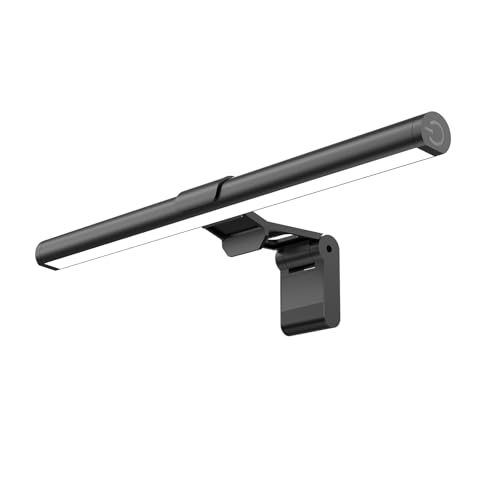
The Xiaomi Mi Computer Monitor Light Bar is a simpler front-lighting design with a cylindrical bar and a rotating control dial. It is generally aimed at flat desktop monitors with a reasonably accessible top edge. USB power keeps installation simple, and adjustable brightness and color temperature make it more flexible than a fixed-color desk lamp.
Its main limitation is not brightness but fit. A bar can be optically well designed and still be a poor purchase if the monitor has a very thin top, an unusually deep rear housing, a top-mounted camera, or a curved screen that prevents the mount from sitting squarely. The light is also less useful as ambient wall illumination than a model with a dedicated rear-facing light.
It is a good choice for a standard 24- to 32-inch monitor when you want a clean desk and reasonable controls at a typical market range of about $45–$80. Confirm regional availability and the included power arrangement, since packages can differ by market.
Generic USB monitor bars: best for a strict budget
Low-cost monitor bars can provide surprisingly usable keyboard illumination, but quality varies more than the price suggests. Look for continuous dimming rather than only three brightness steps, at least three color settings, a bar around 40–50 cm wide, and a mount that uses a rubberized contact surface. A simple USB-A or USB-C cable is preferable to a proprietary adapter.
The compromises usually appear in the beam. Bare or poorly diffused LEDs can create bright spots across the desk, and a shallow reflector may send light onto the lower portion of the screen. These bars are suitable for occasional work, a secondary monitor, or a child’s homework station, but frequent users may notice flicker, loose hinges, or inconsistent color sooner.
Brightness and color temperature: the useful range
Ignore maximum brightness in isolation. A light bar needs enough output for your desk surface, but excessive brightness can create a brighter area below the screen and make the display seem harsh. As a practical target, look for roughly 300–500 lux on the keyboard area at normal monitor height, with a dimmer that can reduce output substantially for late-night use.
Color temperature controls are more valuable than decorative RGB lighting. A range of approximately 2700–6500 K covers warm evening light through neutral and cool daylight-like settings. Use a warm setting when the room is dim and a neutral setting for paperwork or color-sensitive work. Match the bar broadly to the room rather than making the desk dramatically bluer than its surroundings.
Brightness claims are difficult to compare because manufacturers may measure at different distances and angles. Beam shape, diffuser quality, and the bar’s distance from the desk often matter more than a headline lumen figure.
Screen compatibility and mounting stability
Before buying, measure three points:
- Top thickness: include any bezel, camera, and decorative housing. Most clip-on bars need a reasonably flat section rather than a sharply rounded edge.
- Rear clearance: confirm that the counterweight or clamp will not collide with a monitor arm, wall, shelf, or rear-facing ports.
- Screen curvature: a strongly curved ultrawide may leave a straight light bar sitting at an awkward angle. A flexible or separately adjustable mount is safer.
A stable mount should keep the bar from rotating when you adjust the dial or move the display. Rubber pads protect the bezel and improve grip, while a weighted rear section reduces leverage on thin screens. Do not judge stability by the clamp’s stiffness alone: a stiff clamp can still press against a webcam or concentrate force on a narrow plastic edge.
For a monitor wider than about 34 inches, a 45–50 cm bar will not cover the whole desk evenly. That is not automatically a problem; the bar can still light the central keyboard area. If you use a wide desk, two monitors, or a document tray placed far to one side, a desk lamp or a second indirect light source may produce more even coverage.
Power options and cable planning
USB-powered bars are usually the easiest option. They can run from a monitor’s USB port, a computer, a dock, or a standard USB power adapter. A monitor port may switch off in sleep mode, which is convenient if you want the light to turn off with the computer but inconvenient if you use the display with another device.
USB-C is convenient but does not automatically mean higher brightness. Check whether the bar accepts standard 5 V USB power and whether its cable is detachable. A detachable cable is easier to replace and route through a monitor arm. Wireless controls also need their own battery or charging arrangement, so include that maintenance in your decision.
Setup for minimum glare
- Center the bar over the monitor rather than over the desk’s front edge.
- Angle the light downward toward the keyboard, not toward your eyes or the screen.
- Set the lowest brightness that lets you read paper and keys comfortably.
- Check the display from your normal sitting position. If you see a bright strip or reflected LEDs, lower the angle or brightness.
- Use rear or wall illumination if available, keeping it dimmer than the task light.
The reason for this sequence is simple: a monitor light bar should light the work surface through a controlled downward beam. Raising brightness to compensate for poor positioning often increases reflections without improving the areas you actually use.
Durability and ownership realities
The moving hinge and mount usually wear before the LEDs. Repeatedly rotating the bar, tightening a clamp too far, or leaving a heavy webcam attached can loosen the mechanism. Keep the mount clean and avoid hanging accessories from it.
Dust on the diffuser can create uneven bright patches. Unplug the bar, wait for it to cool, and wipe the diffuser with a soft, dry microfiber cloth. Avoid spraying cleaner directly onto the bar or allowing liquid near the USB connection. If the light begins flickering, first try another USB port and cable; intermittent power is more common than LED failure.
For most people, the buying decision is therefore clear: select the BenQ ScreenBar Halo for the best overall glare-management system, the Xiaomi Mi Computer Monitor Light Bar for a conventional monitor and controlled spending, and a well-specified generic USB bar only when occasional use makes premium mounting and optics unnecessary.


Write Your Review
No reviews yet. Be the first to share your experience!