

Key takeaways
- Full-size: Includes the number pad and dedicated navigation cluster. It suits spreadsheet work and games that use many macros, but it consumes the most horizontal space.
- Tenkeyless, or TKL: Keeps the function row and navigation keys while removing the number pad. It is a strong all-purpose gaming layout.
- 75%: Retains most important keys in a tighter arrangement, usually with a compressed navigation cluster. It saves space but requires adapting to closer key spacing.
- 65%: Removes the function row and most navigation keys. It leaves arrows and commonly used modifiers, making it attractive for small desks.
- 60%: Removes arrows and the function row from the physical layout. Layers and shortcuts replace those keys, which can be inconvenient outside games.
The best gaming keyboards for fast, comfortable play are usually magnetic-switch models if adjustable actuation and rapid-trigger behavior matter most, while mechanical keyboards with conventional linear switches offer better value and broad compatibility.
Our top picks
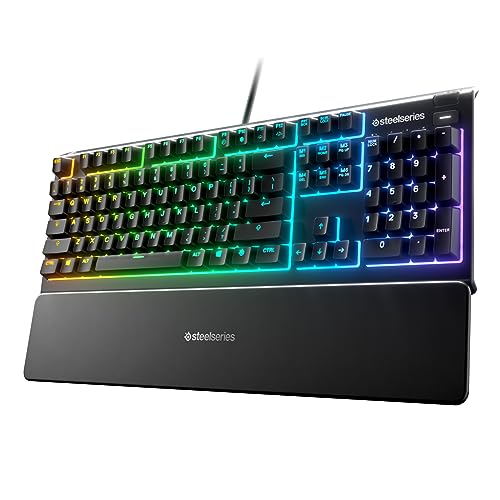


As an Amazon Associate we earn from qualifying purchases at no extra cost to you. Ratings are shown as listed on Amazon.
Quick picks by player and setup
| Situation | Best fit | Why it makes sense | Typical 2026 price range |
|---|---|---|---|
| Competitive FPS and lowest-latency control | Wooting 80HE | Hall-effect switches, adjustable actuation, rapid-trigger functions, and an 80% layout | $180–$220 |
| Competitive FPS with extensive onboard controls | Razer Huntsman V3 Pro TKL | Adjustable optical actuation, rapid-trigger support, tournament-focused TKL design | $180–$220 |
| Premium magnetic keyboard for mixed gaming and work | Keychron Q1 HE | 75% layout, aluminum construction, hot-swappable magnetic switches, and a more substantial typing feel | $180–$230 |
| Wireless gaming without a compact layout | Logitech G Pro X TKL LIGHTSPEED | Tenkeyless arrangement, low-latency wireless, and a familiar mechanical layout | $180–$220 |
| Value-focused mechanical gaming | Hot-swappable TKL or 75% keyboard with linear switches | Good response at a lower cost and easier switch or keycap replacement | $70–$140 |
What matters most when choosing a gaming keyboard
Switch type: magnetic, optical, or mechanical
Magnetic, or Hall-effect, switches measure the position of a magnet as a key moves. This allows adjustable actuation, often from roughly 0.1 mm to 4.0 mm, rather than locking every key to one fixed trigger point. Rapid trigger can reset a key as soon as it begins moving upward, which is useful for repeated strafing and counter-strafing in competitive shooters. The trade-off is price, more software dependence, and less choice of replacement switches than a conventional hot-swappable keyboard.
Optical switches use light rather than metal electrical contacts. They can offer fast actuation and good durability, but replacement options are usually tied to the manufacturer’s switch ecosystem. Check whether the board accepts standard keycaps and whether replacement switches are sold separately.
Traditional mechanical switches remain the sensible choice for many players. Linear switches, such as red-style switches, have a smooth uninterrupted press and are usually the easiest for rapid repeated inputs. Tactile switches provide a bump that helps confirm a press without adding the sharp noise of a clicky switch. Clicky switches are satisfying for typing but are often too loud for shared rooms or voice chat.
Response features are not the same as polling rate
Rapid trigger changes how the keyboard detects key release and reactivation. Adjustable actuation changes how far a key must travel before it registers. These features can help in games that reward precise movement, but they do not improve aim by themselves. A stable board, consistent keycaps, sensible actuation settings, and a reliable connection matter more than a large polling-rate number.
For general gaming, an actuation point around 1.5–2.0 mm is a useful starting point. Competitive players may prefer a shorter setting for movement keys and a deeper setting for accidental-press resistance on abilities or spacebar. If your keyboard allows per-key settings, avoid making every key excessively sensitive: resting a finger on a key can otherwise trigger it.
Layout size: desk space versus convenience
- Full-size: Includes the number pad and dedicated navigation cluster. It suits spreadsheet work and games that use many macros, but it consumes the most horizontal space.
- Tenkeyless, or TKL: Keeps the function row and navigation keys while removing the number pad. It is a strong all-purpose gaming layout.
- 75%: Retains most important keys in a tighter arrangement, usually with a compressed navigation cluster. It saves space but requires adapting to closer key spacing.
- 65%: Removes the function row and most navigation keys. It leaves arrows and commonly used modifiers, making it attractive for small desks.
- 60%: Removes arrows and the function row from the physical layout. Layers and shortcuts replace those keys, which can be inconvenient outside games.
Measure the usable desk width before buying. A typical full-size board is about 440–455 mm wide, a TKL about 350–365 mm, and a 75% board about 320–330 mm. If you use a high mouse sensitivity, a TKL or smaller board gives your mouse more lateral travel. If you frequently enter numbers, the extra width of a full-size model may be worth it.
Head-to-head: magnetic versus conventional mechanical
| Feature | Magnetic Hall-effect keyboard | Conventional mechanical keyboard |
|---|---|---|
| Actuation | Usually adjustable, commonly about 0.1–4.0 mm | Usually fixed, commonly about 1.8–2.2 mm |
| Rapid trigger | Often supported | Usually unavailable without specialized hardware |
| Switch replacement | Limited to compatible magnetic switches | Very broad on hot-swappable boards |
| Typing feel | Can be smooth and precise, but varies by model | Wide choice of linear, tactile, and clicky feels |
| Software dependence | Often high for calibration and per-key settings | Lower on simpler boards; higher for RGB and macros |
| Typical price | About $150–$250 | About $60–$220 |
Choose magnetic switches when competitive movement controls justify the premium. Choose conventional mechanical switches when typing comfort, switch variety, easy repair, or price matters more than rapid-trigger behavior.
Keycap quality, sound, and comfort
Keycaps are easy to overlook because they do not determine electrical latency, but they strongly affect long-term feel. Thin ABS caps are inexpensive and can develop a smooth, shiny surface on frequently used keys. Double-shot ABS can provide excellent legends and a brighter sound. PBT keycaps generally resist shine better and produce a slightly deeper sound, although textured PBT can feel rougher and inexpensive sets may have inconsistent legends.
Look for standard Cherry-compatible stem and layout support if you may replace keycaps later. Nonstandard bottom rows, unusual spacebars, and proprietary stabilizers restrict upgrades. Larger keys also depend on stabilizers: rattling spacebars and shifting Enter keys become irritating during everyday use even when the switches are good.
Noise comes from several sources: the switch, the keycap, the case, and the desk surface. Clicky switches are the loudest option. Linear and tactile switches can still be noisy when keys bottom out or rebound. A desk mat, thicker keycaps, internal case dampening, and careful typing reduce sound, but no “quiet” label guarantees silence. For an office or shared room, a board with factory-lubed linear switches and dampening is safer than a bare aluminum case with clicky switches.
Software, connectivity, and battery trade-offs
Gaming software should let you remap keys, create profiles, control lighting, and save important settings to onboard memory. Magnetic boards additionally need calibration and actuation controls. Onboard storage is valuable if you move between computers or do not want background software running during every game.
Wired USB is the simplest choice for consistent operation and avoids charging. Wireless models add flexibility, but check the connection modes. A 2.4 GHz receiver usually provides the most gaming-oriented wireless behavior; Bluetooth is convenient for laptops and tablets but is better suited to general use. Wireless battery life varies significantly with lighting and polling settings. A claimed 40-hour battery can be much shorter with bright RGB and frequent wireless activity, while a board used without lighting may last considerably longer.
For a wireless desk, confirm whether the receiver can be stored in the keyboard, whether a replacement receiver can be paired, and whether the board can charge and play over USB. These ownership details matter more than a small difference in advertised wireless latency.
Durability and ownership realities
The first parts to show wear are usually keycaps, stabilizers, USB cables, and the switches on frequently held keys such as W, A, S, D, and Space. Hot-swappable conventional boards make switch replacement relatively straightforward, while magnetic and optical boards may require model-specific parts. Stabilizer lubrication can reduce rattle, but disassembling a board may affect its warranty, so check the manufacturer’s policy first.
Clean the board every few weeks if it is used daily. Unplug it, remove loose debris with a soft brush or air blower, and wipe the keycaps with a lightly damp microfiber cloth. Do not spray liquid directly into the switches. For a deeper clean, remove keycaps with a puller and let them dry completely before reinstalling. Avoid aggressive solvents, which can damage legends, plastics, or surface coatings.
A simple ownership estimate helps explain why repairability matters. Suppose a $200 keyboard lasts five years of regular use: at 300 active-use days per year, it costs about $0.13 per day before electricity. A $90 keyboard lasting three years costs about $0.10 per day. The cheaper board is not automatically better value if its worn switches, cable, or nonstandard keycaps cannot be replaced.
Final buying advice
For the fastest movement-focused controls, start with the Wooting 80HE or Razer Huntsman V3 Pro TKL. For a premium board that balances gaming with writing, consider the Keychron Q1 HE. For wireless convenience, the Logitech G Pro X TKL LIGHTSPEED is a practical TKL choice. If your budget is below $140, prioritize a hot-swappable TKL or 75% board with linear switches, PBT or durable double-shot keycaps, decent stabilizers, and the connectivity you actually need.
The best gaming keyboard is therefore not simply the one with the shortest advertised actuation or highest polling rate. Match the layout to your desk, the switch behavior to your games, the noise level to your room, and the software and repair options to how long you expect to keep it.


Write Your Review
No reviews yet. Be the first to share your experience!