

Key takeaways
- Palm grip: choose a mouse long and tall enough to support most of the palm. A vertical mouse or large contoured model is usually more comfortable than a small travel mouse.
- Claw grip: prioritize a shorter rear section and easy access to the main buttons. An oversized palm rest can force the wrist into an awkward angle.
- Fingertip grip: choose a lighter mouse with a low activation force and a smooth sensor. Very tall vertical models may feel difficult to steer.
- Frequent shortcuts: thumb buttons should be separated enough to distinguish by touch. A button placed too far forward encourages thumb stretching.
The best ergonomic mice for all-day comfort depend less on the word “ergonomic” and more on your hand size, grip, desk space, and whether you prefer a sharply rotated vertical shape or a familiar contoured shell.
Our top picks


As an Amazon Associate we earn from qualifying purchases at no extra cost to you. Ratings are shown as listed on Amazon.
Quick answer: which ergonomic mouse fits your situation?
| Situation | Best design direction | Strong candidate | Why it fits |
|---|---|---|---|
| Small or medium hands, frequent office work | Compact vertical | Logitech Lift | Shorter body, thumb rest, quiet clicks, and a 57-degree handshake angle |
| Medium or large hands, long daily sessions | Full-size vertical | Logitech MX Vertical | More palm support and a tall shell that reduces the need to rotate the forearm |
| Mixed work, browsing, and creative applications | Contoured horizontal | Logitech MX Master 3S | Excellent thumb controls, a horizontal scroll wheel, and adjustable pointer sensitivity |
| Several computers or devices | Multi-device vertical or contoured | Logitech Lift or MX Vertical | Bluetooth and Logi Bolt support make switching practical across compatible devices |
| Lowest reasonable cost | Basic wired or 2.4GHz vertical | Entry-level vertical mouse | Often available around $20–$40, although software, sensor quality, and materials are less refined |
Vertical versus contoured: the important difference
A vertical mouse rotates the hand so the thumb faces upward rather than resting flat on the desk. This can make the device feel more natural to people who dislike turning the palm downward. The transition is significant, though: button locations feel unfamiliar, and precise pointer work may take several days to relearn.
A contoured mouse keeps a conventional left-to-right orientation but supports the palm, thumb, and fingers with a sloped shell. It is usually easier to adopt, particularly for gaming, photo editing, spreadsheet work, and shortcuts that require rapid clicking. It may provide less change in forearm position than a true vertical design, but it often offers better control and more usable buttons.
Best vertical ergonomic mice
Logitech Lift: best for small and medium hands
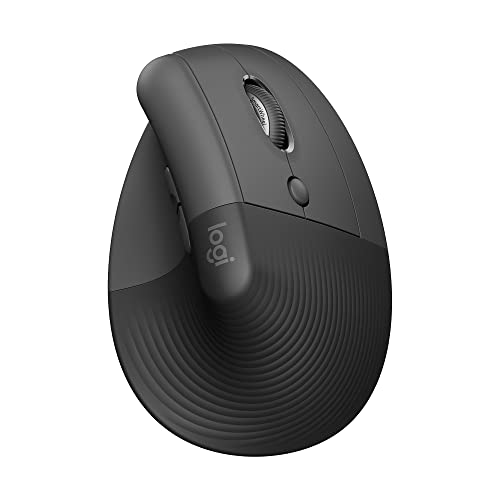
The Logitech Lift is one of the safer choices when a full-size vertical mouse feels too large. Its compact body, raised thumb rest, and 57-degree angle suit many small and medium hands. The left-handed version is also available, which is useful because most ergonomic mice are designed only for right-handed use.
It uses a 4,000 DPI sensor, has six buttons, connects through Bluetooth or the included Logi Bolt receiver, and runs on one AA battery for up to about 24 months under manufacturer estimates. Its approximate weight is 125 grams. The quiet-click version is particularly suitable for shared offices.
The main limitation is its compact palm area. People with large hands may find their little finger dragging on the desk or their palm extending beyond the rear of the shell. It is a good office pointer, but not the first choice for high-speed gaming or highly detailed design work.
Logitech MX Vertical: best full-size vertical option
The MX Vertical is a larger, heavier vertical mouse with a 57-degree angle, a textured thumb rest, four main programmable buttons, and a top-mounted sensitivity button. Its 4,000 DPI sensor is sufficient for ordinary office and creative work, while a USB-C rechargeable battery is rated for roughly four months per charge.
At approximately 135 grams and around 120 mm long, it provides more palm support than the Lift. That can be welcome for large hands, but smaller users may struggle to reach the rear buttons without shifting their grip. It can connect by Bluetooth, USB receiver, or USB cable, and Logitech Flow supports moving between compatible computers.
The vertical shape is its defining advantage and its main adjustment cost. If you frequently need to make tiny movements, drag objects diagonally, or alternate between mouse and keyboard every few seconds, expect a learning period.
Best contoured ergonomic mice
Logitech MX Master 3S: best for control and productivity
The MX Master 3S is a large right-handed contoured mouse rather than a vertical model. Its thumb shelf, thumb wheel, electromagnetic MagSpeed scroll wheel, and gesture button make it particularly useful for spreadsheets, timelines, wide documents, and applications with many shortcuts.
Its 8,000 DPI sensor can track on surfaces where many ordinary mice struggle, including some glass desks. The sensitivity is adjustable, so the high maximum matters mainly to users with multiple monitors or limited desk space. The mouse weighs approximately 141 grams, uses a USB-C rechargeable battery rated for up to 70 days, and supports Bluetooth or Logi Bolt connectivity.
Its size and weight are not ideal for everyone. Small hands may have difficulty reaching the thumb wheel and back button, while users who lift the mouse often may find it tiring. The broad shell also takes more room than a compact office mouse.
Contoured mice with a lighter, simpler feel
If the MX Master 3S has too many controls, look for a medium-sized contoured mouse with a pronounced thumb rest, a 1000–4000 DPI sensor, and five or six buttons. These models generally weigh between 90 and 120 grams and are easier to reposition. They are often a better compromise for users who want palm support without the bulk of a productivity flagship.
Consider Kensington’s Pro Fit Ergo range when you want a vertical or semi-vertical office design with a conventional feature set. Exact dimensions, battery arrangements, and connection options vary by model, so check the individual version rather than assuming every Pro Fit Ergo mouse has the same specifications.
Size, grip, and button placement
Measure from the crease at your wrist to the tip of your middle finger. As a starting point, hands under about 17 cm usually suit compact mice, 17–19 cm suits medium models, and over 19 cm often benefits from a large shell. This is only a screening tool: finger length, palm width, and preferred grip matter just as much.
- Palm grip: choose a mouse long and tall enough to support most of the palm. A vertical mouse or large contoured model is usually more comfortable than a small travel mouse.
- Claw grip: prioritize a shorter rear section and easy access to the main buttons. An oversized palm rest can force the wrist into an awkward angle.
- Fingertip grip: choose a lighter mouse with a low activation force and a smooth sensor. Very tall vertical models may feel difficult to steer.
- Frequent shortcuts: thumb buttons should be separated enough to distinguish by touch. A button placed too far forward encourages thumb stretching.
Do not judge fit from length alone. A mouse that is 120 mm long can feel smaller than a 112 mm mouse if its rear is narrow, and a wide thumb shelf can matter more than several millimeters of overall size.
Sensor, connectivity, and battery trade-offs
For office work, a reliable 1,000–4,000 DPI sensor is normally enough. Higher DPI is useful when you have multiple displays or little desk space, not because it automatically improves comfort. Look for adjustable sensitivity, stable tracking at slow speeds, and a sensor that does not require a glossy specialty surface.
Bluetooth saves a USB port and works well with laptops and tablets, but waking from sleep can occasionally be slower. A 2.4GHz receiver usually feels more immediate and is preferable for a desktop PC. Multi-device models are convenient only when switching is easy; a button hidden underneath the mouse defeats much of the benefit.
Rechargeable models reduce disposable batteries and are convenient if you remember to charge them. A simple runtime calculation illustrates the difference: a mouse rated for 70 days provides about 18 full charge cycles per year, while a model rated for 24 months theoretically uses one AA battery over the same period. Real runtime falls with heavy use, bright indicators, and battery age, so treat manufacturer figures as upper estimates.
Ownership details that listings often omit
- Worn feet: the low-friction pads underneath usually wear before the electronics. Replaceable PTFE feet can extend the life of an expensive mouse.
- Dirty sensors: dust or hair near the sensor can cause skipping. Disconnect the mouse and use a dry cotton swab or air blower; do not spray liquid into the opening.
- Grip coating: soft-touch rubber can become shiny or tacky after years of skin oils and heat. Hard plastic with a textured surface is less luxurious but often ages better.
- Switches and scroll wheels: accidental double-clicking, missed clicks, or inconsistent scrolling are common late-life failures. Avoid pressing harder to compensate, which can accelerate wear.
- Desk posture: a vertical mouse cannot correct a desk that is too high or a forearm that is unsupported. Keep the mouse close, reduce shoulder reach, and let the forearm rest lightly.
How to choose without overbuying
Choose a vertical model if your priority is changing the hand’s rotation and you are willing to relearn pointer control. Choose a contoured model if you need familiar accuracy, many shortcuts, or quick movement between mouse and keyboard. Then match the shell to your hand size, confirm whether you need left-handed support, and decide between rechargeable and replaceable-battery ownership.
For most people, the Logitech Lift is the most approachable compact vertical choice, the Logitech MX Vertical is the better large-hand option, and the Logitech MX Master 3S is the strongest productivity choice when a conventional contoured grip is preferable. If none fits your hand, a correctly sized basic mouse is likely to be more comfortable than a premium model with the wrong shape.


Write Your Review
No reviews yet. Be the first to share your experience!