

Key takeaways
- Full-size: Includes the number pad and navigation cluster. Choose it for accounting, data entry, or frequent spreadsheet work.
- Tenkeyless: Removes the number pad while retaining function and navigation keys. It gives a mouse more room and is a strong gaming-work compromise.
- 75%: Keeps the function row and most navigation controls in a compact arrangement. The Keychron Q1 is a representative example.
- 65%: Removes the function row and usually compresses navigation keys. It is compact, but shortcuts may require function-layer combinations.
- 60%: Removes dedicated arrows, function keys, and navigation keys. It maximizes mouse space but slows workflows that depend on those keys.
The best mechanical keyboards for work and gaming are the Keychron Q1 for an all-round wired setup, the Wooting 80HE for competitive gaming, the NuPhy Air75 V2 for a compact wireless desk, and the Logitech G915 X for low-profile wireless convenience.
The right choice depends less on brand than on four decisions: how much noise your workspace allows, whether you need a number pad, how often you switch between devices, and whether gaming performance matters more than typing feel. Mechanical keyboards are not automatically better; they are better when their switch, layout, firmware, and ergonomics match your routine.
Our top picks


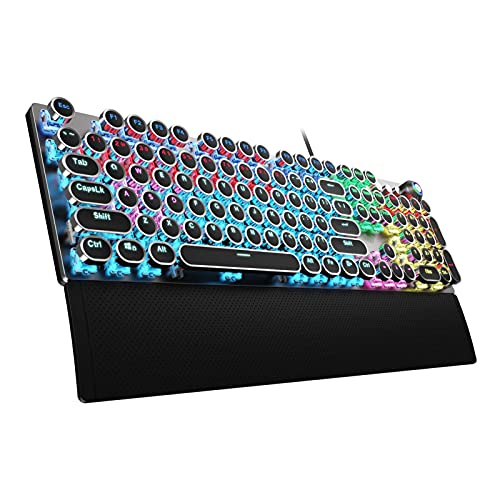
As an Amazon Associate we earn from qualifying purchases at no extra cost to you. Ratings are shown as listed on Amazon.
Best mechanical keyboards by situation
| Best for | Recommended type or model | Useful specifications | Typical market range |
|---|---|---|---|
| Work and gaming in one keyboard | Keychron Q1 | 75% layout, wired USB-C, hot-swappable switches, aluminum case, roughly 1.7 kg | $150–$220 |
| Competitive PC gaming | Wooting 80HE | 80% layout, Hall-effect switches, adjustable actuation, rapid-trigger features, wired USB | $170–$220 |
| Quiet shared office | Low-profile keyboard with silent linear switches | 75% or TKL layout, approximately 1.0–1.4 mm actuation, damped switches and case | $100–$200 |
| Portable wireless work setup | NuPhy Air75 V2 | 75% layout, Bluetooth and 2.4 GHz wireless, USB-C, approximately 2,500 mAh battery | $100–$150 |
| Wireless low-profile gaming | Logitech G915 X | Full-size or TKL variants, low-profile switches, 2.4 GHz wireless, Bluetooth, rechargeable battery | $150–$230 |
| Heavy spreadsheet work | Full-size mechanical keyboard | 104 or 108 keys, dedicated number pad, usually 1.0–1.5 kg | $80–$220 |
Prices are broad 2026 market ranges and vary with switch, keycap, lighting, and regional availability. For many buyers, a hot-swappable board is the safer investment because switches can be replaced without soldering if your preference changes.
Switch types: the decision that changes the keyboard most
Linear switches
Linear switches move smoothly from top to bottom without a tactile bump. They are popular for gaming because repeated key presses feel consistent, especially for movement keys. A medium-weight linear switch around 45–55 gf is a versatile starting point. Lighter switches can feel fast but may cause accidental presses; heavier switches can reduce mistakes but create more finger fatigue during long sessions.
Linear switches are not necessarily quiet. Most of their sound comes from the keycap hitting the switch housing or the keyboard plate, plus the key returning upward. Choose silent linear switches if noise matters, but expect a softer, less crisp feel and potentially less durability from the small dampening pads.
Tactile switches
Tactile switches provide a noticeable bump before the key reaches the actuation point. They suit office typing, coding, and general productivity because the bump gives feedback that a press has registered. Moderate tactile switches are usually easier to live with than sharply “clicky” designs.
Tactile switches vary widely. A light tactile switch may feel close to a smooth linear switch, while a strong tactile switch can require substantially more force. If you type for several hours daily, prioritize a switch that feels controlled without making you bottom out every key aggressively.
Clicky switches
Clicky switches combine a tactile bump with a deliberate click sound. They can make typing feel precise and satisfying, but they are a poor choice for shared offices, meetings, bedrooms, or microphones nearby. The click mechanism creates sound on both the downward and upward parts of a keystroke, so foam inside the case will not make a clicky board truly quiet.
Hall-effect switches
Hall-effect keyboards, such as the Wooting 80HE, detect key position magnetically rather than relying on a conventional metal contact. Software can often adjust actuation, enable rapid-trigger behavior, and assign different actions to different travel depths. These features are most valuable in fast competitive games, not ordinary document editing.
Hall-effect boards usually have a narrower switch ecosystem than conventional hot-swap keyboards. Check replacement availability, keycap compatibility, software support, and whether the board works fully on macOS or Linux before buying.
Layout: reclaim desk space without losing useful keys
- Full-size: Includes the number pad and navigation cluster. Choose it for accounting, data entry, or frequent spreadsheet work.
- Tenkeyless: Removes the number pad while retaining function and navigation keys. It gives a mouse more room and is a strong gaming-work compromise.
- 75%: Keeps the function row and most navigation controls in a compact arrangement. The Keychron Q1 is a representative example.
- 65%: Removes the function row and usually compresses navigation keys. It is compact, but shortcuts may require function-layer combinations.
- 60%: Removes dedicated arrows, function keys, and navigation keys. It maximizes mouse space but slows workflows that depend on those keys.
For a first mechanical keyboard, 75% or tenkeyless is usually less disruptive than 60%. A compact layout can save roughly 8–12 cm of horizontal desk width compared with a full-size board, but that saving is only useful if the missing keys do not interrupt your work.
Noise, keycaps, and build quality
Noise has three main sources: the switch mechanism, the keycap striking the switch or plate, and the case resonating on the desk. For a quieter board, select silent linear or damped tactile switches, thick PBT keycaps, a gasket or foam-damped case, and a desk mat. Avoid hollow aluminum cases with hard, thin keycaps if sound is a priority.
ABS keycaps are often smoother and can offer brighter legends, but their surface may develop a glossy shine on frequently used keys. PBT keycaps generally resist shine better and have a textured feel, although very thick PBT can produce a deeper, louder sound. Double-shot legends are preferable when long-term legend clarity matters; printed legends are more dependent on coating quality.
Build weight improves stability but does not automatically improve typing. A heavy aluminum board may remain planted during gaming, while a plastic board can be easier to move and less expensive. Look for a solid plate, stable feet, a detachable USB-C cable, and minimal case flex rather than choosing by material alone.
Connectivity and software trade-offs
Wired USB is the safest option for competitive gaming: it avoids charging, wireless interference, and occasional connection-management problems. Bluetooth is convenient for laptops and tablets but is better suited to office work than latency-sensitive play. A 2.4 GHz receiver normally provides a more responsive wireless connection and may support higher polling rates than Bluetooth.
Multi-device keyboards are useful if you alternate between a work laptop, personal computer, and tablet. Confirm how many devices can be stored, whether switching uses a physical button or a function shortcut, and whether backlighting remains enabled in wireless mode. Battery claims often assume lighting is off or set low; heavy RGB use can reduce runtime substantially.
Software is part of the ownership experience. Web-based firmware tools are convenient, while desktop utilities may offer deeper macros and lighting controls but can be less pleasant across operating systems. If you work on a managed computer, choose a board whose core functions can be configured without installing software.
Ergonomics for long work sessions
Look for adjustable feet, a moderate front height, a detachable wrist rest, and the ability to use a low or neutral typing angle. A steep keyboard angle can increase wrist extension, especially on tall mechanical cases. A wrist rest should support the heel of the hand rather than force the wrist sharply upward; it should also be close to the keyboard without creating a hard edge.
Split or tented ergonomic keyboards can provide more flexible positioning, but they require an adjustment period and may not suit frequent gaming or shared computers. A conventional 75% board with a flat or mildly angled setup is a simpler choice for most people. If you experience persistent pain, numbness, or weakness, stop changing hardware at random and consult a qualified health professional.
What wears out first—and how to extend its life
The most commonly worn parts are keycap surfaces, stabilizers on the space bar and larger keys, USB cables, and rechargeable batteries. Switches can last for many years, but a single switch may eventually become intermittent. Hot-swappable sockets make this repair inexpensive and avoid replacing the entire keyboard.
- Unplug the board before cleaning.
- Remove loose dust with a soft brush or compressed air held at an angle.
- Pull keycaps vertically with a keycap puller rather than twisting them.
- Wash removable keycaps only if they are fully dried before reinstallation.
- Wipe the case with a lightly damp microfiber cloth; do not spray liquid into switches.
- Inspect stabilizers if the space bar becomes rattly, and use only keyboard-safe lubricant where appropriate.
Do not use household oil, soak a powered keyboard, or force keycaps off with a screwdriver. Keep drinks away from the board; liquid damage is more expensive than most switch upgrades.
Bottom line
Choose the Keychron Q1 if you want a substantial, customizable 75% keyboard for mixed work and gaming. Choose the Wooting 80HE if adjustable actuation and rapid-trigger gaming features justify a wired, specialized board. Choose the NuPhy Air75 V2 or Logitech G915 X when wireless convenience and a low-profile feel matter more than deep customization. If silence is the priority, start with a damped low-profile or silent-switch keyboard, use thick keycaps, and treat layout and desk position as seriously as the switch itself.


Write Your Review
No reviews yet. Be the first to share your experience!