

The best reading chairs with ottomans combine a seat that supports an upright posture, an ottoman that keeps your feet level with your hips, and a footprint that leaves enough clearance to recline without crowding the room.
For most readers, a lounge chair with a separate, movable ottoman is a better choice than a deep sofa chair: it lets you adjust leg support, reading distance, and sitting angle independently. The right pick depends mainly on how long you read, how much floor space you have, and whether you prefer firm support or a softer, enveloping seat.
Our top picks
 Welnow Lazy Chair with Ottoman
- The lazy chair is made of soft and…
- The lounge chair is equipped with a footstool…
- The curved backrest support ergonomically fits your back…
 MAXYOYO Accent Chair with Ottoman
- Adjustable Backrest: The accent chair is equipped with…
- Accent Chair with Ottoman: The matching ottoman is…
- Tufted Crafted Chair: The tufted craft design adds…
 MAXYOYO Oversized Round Chaise Lounge Sofa
- Detachable Chaise Lounge Sofa: The oversized chaise lounge…
- Layered Cushioning Construction: Enjoy the perfect balance of…
- High-Resilience Filling: Filled with high-density elastic filling inside,…
| Product | Key specs | |
|---|---|---|
| Welnow Lazy Chair with Ottoman | The lazy chair is made of soft and… The lounge chair is equipped with a footstool… The curved backrest support ergonomically fits your back… | Check price |
| MAXYOYO Accent Chair with Ottoman | Adjustable Backrest: The accent chair is equipped with… Accent Chair with Ottoman: The matching ottoman is… Tufted Crafted Chair: The tufted craft design adds… | Check price |
| MAXYOYO Oversized Round Chaise Lounge Sofa | Detachable Chaise Lounge Sofa: The oversized chaise lounge… Layered Cushioning Construction: Enjoy the perfect balance of… High-Resilience Filling: Filled with high-density elastic filling inside,… | Check price |
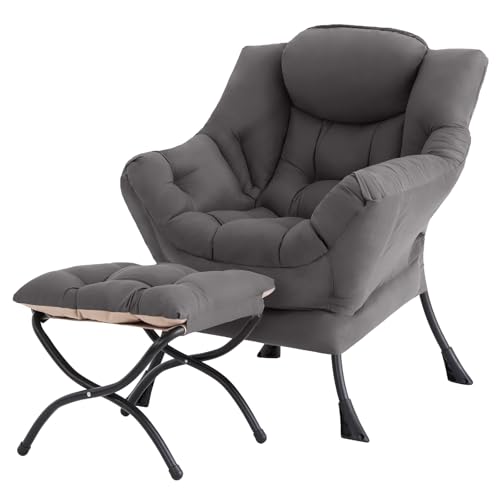 Tiita Lazy Chair with Ottoman | Strong and High-quality Living Room Chairs: Our lazy… Comfy Accent Chairs with Ottoman: Our modern lounge… Spacious Size of Armchair with Ottoman: 28.5"L x… | Check price |
As an Amazon Associate we earn from qualifying purchases at no extra cost to you.
Best reading chairs with ottomans by situation
- Best for long daily reading: A supportive recliner or ergonomic lounge chair with a height-matched ottoman, such as the Stressless Mayfair with its matching footstool.
- Best for a small bedroom or home office: The IKEA POÄNG armchair paired with the POÄNG footstool. Its open wooden frame visually occupies less space than a boxy upholstered recliner.
- Best for classic comfort: The Eames Lounge Chair and Ottoman, provided the budget and substantial footprint are acceptable.
- Best for a softer, more casual setup: A La-Z-Boy recliner with an integrated or matching ottoman-style leg rest. Choose a model with a relatively upright reading position rather than a television-first recline.
- Best for a limited budget: A well-built upholstered accent chair with a separate ottoman, prioritizing seat dimensions, replaceable cushions, and performance fabric over decorative details.
What matters more than the chair’s appearance
Seat depth: enough support, not a hammock effect
Reading requires a different seat depth from lounging. A useful target for many adults is roughly 19 to 22 inches of usable seat depth, measured from the front edge to the point where the back cushion meets the seat. A deeper 23- to 26-inch seat can feel luxurious, but it may leave shorter users with unsupported thighs and cause them to slide forward.
When sitting upright, aim for approximately two to four inches between the back of your knees and the front edge of the cushion. If the chair is too deep, a firm lumbar cushion can help, but it does not fully correct a seat that is fundamentally oversized.
Lumbar support and back angle
A reading chair should let you keep your head over your shoulders without forcing your neck forward toward the book. Look for a back that supports the lower and middle back, with a recline angle that can remain slightly open rather than completely upright. A chair that reclines to 110–120 degrees is often more useful for reading than one designed mainly to lie back.
Adjustable headrests are useful when you alternate between a book, an e-reader, and a television. Fixed, sculpted back cushions can feel supportive, but check whether their lumbar bulge lands at your waist rather than above it. Avoid judging comfort from the softness of the cushion alone: very soft foam can compress and lose usable support sooner.
Ottoman alignment
The ottoman should support the lower legs without forcing the knees high above the hips. For a typical lounge-chair setup, an ottoman height of about 15 to 18 inches works well, but the correct height depends on the chair cushion height and your leg length. The front edge should be close enough that your calves rest on it while your back remains against the chair.
A separate ottoman is usually more versatile than an attached footrest. You can pull it closer for reading, move it aside when standing, or use it as a temporary seat. However, a fixed recliner footrest wins on convenience and takes less planning if the chair is used in a narrow space.
Comparison table: useful targets for a reading setup
| Feature | Compact setup | All-day reading setup | Large-room lounge setup |
|---|---|---|---|
| Usable seat depth | 18–20 in | 19–22 in | 22–26 in |
| Seat width | 18–21 in | 20–24 in | 23–28 in |
| Seat height | 16–18 in | 17–19 in | 16–19 in |
| Ottoman height | 14–16 in | 15–18 in | 16–19 in |
| Clearance behind chair | 6–12 in if fixed | 12–24 in if reclining | 18–30 in if reclining |
| Recommended total width | 30–36 in | 32–40 in | 36–46 in |
| Useful seat firmness | Medium to firm | Medium or medium-firm | Medium-soft to medium |
These are selection targets rather than universal rules. Measure the actual cushion, not only the manufacturer’s outside dimensions; thick arms and heavily padded backs can make a chair feel much smaller inside.
Head-to-head: three types of reading chair
Ergonomic recliner versus lounge chair
An ergonomic recliner is the stronger choice when you read for several hours, change positions often, or want a headrest and adjustable back. Stressless chairs are a prominent example of this category, with a separate footstool and a swivel-and-recline design on many models. Their main disadvantages are price, a larger visual presence than a simple accent chair, and upholstery that may need careful cleaning.
A traditional lounge chair, such as the Eames Lounge Chair and Ottoman, offers a more settled sitting position and distinctive design. It can be excellent for relaxed reading, but its deep seat and low profile are not ideal for every body type. It also needs a substantial footprint and may place the reader farther from a side table or floor lamp than expected.
Fixed accent chair versus integrated recliner
A fixed accent chair is easier to place in a bedroom, study, or corner of a living room. Pair it with an ottoman that can move independently. This arrangement is often the best value, but it depends more on selecting compatible heights and keeping the chair at a comfortable reading angle.
An integrated recliner is simpler to operate and keeps the footrest attached, reducing the chance of misalignment. The trade-off is less flexibility: the footrest may be too short for taller users, and the mechanism can add weight, repair costs, and clearance requirements.
Room-size fit: calculate the real footprint
Do not measure only the chair. Measure the chair, ottoman, movement path, and the space required to reach a table or lamp. As a practical calculation, add the chair’s width to the ottoman’s depth, then reserve at least 18 inches for the gap between the ottoman and the chair when your legs are extended.
For example, a 34-inch-wide chair with a 20-inch-deep ottoman and an 18-inch gap needs at least 72 inches of front-to-back space before adding a side table. In a compact office, a 30-inch chair, 16-inch ottoman, and 12-inch gap reduces that requirement to 58 inches. Mark both footprints on the floor with painter’s tape before ordering.
Allow roughly 24 to 30 inches of walking space around the exposed side of the chair. If the chair reclines, confirm that its back will not strike a wall, radiator, desk, or window covering.
Upholstery durability and ownership realities
For frequent reading, tightly woven polyester, performance chenille, treated microfiber, and durable leather are usually easier to live with than loosely woven boucle or delicate linen. Leather can develop attractive wear but may show scratches and can feel cold or warm depending on the room. Fabric generally offers more color and texture choices, but the cleaning code matters.
- What wears first: the front edge of the seat, arm tops, headrest, and ottoman corners. These areas receive repeated friction from clothing, hands, and shoes.
- Foam compression: rotate reversible cushions where possible and avoid judging a chair only by its showroom softness. A cushion that is too soft may bottom out during long sessions.
- Cleaning: vacuum seams and crevices monthly, remove spills by blotting rather than rubbing, and follow the manufacturer’s fabric or leather code. Test any cleaner on a hidden area.
- Mechanisms: keep crumbs and pet hair out of recliner joints, avoid sitting on an extended footrest, and do not drag a heavy chair by its arms.
- Common mistake: buying a matching ottoman without checking its height. A visually coordinated pair can still leave your knees too high or your calves unsupported.
A practical buying checklist
- Measure your seated hip width, from the outside of one hip to the other, and choose a seat at least two to four inches wider.
- Measure from your lower back to the back of your knees. Compare this with usable seat depth, not the chair’s total depth.
- Check that your feet can reach the floor when seated upright and that the ottoman supports your calves when reclined.
- Test the reading position with a book held at your normal distance. A chair can feel comfortable while empty but force your shoulders forward once your arms are raised.
- Confirm the upholstery cleaning code, warranty coverage for the frame and mechanism, delivery access, and whether replacement cushions or parts are available.
- Mark the complete chair-and-ottoman footprint before purchase, including recline clearance and walking space.
Bottom line
The best reading chairs with ottomans are not necessarily the deepest or softest. Choose a medium-depth seat with dependable lumbar support for long sessions, match the ottoman height to your legs, and treat the complete footprint as part of the product. For a small room, a POÄNG-style chair and footstool is a sensible compact solution; for intensive daily use, a supportive adjustable recliner such as a Stressless Mayfair is more adaptable; and for design-led comfort in a spacious room, the Eames Lounge Chair and Ottoman remains a distinctive, premium option.


Write Your Review
No reviews yet. Be the first to share your experience!