

Key takeaways
- Fixed swivel: Usually has a firmer, more upright feel and fewer moving joints. It is a good choice for dining tables and narrow spaces.
- Swivel rocker: Adds a small front-to-back motion, commonly about 10 to 15 degrees. It is more relaxed but needs extra space behind the chair and can feel less stable on an uneven surface.
- Low lounge swivel: Best for conversation seating and fire-pit areas. Its lower seat is usually awkward with a standard dining table.
Best Patio Swivel Chairs for Outdoor Seating
The best patio swivel chairs are the ones that match your table height, provide at least 270 degrees of useful rotation, drain quickly after rain, and leave enough clearance to turn without striking the tabletop or nearby furniture.
Quick picks by patio situation
| Patio situation | Best chair type | Target specifications | Why it fits |
|---|---|---|---|
| Small balcony or compact dining area | Compact swivel dining chair | 24–27 inches wide; 16–18 inch seat depth; 180–270 degree swivel | Uses less floor space and needs less clearance behind the chair |
| Long outdoor meals | Swivel rocker dining chair | 18–20 inch seat height; 2–4 inch cushion; 10–15 degree rocking range | Allows small posture changes without requiring a lounge chair |
| Exposed, rainy patio | Aluminum-frame swivel chair | Powder-coated aluminum; stainless or coated hardware; quick-dry cushion | Reduces rust risk and shortens drying time after wet weather |
| Low coffee table or conversational seating | Low swivel lounge chair | 15–17 inch seat height; 28–32 inch overall depth | More comfortable for relaxed seating, but usually too low for a dining table |
| Heavy daily use | Commercial-style swivel rocker | Reinforced frame; 300-pound-or-higher stated capacity; replaceable cushions | Better suited to frequent sitting and repeated rotation |
Best overall: a rust-resistant swivel rocker dining chair
For most patios, a swivel rocker dining chair offers the most useful balance. It lets you turn toward another guest, rock slightly while talking, and stand up without dragging the chair across the deck. Look for a seat height of about 18 to 20 inches, measured from the floor to the top of the compressed seat cushion.
Our top picks


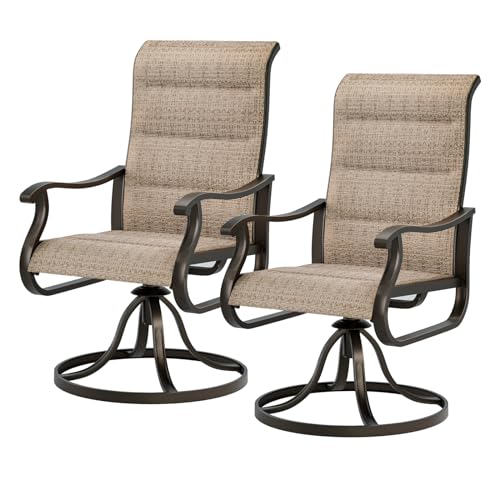
As an Amazon Associate we earn from qualifying purchases at no extra cost to you. Ratings are shown as listed on Amazon.
This style works especially well with tables that are approximately 28 to 30 inches high. A chair with a seat below 17 inches may feel too low for dining, while one above 21 inches can leave your knees uncomfortably high under the tabletop. Because cushions compress with age, compare the listed seat height with the cushion installed, not just the bare metal frame.
Swivel range: 180 degrees is usable, 360 degrees is not always better
A 180-degree return swivel is sufficient when the chair sits against a wall or at the end of a table. It lets you turn toward the table and then face outward without repeatedly lifting the chair. A 270-degree range is more versatile for conversation areas because it allows a wider turn while preserving a return-to-center position.
Full 360-degree swiveling is useful around a freestanding table, but it can encourage the chair to rotate into a railing, planter, or neighboring seat. Check whether the mechanism automatically returns to center. A return mechanism is convenient, although it adds moving parts that may eventually need cleaning or replacement.
When comparing chairs, ask whether the stated range describes the actual seat movement or only the swivel base. A chair may rotate fully while its arms collide with the tabletop before the mechanism reaches its advertised limit.
Swivel rocker versus fixed swivel
- Fixed swivel: Usually has a firmer, more upright feel and fewer moving joints. It is a good choice for dining tables and narrow spaces.
- Swivel rocker: Adds a small front-to-back motion, commonly about 10 to 15 degrees. It is more relaxed but needs extra space behind the chair and can feel less stable on an uneven surface.
- Low lounge swivel: Best for conversation seating and fire-pit areas. Its lower seat is usually awkward with a standard dining table.
Rocking motion should be controlled rather than loose. If the chair rocks noticeably from side to side, the frame may be twisting or the base may be sitting unevenly. On pavers, use adjustable feet or a stable leveling pad rather than forcing the chair to compensate for a sloped surface.
Frame materials and rust resistance
Powder-coated aluminum is the safest general choice for an uncovered patio because it is light and does not rust like ordinary steel. However, aluminum can bend if the frame is thin, and chipped powder coating exposes the metal to oxidation. A thicker, reinforced aluminum frame is preferable for daily use.
Steel frames can provide a solid, planted feel, but they need better corrosion protection. Look for a fully powder-coated frame, sealed tube ends, and stainless-steel or corrosion-resistant fasteners. The swivel plate deserves particular attention because water can collect around its bearings and mounting screws.
Wrought iron and ordinary painted steel can work in a covered, dry area, but they demand more maintenance. Inspect the underside of the base once or twice a year for bubbling paint, orange staining, or water trapped inside tubing. Touch up small chips before they spread.
Cushion drainage matters more than cushion thickness
A thick cushion is not automatically a comfortable or weather-ready cushion. For outdoor seating, prioritize a slatted or mesh seat, a zippered cover, and foam designed to release water rather than retain it. Quick-dry foam can drain substantially faster than conventional dense foam, but it still needs airflow beneath and around the cushion.
- Prefer removable covers with outdoor-rated fabric and strong, corrosion-resistant zippers.
- Look for an open-weave or mesh underside rather than a fully sealed fabric panel.
- Do not leave cushions pressed against a wet chair frame or stacked tightly after rain.
- Store cushions vertically or under a breathable cover once they are mostly dry.
Even weather-resistant fabric can develop mildew when dirt, pollen, and moisture remain trapped between the cushion and frame. Brush off debris weekly during heavy-use seasons and clean spills promptly with mild soap and water. Avoid harsh bleach unless the fabric manufacturer specifically permits it.
How much clearance does a swivel chair need?
Allow more space than the chair’s listed width. A practical starting point is 30 to 36 inches from the table edge to the nearest wall, railing, planter, or other obstacle. For a chair with arms or a 360-degree swivel, 36 to 42 inches is safer.
Use this simple fit calculation before ordering:
Required zone = chair depth + pull-out clearance + turning allowance.
For example, a chair that is 27 inches deep with 18 inches for pulling back and 9 inches for a partial turn needs about 54 inches from the table edge to the obstacle behind it. If the chair swivels fully or has wide arms, increase the turning allowance to 15 inches, producing a 60-inch zone.
Measure the chair at its widest point, including arms. Also check neighboring chairs: two chairs can technically fit beside a table while their armrests collide when both users rotate.
What wears out first?
The swivel mechanism is usually the first part to show problems, particularly on uncovered patios. Grit can make rotation feel rough, while standing water can corrode bearings and fasteners. Clean the underside with a soft brush and low-pressure water, then allow it to dry fully. Do not pack the mechanism with grease unless the manufacturer specifies a lubricant; grease can trap abrasive dirt.
Cushion ties, zipper pulls, and fabric seams often wear before the frame. Replaceable covers and standard cushion dimensions can reduce the cost of ownership. If the chair uses a proprietary cushion shape, a damaged cover may require replacing the entire cushion.
Inspect the chair every few months for loose bolts, cracked welds, frayed straps, and rocking that was not present when new. Tighten hardware carefully, but do not overtighten bolts against aluminum tubing.
Buying checklist for the best patio swivel chairs
- Confirm the seat height against your table height, with the cushion compressed.
- Choose at least 180 degrees of swivel for wall-adjacent seating and 270 degrees for flexible conversation areas.
- Decide whether the comfort of rocking is worth the additional depth and moving parts.
- Prefer powder-coated aluminum for exposed patios or properly protected steel for a heavier feel.
- Check the hardware, swivel plate, and tube ends for corrosion-resistant construction.
- Measure total chair width, arm width, and the full clearance zone—not just the gap between table legs.
- Look for quick-dry or drainage-friendly cushions and removable, replaceable covers.
- Check the stated weight capacity and leave a margin rather than choosing a chair at its limit.
Bottom line
Choose a compact fixed swivel for a tight dining area, a swivel rocker for longer meals and relaxed conversation, and a low lounge swivel for a separate seating group. For most uncovered patios, the strongest combination is a 270-degree swivel, modest rocking motion, an 18- to 20-inch seat height, powder-coated aluminum, corrosion-resistant hardware, and cushions that drain rather than merely resist water.


Write Your Review
No reviews yet. Be the first to share your experience!