

Key takeaways
- Solid hardwood: A strong long-term option when joints are glued, screwed, or doweled properly. Look for level legs and no movement when the chair is twisted gently.
- Steel: Slim, strong, and useful for contemporary designs. Powder-coated steel resists ordinary moisture, but exposed welds and thin tubing can affect the appearance and stability.
- Plywood: Quality plywood can form a durable seat shell or frame component. It is not equivalent to low-density particleboard, particularly at heavily loaded joints.
- Engineered wood: Cost-effective and stable in a dry indoor environment. Inspect the leg attachments, because stripped fasteners are difficult to repair.
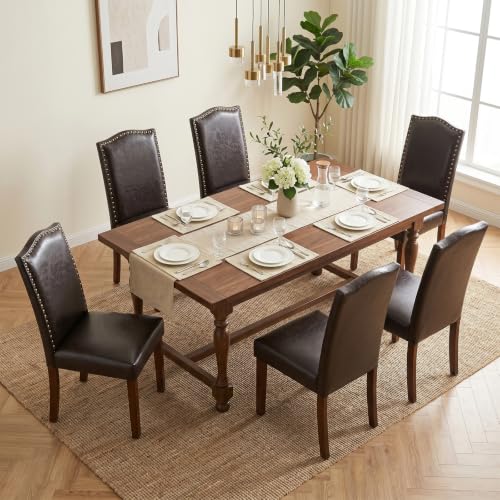
The best leather dining chairs for lasting comfort are usually genuine top-grain or corrected-grain chairs with a 19–20 inch seat height, a 17–19 inch seat depth, medium-firm foam, and a solid wood or steel frame; bonded leather is more suitable when the budget is the priority and usage is occasional.
Our top picks


As an Amazon Associate we earn from qualifying purchases at no extra cost to you. Ratings are shown as listed on Amazon.
Quick comparison: which leather dining chair fits your situation?
| Situation | Best choice | Why it fits | Typical market range per chair |
|---|---|---|---|
| Daily family meals | Top-grain or corrected-grain leather, solid wood frame | Better resistance to abrasion, repairable frame, comfortable over long use | $250–$700 |
| Low-cost dining set | Bonded leather with a reinforced engineered-wood frame | Lower initial price and consistent appearance | $80–$220 |
| Small dining area | Armless chair, 17–18 inch seat width | Allows more chairs around the table and makes movement easier | $120–$450 |
| Long dinners or work at the table | Genuine leather, 19–20 inch seat depth, gently curved back | More usable sitting space and better support without a hard edge | $250–$800 |
| Children, pets, or frequent spills | Protected corrected-grain leather or high-quality leather-look upholstery | Simple wipe-clean surface; less concern about minor marks | $120–$400 |
Genuine leather versus bonded leather
Genuine leather
Genuine leather is made from animal hide, although the label alone does not indicate a premium grade. Top-grain leather retains the hide’s outer layer and generally offers the best balance of durability, softness, and aging. Corrected-grain leather has been lightly sanded or embossed to create a more uniform finish. It is often more stain-resistant than unfinished leather and can be a practical dining-room choice.
Full-grain leather is the least altered and may develop a noticeable patina. That character is attractive, but the surface can show scratches, variation, and color changes. For a formal dining room, that may be desirable; for a busy household seeking a uniform finish, corrected-grain leather is often easier to live with.
Bonded leather
Bonded leather combines leather fibers with polyurethane or other binders and applies the mixture to a backing. It can look convincing when new and usually costs less. Its weakness is the surface coating: repeated flexing, body heat, cleaning chemicals, and sunlight can eventually cause cracking, peeling, or flaking, especially at the front edge of the seat and on the upper back.
Bonded leather is not automatically a poor purchase. It makes sense for a seldom-used dining room, a first apartment, or a set expected to last several years rather than decades. Ask whether the specification says “bonded leather,” “leather match,” or “leather upholstery.” “Leather match” commonly means leather is used on the seat and another material covers the sides or back.
Seat dimensions matter more than the upholstery label
Most dining tables are approximately 28–30 inches high, measured from the floor to the tabletop. A chair seat around 17.5–19.5 inches high usually leaves enough legroom for most adults. A seat that is too high makes the underside of the table feel cramped; one that is too low can force the elbows upward while eating.
| Chair dimension | Useful target | What it changes |
|---|---|---|
| Seat height | 17.5–19.5 inches | Fit with a standard 28–30 inch table |
| Seat width | 17–20 inches | Personal space and how many chairs fit |
| Usable seat depth | 17–19 inches | Thigh support without pressing behind the knees |
| Seat-to-table clearance | 9.5–12 inches | Room for thighs, arms, and comfortable posture |
| Armrest height | Usually below 27 inches | Whether the chair can slide under the table |
Measure the table’s underside rather than relying only on tabletop height. Aprons, drawers, and support rails can reduce clearance. For a table with a 29-inch top and a 3-inch apron, an 18.5-inch chair seat leaves 7.5 inches to the apron, which may be restrictive for a tall user or a chair with thick cushioning. If you want armchairs, measure the opening between table legs as well as the height below the apron.
Cushioning: soft is not always comfortable
Dining chairs benefit from medium-firm cushioning. Very soft foam feels inviting for the first few minutes but may compress quickly, allowing the seat frame to be felt during a long meal. A useful construction is high-resilience polyurethane foam approximately 2–4 inches thick over a supportive base, with a rounded or waterfall front edge that reduces pressure behind the knees.
Webbing, sinuous springs, and plywood seat panels can all work. What matters is how well the seat distributes weight and whether the frame prevents sagging. Removable cushions are convenient to replace or reupholster, but their seams and gaps can collect crumbs. Fixed cushions look cleaner and move less, while making future repairs more involved.
Back comfort depends on shape as much as padding. A back with mild lumbar contouring and a top that reaches at least the lower shoulder blades is more supportive than a thin, flat panel. If the chair will also be used for reading or laptop work, choose a slightly taller back and a seat depth near 18 inches rather than a compact dining-only design.
Frame materials and the parts that wear first
- Solid hardwood: A strong long-term option when joints are glued, screwed, or doweled properly. Look for level legs and no movement when the chair is twisted gently.
- Steel: Slim, strong, and useful for contemporary designs. Powder-coated steel resists ordinary moisture, but exposed welds and thin tubing can affect the appearance and stability.
- Plywood: Quality plywood can form a durable seat shell or frame component. It is not equivalent to low-density particleboard, particularly at heavily loaded joints.
- Engineered wood: Cost-effective and stable in a dry indoor environment. Inspect the leg attachments, because stripped fasteners are difficult to repair.
The first visible wear usually appears at the front seat edge, where people slide in and out, followed by the armrests and areas touched by skin or hair products. On bonded leather, inspect these zones carefully. On genuine leather, the finish may become shinier or darker before the material itself is damaged. Loose joints, squeaks, and uneven legs are more urgent structural warnings than minor surface marks.
Cleaning and maintenance requirements
For routine care, remove crumbs with a soft brush or vacuum upholstery attachment and wipe spills promptly with a slightly damp, clean cloth. Use a leather cleaner only if the upholstery manufacturer approves it. Test any product in an inconspicuous area first. Avoid bleach, alcohol-based sprays, abrasive sponges, soaking, and household degreasers; these can strip protective finishes or leave a patchy surface.
Keep chairs away from strong, prolonged sunlight and heating vents. Excessive heat can dry genuine leather and accelerate deterioration of synthetic coatings. Depending on the leather finish, a conditioner may be appropriate once or twice a year, but over-conditioning can make the surface greasy and attract dirt. Bonded leather generally needs cleaning and protection according to its specific coating instructions rather than repeated oiling.
A practical way to calculate table fit
Before ordering, use this simple check:
- Measure floor to tabletop: for example, 29 inches.
- Measure floor to the bottom of the table apron: for example, 25.5 inches.
- Subtract the chair seat height: 25.5 minus 18.5 equals 7 inches of apron clearance.
- Add the chair cushion’s compression and the user’s leg thickness into your judgment. A seven-inch opening may work for an armless chair but feel tight with thick arms or a deep apron.
For chairs placed side by side, allow roughly 24 inches of table edge per person for comfortable everyday dining. Four 19-inch-wide chairs need 76 inches of linear space before accounting for gaps, table legs, and armrests. A compact table may technically fit four chairs but still feel crowded when everyone is seated.
Bottom line
Choose top-grain or corrected-grain genuine leather and a solid, well-joined frame for daily use, long meals, and ownership measured in many years. Choose bonded leather when price, matching appearance, and easy replacement matter more than long-term surface aging. Whichever material you select, prioritize a seat height that fits the table, at least 17 inches of usable depth, supportive medium-firm cushioning, and enough clearance for knees and armrests. Those measurements will influence comfort far more than a fashionable color or an attractive product photograph.


Write Your Review
No reviews yet. Be the first to share your experience!