

Key takeaways
- Rounded edges: Look for corners with a noticeable radius rather than merely a thin edge band. A radius of about 6–12 mm reduces sharp contact points during ordinary bumps.
- Stable base: A desk should not rock when a child presses down while writing. Wide legs, cross-bracing, adjustable levelers, or a wall anchor can improve stability.
- Pinch protection: Height-adjustment joints, folding tops, and drawers should have controlled movement and gaps that do not invite fingers.
- Secure tall storage: Any hutch, bookcase, or drawer unit that could tip should be anchored according to the manufacturer’s instructions.
- Low-emission materials: Sealed wood, laminate, and powder-coated metal are easier to maintain than unfinished porous surfaces. Check the product’s stated finish and indoor-use guidance.
- Manage cables: If a lamp or computer is used, route cords away from the chair and walking path. Do not rely on a loose cable tray to prevent pulling.
Best Kids Desks for Study and Creative Play
The best kids desks are height-appropriate, large enough for the child’s actual activities, easy to clean, and stable without taking over the room; for most families, a height-adjustable desk with a desktop around 31–40 inches wide offers the best long-term value.
A preschooler who mainly draws needs a different desk from a nine-year-old doing homework and using a laptop. The right choice depends on four practical questions: how long the desk must last, how much floor space is available, whether supplies need built-in storage, and how much adjustment is worth paying for.
Our top picks
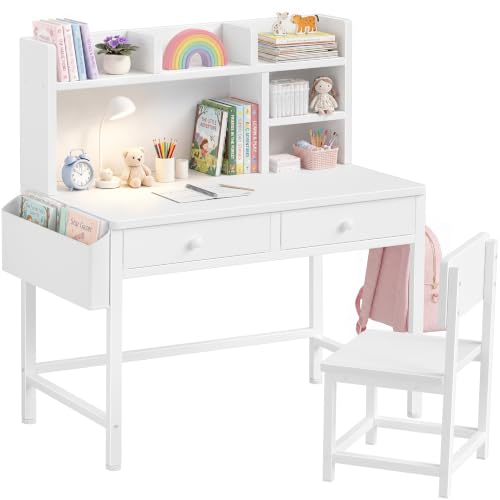
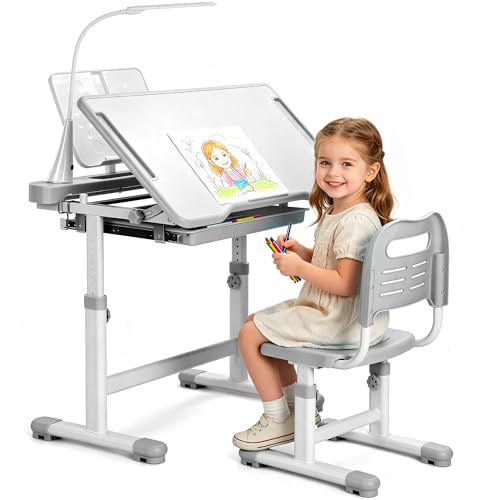


As an Amazon Associate we earn from qualifying purchases at no extra cost to you. Ratings are shown as listed on Amazon.
Quick comparison: which desk type fits your situation?
| Desk type | Typical height range | Typical desktop size | Storage | Best for | Typical 2026 price range |
|---|---|---|---|---|---|
| Preschool activity table | 18–22 inches | 24–30 × 20–24 inches | Usually none or one shelf | Ages 2–5, drawing and building | $50–$150 |
| Fixed-height study desk | 24–30 inches | 30–40 × 18–24 inches | One drawer or open cubby | Ages 5–10 on a budget | $80–$250 |
| Height-adjustable kids desk | 21–30 inches | 31–40 × 20–24 inches | Drawer, shelf, or optional accessory | Growing children and shared rooms | $150–$450 |
| Compact wall-mounted desk | 22–30 inches, if adjustable | 24–36 × 16–20 inches | Small compartments | Bedrooms with limited floor space | $70–$250 |
| Larger youth desk | 26–30 inches | 40–48 × 22–26 inches | Drawers or side cabinet | Ages 8+ and regular homework | $180–$600 |
Best overall: a height-adjustable desk with a 31–40-inch desktop
A height-adjustable desk is the strongest all-round choice when two children may use it, when you want to avoid replacing furniture during a growth spurt, or when the desk must support both crafts and schoolwork. Look for a desktop height of approximately 21–30 inches and a mechanism that locks securely rather than relying on friction alone.
The most useful adjustment is not a large maximum height; it is the ability to set the desk low enough for the youngest intended user. A child should be able to sit with feet supported, shoulders relaxed, and elbows near the desktop without raising the shoulders. If the desktop is too high, a footrest can improve leg support, but it does not fully solve an arm position that is consistently elevated.
A 31–40-inch-wide surface gives a child room for an exercise book, pencil case, and art materials without forcing everything into a pile. A depth of 20–24 inches is generally enough for writing and a small laptop. Deeper desks are useful for larger projects but can make it harder for a small child to reach the back edge.
Best for preschool creative play: a low activity table
For children aged roughly two to five, a low activity table is often more practical than a conventional study desk. Choose a height around 18–22 inches and pair it with a chair that lets the child sit with both feet on the floor. Open storage underneath is more useful than a narrow drawer for blocks, paper, washable crayons, and puzzles.
Preschool desks tend to receive heavier treatment than their appearance suggests. Children may climb on them, drag them across the floor, or spill paint and glue. Prefer thick, wipe-clean laminate, sealed solid wood, or molded plastic, along with broad feet that resist tipping. Avoid a design with a large open gap where a child can trap a foot or knee.
A smaller 24–30-inch tabletop works well in a playroom corner. It also keeps materials within reach, which can make independent cleanup easier. However, it may feel cramped once the child starts using worksheets, a tablet, and a pencil holder at the same time.
Best for small rooms: a compact desk or wall-mounted design
When floor space is limited, measure the complete working area—not just the desktop. Allow at least 24 inches of clear space for the chair, and preferably 30–36 inches so the child can sit down and stand up without hitting a bed or dresser.
A wall-mounted or folding desk can reduce its footprint to about 8–12 inches when closed, but it needs secure installation into suitable wall structure. It is a good option for occasional drawing or homework in a bedroom shared with another function. It is less suitable if the child leaves projects set up overnight or needs daily access to many supplies.
For a small fixed desk, prioritize a simple 30–36-inch-wide top over a bulky hutch. Vertical storage can be added with a narrow bookcase or wall organizer, provided heavy items are secured and the child can reach frequently used materials safely.
Best for regular homework: a youth desk with real storage
A child who does homework several times a week benefits from a desk at least 36 inches wide and about 20–24 inches deep. One shallow drawer is useful for pencils and rulers, while a deeper drawer or side cabinet can hold notebooks, headphones, and craft supplies. Open cubbies are easier for younger children to use, but they show clutter and collect dust more quickly.
Storage should not consume the entire work surface. A desktop organizer or raised hutch can reduce usable space, especially on a 30-inch-wide desk. If the child uses a laptop, leave a clear area approximately 24 inches wide by 16 inches deep. A separate laptop stand or monitor can make the work area more flexible, but it should not push the screen so far back that the child leans forward to see it.
Safety details that matter more than decoration
- Rounded edges: Look for corners with a noticeable radius rather than merely a thin edge band. A radius of about 6–12 mm reduces sharp contact points during ordinary bumps.
- Stable base: A desk should not rock when a child presses down while writing. Wide legs, cross-bracing, adjustable levelers, or a wall anchor can improve stability.
- Pinch protection: Height-adjustment joints, folding tops, and drawers should have controlled movement and gaps that do not invite fingers.
- Secure tall storage: Any hutch, bookcase, or drawer unit that could tip should be anchored according to the manufacturer’s instructions.
- Low-emission materials: Sealed wood, laminate, and powder-coated metal are easier to maintain than unfinished porous surfaces. Check the product’s stated finish and indoor-use guidance.
- Manage cables: If a lamp or computer is used, route cords away from the chair and walking path. Do not rely on a loose cable tray to prevent pulling.
How to choose the correct height
Measure the child in the chair they will actually use. The desk should allow the forearms to rest approximately parallel to the floor while the shoulders remain relaxed. There should be room for the knees beneath the top, and the feet should be supported by the floor or a stable footrest.
As a rough starting point, a preschool desk is commonly 18–22 inches high, an early-school desk 22–26 inches, and an older child’s desk 25–30 inches. These are ranges, not rules: chair height, torso length, and footwear change the result. Adjustable legs are valuable only if the mechanism can be set precisely and tightened securely.
Decision matrix: match the desk to the household
| Your situation | Recommended choice | What to prioritize | What to avoid |
|---|---|---|---|
| Budget under $150 and one young child | Fixed-height activity or study desk | Strong frame, wipe-clean top, rounded corners | Paying for decorative storage that reduces legroom |
| Desk must last through several growth stages | Height-adjustable desk | 21–30-inch range, positive locking mechanism | A narrow top under 28 inches wide |
| Bedroom has less than 30 inches of usable depth | Compact or wall-mounted desk | 16–20-inch depth, fold-away design, secure mounting | Deep hutches and permanent clutter |
| Daily homework plus art projects | 36–48-inch youth desk | At least one drawer and a durable 20–26-inch-deep top | Small tablet-only surfaces |
| Two children may share the desk | Wide adjustable desk or two compact desks | At least 48 inches for side-by-side work, or separate storage | One chair position blocking the other child |
Ownership realities: what wears out first
Desk tops usually show wear before the frame. Pencil marks, permanent-marker stains, dried glue, and moisture around drink containers can damage unsealed wood. A desk mat or washable craft sheet protects the main surface, but avoid mats with edges that curl into a tripping or snagging hazard.
Drawers and adjustable joints are the parts most likely to loosen. Check screws after the first few weeks and then every few months. Do not overtighten particleboard fittings, because the material can strip. Wipe surfaces with a slightly damp cloth and mild soap; excessive water can swell engineered wood, while abrasive cleaners can dull laminate or painted finishes.
For a simple value calculation, consider a $300 adjustable desk used for six years. At five study or creative sessions per week for 45 weeks each year, that is about 1,350 sessions, or roughly 22 cents per session before accessories. A $100 fixed desk used for two years at the same frequency costs about 22 cents per session as well. The adjustable model is not automatically cheaper; its advantage is reducing replacement risk and accommodating different users.
Final verdict
Choose a low, rounded activity table for preschool play; a 31–40-inch height-adjustable desk for the best long-term flexibility; a compact wall-mounted model when every inch matters; and a 36–48-inch youth desk when homework, art, and storage must share one surface. Whichever style you choose, verify the lowest and highest settings, measure the chair clearance, check that the desk cannot tip, and leave enough open desktop for the child’s main activity.


Write Your Review
No reviews yet. Be the first to share your experience!