

Key takeaways
- Stainless steel: A practical choice for the face and body, particularly in humid bathrooms. It resists corrosion better than thin decorative coatings.
- Brass: Heavier and generally more substantial, especially for shower arms and joints. Confirm that the wall connection is adequately supported.
- ABS plastic: Lightweight and often inexpensive. It can be perfectly serviceable, but the finish and threads may be less durable than metal on lower-cost models.
- Chrome: Usually the easiest finish to maintain and good at hiding water spots.
- Brushed nickel: Less reflective and often forgiving of fingerprints, but may show mineral residue as a pale film.
- Matte black: Visually striking, though soap and hard-water deposits can be more noticeable. Avoid abrasive cleaners that can polish or damage the coating.
- Brushed gold or bronze: Match the finish carefully with the existing valve and accessories. Coating quality matters more than color alone.
Best Rain Shower Heads for a More Luxurious Shower
The best rain shower heads are usually 8 to 12 inches wide, flow at 1.8 to 2.5 gallons per minute (GPM), and use silicone spray nozzles that maintain a broad, even pattern without demanding unusually high water pressure.
Your ideal choice depends less on appearance than on four practical questions: how much ceiling or wall space you have, whether your plumbing delivers adequate pressure, how much water you want to use, and how willing you are to clean mineral deposits. A large fixed head can feel luxurious in a spacious shower, while a smaller air-injection or combination head is often better for a compact bathroom or a home with marginal pressure.
Our top picks

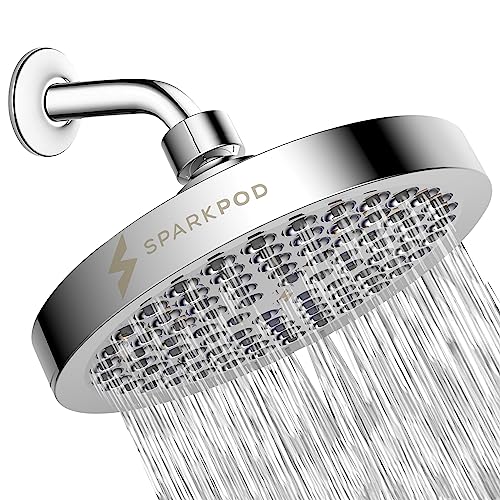


As an Amazon Associate we earn from qualifying purchases at no extra cost to you. Ratings are shown as listed on Amazon.
Best rain shower head types by situation
| Situation | Best configuration | Recommended size and flow | Why it fits |
|---|---|---|---|
| Small shower or tub enclosure | Wall-mounted round head | 6–8 inches; 1.75–2.0 GPM | Less likely to interfere with walls, doors, or a handheld hose |
| Large walk-in shower | Fixed 10–12-inch head or ceiling-mounted head | 2.0–2.5 GPM | Creates wider coverage and a more enveloping spray |
| Low or inconsistent pressure | Air-injection or pressure-compensating design | 8–10 inches; usually 1.75–2.0 GPM | Maintains a fuller-feeling spray than a very wide, unrestricted head |
| Shared household with different preferences | Combination rain head and handheld | 8–10 inches plus handheld; up to 2.5 GPM total | Offers overhead coverage and targeted rinsing |
| Hard-water area | Simple stainless-steel or brass head with flexible nozzles | 6–10 inches; 1.75–2.0 GPM | Fewer concealed passages and easier mineral-deposit removal |
| Rental or non-invasive upgrade | Shower-arm-mounted replacement head | 6–8 inches; 1.75–2.0 GPM | Usually installs using the existing threaded shower arm |
How the leading design choices compare
Fixed wall-mounted rain heads
A wall-mounted head is the simplest replacement because it normally connects to the existing shower arm. A short arm produces a spray that falls at an angle, while a 12- to 16-inch extension arm moves the head farther into the shower area. This can improve coverage, but it also increases leverage on the wall connection. Use a properly supported arm and avoid forcing a heavy brass head onto an uncertain fitting.
Wall mounting is usually the best value. Typical market pricing ranges from about $25 to $100 for basic stainless-steel or plated models, with premium brass designs and coordinated systems costing more. It is also the easiest option for renters and for anyone who does not want to open the ceiling.
Ceiling-mounted rain heads
Ceiling mounting gives the most natural straight-down spray and makes a large head feel more effective because the water does not arrive at a shallow angle. However, it is not a simple cosmetic swap. The ceiling must have a correctly positioned water supply, adequate framing, and a finished connection that can support the chosen arm or drop pipe.
Choose ceiling mounting during a bathroom renovation or new construction rather than as a casual upgrade. A 10- to 12-inch ceiling head is a sensible range for most residential showers; larger models can look impressive but may spread a limited flow too thinly.
Combination rain head and handheld systems
Combination systems are the most versatile choice. The rain head supplies broad coverage, while the handheld helps rinse hair, clean the enclosure, and direct water where a fixed head cannot. The trade-off is complexity: a diverter, hose, slide bar, and extra seals create more parts that can loosen or collect mineral buildup.
Check the system’s total flow rating rather than looking only at the rain-head specification. If both outlets can run simultaneously, a system labeled 2.5 GPM may divide that flow between the two outlets. A pressure-balancing valve or compatible diverter also matters; an inexpensive universal diverter may not perform well with every existing valve.
Spray coverage, pressure, and flow rate
A larger face does not automatically provide a stronger shower. At the same flow rate, water is distributed across more nozzles and a wider area. For example, a 10-inch head operating at 2.0 GPM delivers about 0.2 GPM per inch of head diameter as a rough comparison, while a 6-inch head at the same flow concentrates the water more tightly. This is not a nozzle-by-nozzle measurement, but it explains why smaller heads often feel more forceful.
To estimate your home’s available flow, place a one-gallon container beneath the shower outlet and measure the fill time before installing the new head. The approximate flow is:
Flow rate in GPM = 60 ÷ seconds needed to fill one gallon.
If the container takes 30 seconds to fill, the supply produces approximately 2.0 GPM at that outlet. A head rated above the available supply cannot create additional water; it may produce a weak or uneven pattern. Test with the shower’s pressure-control valve fully open and consider that other fixtures running at the same time can reduce performance.
For homes with modest pressure, look for air-injection, pressure-compensating, or tightly engineered nozzle designs. These can make a restricted flow feel fuller, but no shower head can overcome a blocked filter, undersized pipe, failing valve, or serious pressure problem. If pressure is poor throughout the house, investigate the plumbing rather than repeatedly changing shower heads.
Materials and finishes that hold up
- Stainless steel: A practical choice for the face and body, particularly in humid bathrooms. It resists corrosion better than thin decorative coatings.
- Brass: Heavier and generally more substantial, especially for shower arms and joints. Confirm that the wall connection is adequately supported.
- ABS plastic: Lightweight and often inexpensive. It can be perfectly serviceable, but the finish and threads may be less durable than metal on lower-cost models.
- Chrome: Usually the easiest finish to maintain and good at hiding water spots.
- Brushed nickel: Less reflective and often forgiving of fingerprints, but may show mineral residue as a pale film.
- Matte black: Visually striking, though soap and hard-water deposits can be more noticeable. Avoid abrasive cleaners that can polish or damage the coating.
- Brushed gold or bronze: Match the finish carefully with the existing valve and accessories. Coating quality matters more than color alone.
Look for a standard 1/2-inch connection, a replaceable screen washer, and a swivel joint if you need to aim the head. A metal ball joint or sturdy polymer joint is preferable to a flimsy decorative collar, since the joint is a common source of leaks and sagging.
Hard-water maintenance and ownership costs
Mineral scale usually appears first around the smallest spray openings, the screen washer, and the diverter. Flexible silicone nozzles let you rub away deposits with a fingertip, which is more useful than a complicated faceplate with narrow, inaccessible channels.
- Wipe the nozzles after each shower if your water leaves visible spots.
- Once a month, remove the head if practical and inspect the inlet screen for grit or scale.
- Soak removable metal parts in diluted white vinegar or a manufacturer-approved descaling solution.
- Rinse thoroughly and reinstall with a clean screen washer.
- Use plumber’s tape only on the tapered male threads where appropriate; do not put tape over the washer or on a connection that seals with a gasket.
Do not soak every finish in vinegar automatically. Acid can dull some plated or colored coatings, and it can damage nearby natural stone if it drips onto the surface. Follow the care instructions for the particular finish and rinse the shower wall afterward.
The parts most likely to wear first are the rubber or silicone seals, diverter cartridges, inlet screens, and flexible hose connections. Keeping the screen clear is often more effective than buying a higher-flow head. If the head begins spraying sideways from a joint, replace the washer before applying more force to the fitting.
Final buying recommendation
For most bathrooms, choose an 8- to 10-inch stainless-steel or brass wall-mounted rain shower head with silicone nozzles, a 1.75- to 2.0-GPM rating, and a swivel connection. Select a 10- to 12-inch model when the shower is spacious and the water supply can support it. Choose a combination system when a handheld is useful enough to justify the extra maintenance, and reserve ceiling mounting for a properly planned renovation.
The best rain shower heads are not necessarily the largest or most expensive. The right match between head size, available flow, mounting position, finish, and cleaning routine will produce a more consistently comfortable shower than a wide faceplate installed on inadequate plumbing.






Write Your Review
No reviews yet. Be the first to share your experience!