

Key takeaways
- Avoid exercise, caffeine, and smoking for about 30 minutes beforehand unless a healthcare professional has given you different instructions.
- Empty your bladder, sit quietly for around five minutes, and keep both feet flat on the floor.
- Support your back and arm. Keep the cuff on bare skin, not over clothing.
- Do not talk, text, or clench your fist during the reading.
- Take a second reading after a short pause if your care plan calls for repeated measurements, and record the date, time, and circumstances.
The best blood pressure monitors for home use are usually validated upper-arm models with the correct cuff size; wrist monitors are more compact, but they demand stricter positioning and are easier to read incorrectly.
Our top picks
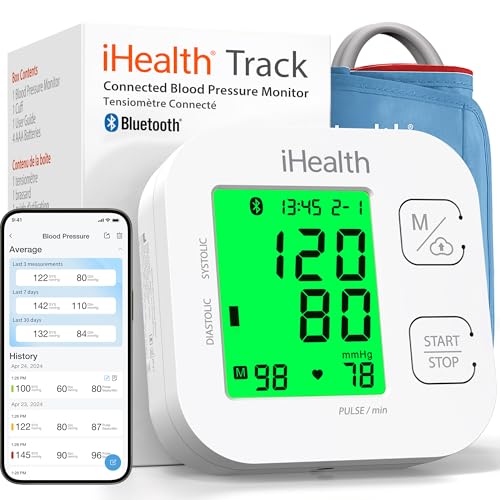
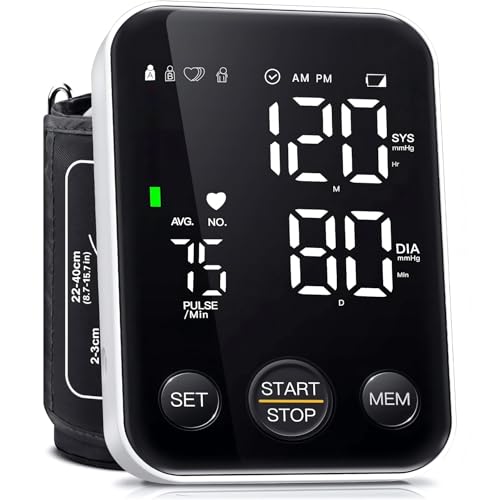


As an Amazon Associate we earn from qualifying purchases at no extra cost to you. Ratings are shown as listed on Amazon.
Quick picks by situation
| Situation | Best fit | Why | Trade-off |
|---|---|---|---|
| Routine readings at home | Upper-arm monitor with a 22–42 cm cuff | More forgiving positioning and generally preferred for home measurement | Larger than a wrist model |
| Two people sharing one monitor | Upper-arm model with two user profiles and at least 120 stored readings | Keeps each person’s history separate | Usually costs more than a single-user model |
| Travel or very limited storage | Wrist monitor with a 12.5–21.5 cm wrist range | Small, light, and quick to pack | Positioning errors can significantly affect readings |
| Occasional use on a budget | Basic upper-arm monitor with one-button operation | Fewer features reduce cost and setup confusion | May store little or no measurement history |
Upper-arm versus wrist monitors
Upper-arm monitors: the better default
An upper-arm monitor places the cuff around the same general level as the heart when your arm rests on a table. That makes the measurement process less dependent on tiny changes in posture. For most people taking routine readings, this is the easier design to use consistently.
Examples include the Omron 3 Series, Omron 7 Series, Omron 10 Series, A&D Medical UA-651, A&D Medical UA-767, Beurer BM28, and Braun ExactFit 5. Product features vary by model, so check the cuff range and memory capacity rather than choosing by series name alone.
A good upper-arm model should include a cuff that fits without forcing the fabric to its limit, a clear start button, an irregular-heartbeat indicator, and a memory function. Bluetooth can be useful, but it is not essential if you record readings manually.
Wrist monitors: compact but less forgiving
Wrist models are useful when an upper-arm cuff cannot be used comfortably, when portability is the priority, or when storage space is extremely limited. Omron and Beurer both make wrist monitors, along with other established medical-device brands.
The main issue is height. During measurement, the wrist must be held at heart level, with the arm supported and the hand relaxed. Letting the wrist drop onto your lap or lifting it above the heart can change the result. A wrist monitor is therefore not automatically a poor choice, but it requires more disciplined technique.
Features that matter more than the product name
| Feature | Useful target | Why it matters |
|---|---|---|
| Cuff range | At least 22–42 cm for a general adult upper-arm cuff | A correct fit is more important than having many app features |
| Wrist range | Approximately 12.5–21.5 cm | Confirms that the monitor can sit correctly on your wrist |
| Memory | 60 readings for one user; 120–200 total for two users | Allows trends to be reviewed without relying on memory |
| Power | 4 AA batteries for many upper-arm models; 2 AAA for many wrist models | Common batteries are easier to replace than a proprietary battery pack |
| Weight | 300–600 g for an upper-arm unit; roughly 90–150 g for a wrist unit | Relevant if the monitor is stored away or carried frequently |
| Measurement averaging | Three-reading average or automatic repeated readings | Reduces reliance on a single potentially unusual reading |
Best choices for different buyers
Best simple choice: a basic upper-arm monitor
Choose a model such as the A&D Medical UA-651 or an entry-level Omron 3 Series if you want a straightforward monitor for occasional or regular readings. These types typically have a large display, one-button operation, and a memory function, without requiring a phone connection.
This is often the sensible choice for a first monitor. A complicated app cannot compensate for an incorrectly sized cuff or poor posture.
Best for two users: a dual-profile upper-arm model
For a household sharing one device, look for two user buttons or clearly separated user memories. The Omron 7 Series and Omron 10 Series include models designed around connected or multi-user tracking, while some A&D Medical and Beurer models offer substantial memory without requiring Bluetooth.
Check how memory is divided. A device advertised with 200 stored readings may provide 100 per user, rather than 200 for each person. That is still adequate for many households, but the distinction matters if you measure several times a day.
Best for portability: a wrist monitor
A wrist device is the practical choice for a suitcase, desk drawer, or small living space. It usually weighs less than 150 g and may fit inside a compact storage case. Choose one with a clear positioning guide or body-position sensor if possible, then practise the correct arm position before relying on it for a log.
If wrist readings seem consistently different from readings taken with a properly fitted upper-arm device, bring both monitors to a healthcare appointment and ask whether the technique and devices should be checked.
How to choose the right cuff size
Measure around the bare upper arm, halfway between the shoulder and elbow, without tightening the tape. Compare that measurement with the manufacturer’s printed cuff range. Do not select a cuff based only on shirt size.
For example, suppose your arm circumference is 39 cm. A cuff rated for 22–42 cm technically covers it, leaving 3 cm of range. A cuff rated for 22–32 cm does not fit, even if the monitor itself is the same. If your measurement is close to the edge of a range, choose a model with a larger compatible cuff rather than stretching a small cuff.
Some Omron and Braun upper-arm monitors are sold with wide-range cuffs, while other models require a separate small, large, or extra-large cuff. Confirm that replacement cuffs are available before buying.
How to get more consistent readings
- Avoid exercise, caffeine, and smoking for about 30 minutes beforehand unless a healthcare professional has given you different instructions.
- Empty your bladder, sit quietly for around five minutes, and keep both feet flat on the floor.
- Support your back and arm. Keep the cuff on bare skin, not over clothing.
- Do not talk, text, or clench your fist during the reading.
- Take a second reading after a short pause if your care plan calls for repeated measurements, and record the date, time, and circumstances.
For a wrist monitor, support the elbow and bring the wrist to heart level before pressing start. Follow the device’s instructions if they specify a particular orientation.
Ownership costs and maintenance
General market prices in 2026 are roughly $25–$60 for a basic upper-arm or wrist monitor, $60–$120 for a feature-rich upper-arm model, and $100–$180 for some connected or clinically oriented devices. Replacement cuffs commonly cost about $15–$40, depending on size and brand. Four AA batteries may last several months to more than a year, depending on usage and battery quality; frequent users should keep a spare set available.
The cuff is usually the first part to wear. Repeated bending, pulling the tube, storing the cuff tightly folded, or fastening the hook-and-loop closure at an angle can shorten its life. Wipe the cuff and monitor with a slightly damp cloth according to the manufacturer’s instructions, and never immerse the cuff, pump, or display unit in water.
A useful ownership calculation is simple: if a $50 monitor is used four times each week for three years, that is about 624 uses, or roughly eight cents per use before batteries. A $100 connected monitor used at the same frequency costs about 16 cents per use. The extra cost is worthwhile only if the app, profiles, or averaging features will actually be used.
What to check before buying
- Is the included cuff large or small enough for your measured arm?
- Does the memory separate two users, and how many readings does each profile hold?
- Can you read the display without glasses or a phone?
- Does it use standard AA or AAA batteries?
- Are replacement cuffs available in your required size?
- Does the manufacturer provide instructions for cleaning and accuracy checks?
Home monitors are intended to support, not replace, professional advice. If readings are repeatedly unusual, differ substantially from your usual results, or cause concern, contact a qualified healthcare professional. Seek urgent help for severe symptoms or a reading that your clinician has told you requires immediate attention.





Write Your Review
No reviews yet. Be the first to share your experience!