

Key takeaways
- Five 1.75mm filaments compared on maker specs only: two PLA lines, a PETG for functional parts, a weather-ready ASA and a flexible TPU for FDM printers.
Every FDM printer in our printer roundups ships ready to print, but the spool you load decides what the finished part can actually do. The five filaments below cover the materials a home office or workshop printer sees most: two PLA lines for everyday work, a PETG for functional parts, an ASA built for outdoor use, and a flexible TPU. Each pick is named at one color and one spool size, because filament listings split by color and every color carries its own listing code.
All temperatures, tolerances and spool figures here come from maker copy only. PLA remains the sensible default for models and prototypes, PETG adds toughness for brackets and enclosures, ASA asks for an enclosed machine and repays it with weather resistance, and TPU trades speed for bend. Match the material to the part first, then check that your printer can hold the bed and nozzle temperatures the maker publishes.
As an Amazon Associate, we earn from qualifying purchases.
Quick answer
For most prints, load HATCHBOX PLA in Black: it runs cool, needs no heated bed and suits almost any FDM machine. Choose eSUN PLA+ when a PLA part needs more toughness, OVERTURE PETG for functional pieces, Polymaker PolyLite ASA for outdoor parts on an enclosed printer, and eSUN TPU 95A when the part has to flex.
HATCHBOX PLA, Black, 1 kg

HATCHBOX built its name on this spool, and the published figures explain why it stays the default recommendation for a first filament. The maker rates diameter accuracy at plus or minus 0.03 mm, which is the tolerance class that keeps extrusion consistent on budget and mid-range machines alike. The recommended nozzle range of 180 to 210 degrees Celsius is the coolest in this roundup, and HATCHBOX states that no heated bed is required, so the spool suits open-frame printers with unheated or low-power beds. Black is the color named here; the same line sells many other colors, each under its own listing.
Specs
- : Material: PLA (polylactic acid); Diameter: 1.75 mm, tolerance plus or minus 0.03 mm per maker; Spool weight: 1 kg; Print temperature: 180–210 °C per maker; Bed temperature: heated bed not required, 0–60 °C per maker
eSUN PLA+, Black, 1 kg
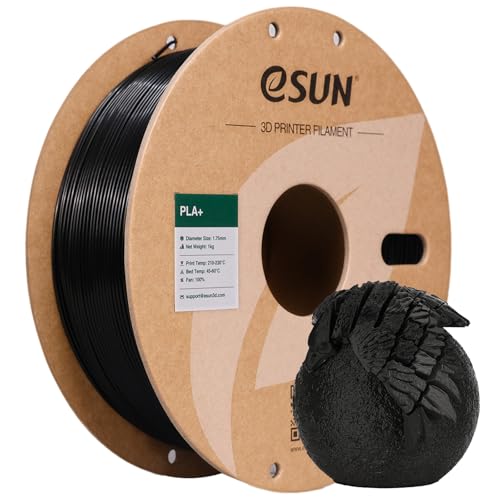
PLA+ is eSUN’s modified PLA line, positioned by the maker above its basic PLA for parts that take knocks. eSUN’s current data sheet credits PLA+ with more than twice the Izod impact figure of its PLA Basic on identical settings, while the printing window stays firmly in PLA territory: 210 to 230 degrees at the nozzle and 45 to 60 degrees at the bed. Diameter accuracy is plus or minus 0.03 mm, and the spool is cardboard, which some multi-material units prefer over plastic flanges. Pick this line when a PLA part needs to survive clips, snap fits or repeated handling rather than sit on a shelf.
Specs
- : Material: PLA+ (modified PLA); Diameter: 1.75 mm, tolerance plus or minus 0.03 mm per maker; Spool weight: 1 kg, cardboard spool; Print temperature: 210–230 °C per maker; Bed temperature: 45–60 °C per maker
OVERTURE PETG, Black, 1 kg

PETG is the step up when PLA parts crack or soften: OVERTURE positions this spool for functional prototypes and mechanical parts that need impact resistance and layer adhesion beyond PLA. The maker rates diameter accuracy at plus or minus 0.02 mm, the tightest tolerance in this group. The current OVERTURE data sheet recommends a 230 to 260 degree nozzle range with the bed at 65 to 70 degrees, and advises drying the spool at 60 degrees for five hours when it has picked up moisture. Expect to slow down and tune retraction compared with PLA; the payoff is a part that shrugs off drops and outdoor-adjacent duty.
Specs
- : Material: PETG (polyethylene terephthalate glycol); Diameter: 1.75 mm, tolerance plus or minus 0.02 mm per maker; Spool weight: 1 kg; Print temperature: 230–260 °C per maker; Bed temperature: 65–70 °C per maker
Polymaker PolyLite ASA, Black, 1 kg

ASA pairs ABS-like mechanical behavior with the weather resistance outdoor parts need, and Polymaker rates PolyLite ASA for heat resistance up to 100 degrees Celsius. This is the demanding spool of the five: Polymaker publishes a nozzle range of 240 to 260 degrees, a bed range of 75 to 90 degrees and print speeds of 30 to 50 mm per second, and the material belongs in an enclosed printer that can hold those temperatures without warping the part off the plate. Garden fittings, automotive trim and enclosures that live outside are the jobs that justify it. The spool is cardboard, and the maker sells the same line in many colors under separate listings.
Specs
- : Material: ASA (acrylonitrile styrene acrylate); Diameter: 1.75 mm; Spool weight: 1 kg, cardboard spool; Print temperature: 240–260 °C per maker; Bed temperature: 75–90 °C per maker
eSUN TPU 95A, Grey, 1 kg

Flexible filament changes what a desktop printer can make: phone cases, gaskets, grips and bumpers that bend instead of snapping. The 95A in the name is the Shore hardness eSUN assigns this TPU, firm for a flexible material, which helps it feed through a wider range of extruders than softer grades. eSUN publishes a diameter tolerance of plus or minus 0.05 mm, a nozzle range of 220 to 250 degrees and a bed range of 45 to 60 degrees. Flexible filament rewards patience, so plan on slower speeds than any other spool here, and keep the spool dry between sessions.
Specs
- : Material: TPU (thermoplastic polyurethane), 95A Shore hardness per maker; Diameter: 1.75 mm, tolerance plus or minus 0.05 mm per maker; Spool weight: 1 kg; Print temperature: 220–250 °C per maker; Bed temperature: 45–60 °C per maker
How to choose
Begin with the part, not the spool. Display models, prototypes and jigs that live indoors belong in PLA, and the only real decision is whether the part takes enough handling to justify the tougher PLA+ line. Parts that flex, snap or carry load move to PETG, provided your printer holds a 65 to 70 degree bed. Outdoor duty points to ASA, but only when the machine is enclosed and its hotend comfortably reaches 260 degrees. Flexible parts point to TPU, with the understanding that print speeds drop.
Then check three published figures against your printer. First, the bed range: a machine that tops out at 60 degrees rules out PETG and ASA no matter how good the spool is. Second, the nozzle range: ASA’s 240 to 260 degree window sits beyond some stock hotends. Third, tolerance: plus or minus 0.02 or 0.03 mm lines feed more predictably than wider tolerances, which matters most on long prints. Every spool here is 1.75 mm and 1 kg, the standard pairing for current FDM machines; confirm your printer is not a 2.85 mm model before ordering any of them.
Who should skip
Skip this roundup if your printer is a resin or powder machine, since none of these spools fits it. Skip ASA and PETG if your printer is open-frame with an unheated bed; the parts will warp and the spool is not the problem. Skip TPU if your extruder is a long Bowden design that already struggles with soft filament, and skip the whole 1.75 mm format if your machine takes 2.85 mm filament. Finally, skip filament shopping entirely until you have dry storage: every maker here publishes drying guidance, and a damp spool prints badly in any material.
FAQ
Which filament should a beginner load first?
PLA. HATCHBOX PLA runs at the lowest temperatures in this group, needs no heated bed and tolerates a wide range of machines, which makes it the forgiving default while you learn your printer. Move to PLA+ or PETG once basic prints come out clean.
Does PETG need an enclosure?
No. OVERTURE publishes a bed range of 65 to 70 degrees and a nozzle range of 230 to 260 degrees for this PETG, and open-frame printers with heated beds print it routinely. ASA is the spool in this group that belongs in an enclosed machine.
Why does diameter tolerance matter?
The extruder pushes filament by volume, so a spool that wanders in diameter feeds unevenly and shows it as banding or weak layers. The tightest rating here is OVERTURE PETG at plus or minus 0.02 mm; the PLA lines sit at plus or minus 0.03 mm and the TPU at plus or minus 0.05 mm, all per maker.
Can one printer run all five of these spools?
Only an enclosed machine with a heated bed that holds 90 degrees and a hotend rated for 260 degrees covers every window published here. Open-frame printers handle the two PLA lines happily, manage PETG with a heated bed, and are not the right home for ASA.
Final verdict
Stock one PLA spool first: HATCHBOX PLA for general work, or eSUN PLA+ when parts take abuse. Add OVERTURE PETG when functional parts enter the queue, Polymaker PolyLite ASA when parts move outdoors and your printer is enclosed, and eSUN TPU 95A when a part has to bend. Five spools, five distinct jobs, and every figure above traces to the maker’s own published specifications.
Product and ASIN Reference
| Product | ASIN |
|---|---|
| HATCHBOX PLA, Black | B00J0ECR5I |
| eSUN PLA+, Black | B0D256S2RQ |
| OVERTURE PETG, Black | B07PGYHYV8 |
| Polymaker PolyLite ASA, Black | B09DKPYYBP |
| eSUN TPU 95A, Grey | B07PM2PS12 |
More from Amazon
Programs that pair well with the guide above. Offers and eligibility are set by Amazon and may change.
Free shipping on eligible items, Prime Video and more. Eligible new members can start with a free trial.
Start a Prime free trialAudiobooks and podcasts to listen to on the go. Eligible new members can start with a free trial.
Try Audible freeAd-free music streaming. Eligible new subscribers can start with a free trial.
Try Music Unlimited freeA free business account with business pricing and bulk-buying tools for work, shop or home office.
Create a business accountAs an Amazon Associate we earn from qualifying purchases.

Write Your Review
No reviews yet. Be the first to share your experience!