

Key takeaways
- DisplayPort: usually the best desktop connection and useful for high refresh rates.
- HDMI 2.1: important for 4K gaming at high refresh rates and current consoles.
- USB hub: useful for a keyboard, mouse, webcam, or storage drive.
- Ethernet: valuable when a monitor includes a docking function for laptops.
- DisplayPort out: enables daisy-chaining on supported productivity monitors.
- Headphone output: convenient when the display receives audio from a laptop or console.
The best computer monitors match your work, creative, and gaming priorities rather than simply offering the largest panel or the highest refresh rate: choose IPS for balanced productivity, OLED for fast-moving games and deep contrast, 4K for sharp text and detailed content, and a stand with height, swivel, and tilt adjustment for everyday comfort.
Our top picks


As an Amazon Associate we earn from qualifying purchases at no extra cost to you. Ratings are shown as listed on Amazon.
Quick picks by situation
| Situation | Best target specification | Monitor type to consider | Typical market range |
|---|---|---|---|
| General office work | 27 inches, 1440p, 75–120 Hz, USB-C charging | IPS or IPS Black | $250–$550 |
| Office work with very sharp text | 27–32 inches, 4K, 60–120 Hz | IPS, IPS Black, or 5K IPS | $400–$1,600 |
| Photo and video creation | 27–32 inches, 4K, wide color gamut, hardware calibration | IPS or professional IPS | $500–$2,000 |
| Competitive gaming | 24–27 inches, 1080p or 1440p, 180–360 Hz | Fast IPS or OLED | $250–$900 |
| Immersive single-player gaming | 27–34 inches, 1440p or 4K, 144–240 Hz, HDR | OLED or fast IPS | $500–$1,500 |
Which panel type is right for you?
IPS: the safest all-round choice
IPS panels provide consistent viewing angles, reliable color, and good motion performance. They are usually the best choice for spreadsheets, programming, design, and mixed work-and-play setups. Standard IPS generally has weaker contrast than VA or OLED, so blacks can look gray in a dark room.
IPS Black panels improve contrast while retaining the broad viewing angles associated with IPS. Dell’s UltraSharp U2724D, for example, combines a 27-inch 2560 × 1440 panel with a 120 Hz refresh rate and IPS Black technology. It is a sensible target for office users who want smoother scrolling without paying for a gaming-focused display.
OLED: exceptional contrast and motion
OLED pixels switch quickly and can turn off individually, producing near-black blacks and excellent HDR contrast. This makes OLED especially attractive for games, films, and dark creative work. Examples include the 27-inch LG 27GS95QE, a 1440p OLED gaming monitor with a very high refresh rate, and the 32-inch Samsung Odyssey OLED G8 G80SD, which targets 4K gaming at up to 240 Hz.
The ownership trade-off is potential image retention or burn-in after displaying static elements for long periods. Pixel-shift, screen-saver, panel-refresh, and automatic brightness features reduce risk but do not eliminate it. OLED is a strong choice when gaming and video are central; IPS is easier to live with for an eight-hour desktop filled with fixed menus and toolbars.
VA: strong contrast at moderate prices
VA panels typically deliver deeper blacks than standard IPS and are common in affordable large or ultrawide monitors. They can be excellent for films and general gaming, but some VA models show dark-level smearing behind moving objects. Check independent motion measurements if fast games matter.
Resolution and size: avoid paying for pixels you cannot use
A 27-inch 1440p monitor is a practical middle ground: text is visibly sharper than 1080p, graphics hardware does not need to work as hard as it would at 4K, and most operating systems scale it comfortably. A 27-inch 4K monitor provides much finer detail, but interface scaling is often needed. A 32-inch 4K panel gives a more comfortable physical size for that resolution and works well for editing timelines, large documents, and split-screen work.
Ultrawide monitors can replace two displays with one continuous desktop. A 34-inch 3440 × 1440 model is a good fit for side-by-side documents and immersive games, while a 49-inch 5120 × 1440 super-ultrawide requires a wide desk and substantial graphics performance. Check your desk before buying: a 34-inch ultrawide is often around 32 inches wide, while a 49-inch model can approach 48 inches.
Use this simple graphics-load comparison when choosing resolution. A 2560 × 1440 image contains about 3.7 million pixels. A 3840 × 2160 image contains about 8.3 million—roughly 2.25 times as many. If a game runs at 120 frames per second at 1440p, the same graphics card may need substantially reduced settings to approach that rate at 4K.
Refresh rate and response time for work and play
60 Hz is adequate for documents, coding, email, and most creative applications. Moving to 90–120 Hz makes pointer movement and scrolling look smoother without requiring an extreme gaming setup. For competitive games, 165–240 Hz is a more relevant target, and specialist esports displays can reach 360 Hz or higher.
Do not judge motion quality by refresh rate alone. Look for a usable response-time setting, adaptive sync support, and independent measurements of ghosting. Variable refresh technologies such as AMD FreeSync and VESA Adaptive-Sync help reduce tearing when frame rates fluctuate. NVIDIA graphics cards can also work with many compatible adaptive-sync displays, but compatibility varies by model and connection.
Connectivity that prevents desk clutter
For a laptop-based office, USB-C is more useful than a high speaker wattage. A suitable USB-C monitor can carry video, data, and power through one cable. Check the power-delivery rating: 65 W may suit ultraportables, while larger performance laptops may need 90–100 W or their original charger.
- DisplayPort: usually the best desktop connection and useful for high refresh rates.
- HDMI 2.1: important for 4K gaming at high refresh rates and current consoles.
- USB hub: useful for a keyboard, mouse, webcam, or storage drive.
- Ethernet: valuable when a monitor includes a docking function for laptops.
- DisplayPort out: enables daisy-chaining on supported productivity monitors.
- Headphone output: convenient when the display receives audio from a laptop or console.
Before buying, confirm whether USB-C supports video input, whether it charges the laptop, and how many ports remain active at high resolution and refresh rate. A monitor may advertise USB-C while providing only data or low-power charging.
Ergonomics matter more than a small specification upgrade
Prioritize a stand with height adjustment, tilt, and swivel. A useful starting position is to place the top edge near eye level, keep the screen roughly an arm’s length away, and angle it so you look near the center without leaning forward. The correct height depends on glasses, text size, and posture, so treat these as starting points rather than fixed medical rules.
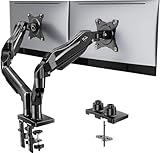
VESA mounting, commonly 100 × 100 mm, lets you use an arm when the supplied stand is too deep or lacks adjustment. Measure the desk’s usable depth and the monitor’s stand footprint. A large display can technically fit while leaving too little space for a keyboard, speakers, and comfortable viewing distance.
Recommended monitor profiles
Best balanced work monitor profile
Choose a 27-inch 1440p IPS monitor with 100–120 Hz, a height-adjustable stand, and at least one DisplayPort and one HDMI input. Add USB-C with 65 W or more if you frequently connect a laptop. This profile usually costs less than a 4K professional display while making everyday scrolling feel noticeably smoother.
Best creative-work profile
Choose a 27- or 32-inch 4K IPS monitor with a wide-gamut mode, factory calibration data, a uniformity-focused design, and hardware calibration support if color-critical work pays your bills. BenQ’s PD2725U is an example of a professional 27-inch 4K display with creator-oriented connectivity and color features. Apple’s 27-inch Studio Display is another 5K option for Mac users who value dense text and integrated hardware, though its 60 Hz refresh rate and limited adjustability on some configurations should be considered.
Best gaming profile
For competitive play, prioritize refresh rate, motion clarity, input latency, and the resolution your graphics card can sustain. A 27-inch 1440p fast IPS display around 165–240 Hz is a versatile choice. For cinematic games, an OLED at 1440p or 4K gives better contrast, but assess static-content habits and warranty coverage before committing.
Ownership details buyers often miss
- Ports and cables: a high-refresh 4K signal may require a suitable DisplayPort or HDMI cable; an old cable can limit the display to a lower mode.
- Cleaning: switch the monitor off, use a clean microfiber cloth, and apply cleaner to the cloth rather than spraying the panel. Avoid abrasive products and household window cleaner.
- Dust and heat: keep ventilation clear, especially on monitors with external power bricks or active cooling.
- OLED maintenance: allow automatic panel-care cycles to run and avoid disabling protective features solely to preserve brightness.
- Built-in speakers: they are convenient for calls and alerts but rarely replace dedicated speakers or headphones.
- Dead-pixel policies: check the manufacturer’s policy before purchase because acceptable pixel defects differ between brands and panel classes.
For most people, the best computer monitors are a 27-inch 1440p IPS display for general work, a 27- or 32-inch 4K IPS model for detailed creative tasks, or a 27-inch 1440p OLED/fast IPS model for gaming. Start with desk space and graphics capability, then choose refresh rate and panel technology; those priorities produce a better fit than selecting by resolution or screen size alone.





Write Your Review
No reviews yet. Be the first to share your experience!