

Key takeaways
- Record the exact model number, not just the brand and bowl size.
- Confirm whether the accessory connects to a front hub, bowl shaft, or proprietary port.
- Check whether it is approved for glass, ceramic, stainless-steel, or coated bowls.
- Verify the permitted mixer speed and maximum batch size.
- Look for replacement blades, cutters, seals, and bowls before purchasing.
Best Stand Mixer Attachments for Every Baking Job
The best stand mixer attachments are the ones that add a job you will repeat, fit your exact mixer model, and replace a separate appliance without creating difficult cleanup or storage problems. For most home bakers, a pasta roller, food grinder, flex-edge beater, or precise scale attachment is more useful than buying every accessory in a matching range.
Quick picks by baking situation
| Your situation | Best attachment type | Why it earns the space | Check before buying |
|---|---|---|---|
| You make bread weekly | Dough hook or replacement dough tool | Improves kneading consistency and keeps hands free | Hook shape, bowl size, and mixer-specific fit |
| You bake cakes and frostings often | Flex-edge beater | Reduces scraping for batters, buttercream, and cream cheese mixtures | Whether the silicone edge is approved for your bowl |
| You want fresh pasta occasionally | Roller and cutter set | Uses the mixer motor instead of another countertop machine | Hub compatibility and storage for long rollers |
| You process meat or vegetables in batches | Metal food grinder | More durable for repeated grinding than lightweight plastic housings | Cold handling, plate sizes, and cleaning instructions |
| You have little cabinet space | Digital scale or compact slicer/shredder | Provides a specific function without a large stand-alone appliance | Whether it fits in a drawer or must remain assembled |
What each attachment actually does
Flex-edge beater: the practical upgrade for cake baking
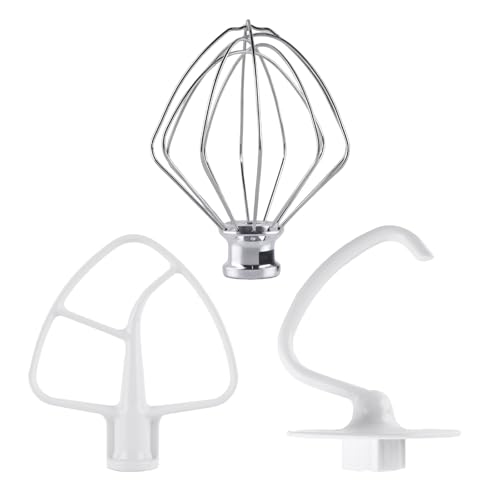
A flex-edge beater has a silicone or rubber scraper along one or more sides. As it rotates, the edge contacts the bowl and gathers butter, sugar, batter, or frosting that a conventional flat beater leaves behind. It is particularly useful for buttercream, cookie dough, mashed ingredients, and small batches.
Our top picks


As an Amazon Associate we earn from qualifying purchases at no extra cost to you. Ratings are shown as listed on Amazon.
It does not replace a whisk or dough hook. The scraper edge may also increase friction, so use the mixer’s normal low or medium settings rather than treating it like a high-speed whisk. Inspect the edge when it becomes loose, cracked, or permanently stained. A damaged edge can detach during mixing.
Wire whisk: best for air, not heavy mixtures
A wire whisk incorporates air into egg whites, whipped cream, meringue, and light sponge mixtures. Choose one with stainless-steel wires if you frequently wash it by hand or want better resistance to corrosion. Some mixer manufacturers advise hand-washing whisk assemblies because moisture can remain inside the hub; follow the instructions for your model.
Do not use a whisk for dense dough, cold butter, or mixtures containing hard inclusions. Bent wires reduce performance and can scratch some coated bowls.
Dough hook: useful when the bowl and recipe match
A dough hook handles yeast dough more efficiently than a flat beater, but attachment choice is only part of the result. A small batch may fail to contact the hook, while an oversized batch can overload the motor. Follow your mixer’s stated flour capacity rather than assuming that a larger bowl means unlimited dough.
Coated hooks are usually easier to find at a lower price, while stainless-steel hooks generally tolerate repeated use and careful cleaning better. Neither type makes an overloaded mixer safe. If the head walks, the motor sounds strained, or the dough climbs into the hub, stop and reduce the batch.
Pasta roller and cutters: high value if you make pasta repeatedly
A roller turns dough into sheets of a consistent thickness; cutters can produce styles such as fettuccine or spaghetti. A three-piece set commonly includes one roller and two cutters, but the precise cutting widths vary by manufacturer. Stainless-steel rollers and cutters usually cost more than painted or coated alternatives and are easier to keep smooth over time.
Many pasta attachments are not dishwasher-safe. Brush away dried flour after the dough has hardened rather than rinsing flour into the gears. Allow the attachment to dry fully before storing it. A roller needs more cabinet length than its weight suggests, so measure the shelf or drawer rather than relying on the product’s compact appearance.
Food grinder: a serious tool with more cleanup
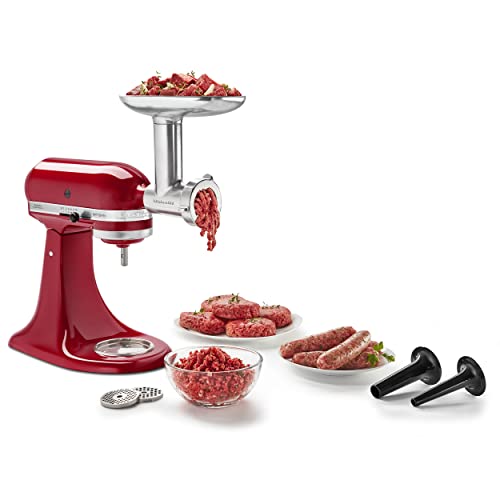
A grinder can process meat, vegetables, breadcrumbs, and some prepared doughs, depending on the model. Metal grinding plates and a metal body generally suit frequent batch work better than plastic components, though the feed tray and pusher may still be plastic.
Keep meat very cold, cut it into pieces that fit the feed tube, and never push food with fingers. Wash removable food-contact parts promptly. Dry plates completely before storage; moisture left on carbon-steel components can cause rust. If you only grind a few times per year, a compact stand-alone grinder may be easier to clean and store than a mixer attachment.
Slicer and shredder: convenient, but not always a space saver
A rotary slicer/shredder attachment can prepare cheese, vegetables, and some fruits quickly. It is useful for large batches of pizza toppings, slaw, or grated vegetables. The relevant comparison is not just motor power: examine the number of drums, the diameter of the feed tube, and whether the drums can be safely cleaned without trapping food.
For occasional single-carrot jobs, a box grater is faster to retrieve and wash. Choose the attachment when batch volume or repetitive prep is the problem.
Digital scale: small attachment, large effect on consistency
A scale that integrates with a mixer or sits beside it can improve baking more than a decorative accessory. Weighing flour, sugar, and water reduces measuring variation, especially for bread. Look for at least 1-gram increments, a capacity around 5 kilograms, and a tare function. A scale does not need to attach mechanically to the mixer to be useful, so compare its footprint with the price of a mixer-specific version.
Compatibility: the detail that prevents an expensive mistake
Attachments are not universally interchangeable. KitchenAid’s front power hub accepts many KitchenAid-branded hub accessories, but bowl-lift and tilt-head mixers can require different beaters, hooks, and bowl clearances. Kenwood, Ankarsrum, Bosch, and other manufacturers use their own connection systems or model-specific adapters. Even two mixers from the same brand may have different bowl capacities, head geometry, or attachment clearances.
- Record the exact model number, not just the brand and bowl size.
- Confirm whether the accessory connects to a front hub, bowl shaft, or proprietary port.
- Check whether it is approved for glass, ceramic, stainless-steel, or coated bowls.
- Verify the permitted mixer speed and maximum batch size.
- Look for replacement blades, cutters, seals, and bowls before purchasing.
For KitchenAid owners, a common distinction is between attachments that use the universal front hub and tools that replace the beater on the lower shaft. A front-hub pasta roller may fit several KitchenAid mixers, while a beater designed for a 5-quart tilt-head bowl may not clear a 6-quart bowl-lift model. Treat “fits KitchenAid” as incomplete information until the model list is visible.
Materials, cleanup, and storage compared
| Attachment | Common materials | Typical cleanup time* | Storage footprint to plan for | First likely wear point |
|---|---|---|---|---|
| Flex-edge beater | Aluminum body, silicone edge | 2–5 minutes | About 18–25 cm long | Scraper edge or coating |
| Whisk | Stainless steel wires, metal hub | 3–6 minutes | About 15–22 cm long | Bent wires or hub corrosion |
| Pasta set | Stainless steel or coated metal | 5–10 minutes | Three pieces, commonly 20–35 cm long | Cutter edges or drive gears |
| Food grinder | Plastic or aluminum body; steel plates | 10–20 minutes | Several parts, commonly 20–30 cm long | Plates, blade, and retaining ring |
| Slicer/shredder | Plastic housing; stainless-steel drums | 5–12 minutes | Housing plus 3–5 drums | Drum cutting surfaces |
*Approximate active cleanup time for a normal home batch; dried dough, grease, and dishwasher restrictions can make it longer.
Dishwasher-safe does not automatically mean dishwasher-friendly. High heat can dull finishes, deform plastic, or accelerate corrosion around seams. For any attachment with gears, bearings, or a sealed hub, wipe the housing with a damp cloth and wash only the removable food-contact parts. Never immerse a powered connector.
How to avoid redundant purchases
Write down the jobs you perform over a typical month and mark whether each job is limited by speed, consistency, or cleanup. If you make one pizza and shred one carrot per week, a slicer attachment may not solve a meaningful problem. If you make four loaves, two batches of cookies, and a large cake every week, a flex-edge beater and reliable scale are more likely to earn their cabinet space.
A simple cost-per-use check helps. Suppose a $100 attachment is used twice a month for three years: 2 uses × 36 months = 72 uses, or about $1.39 per use before consumables. Used twice a year, it costs about $16.67 per use over the same period. This calculation does not prove that the cheaper option is better, but it exposes accessories bought for an imagined baking habit.
Best buying order for most home bakers
- Buy the correct replacement beater, hook, or whisk first if an existing tool is damaged or poorly matched to your bowl.
- Add a scale if inconsistent flour or liquid measurements cause failed recipes.
- Choose a flex-edge beater for frequent cakes, cookies, and frostings.
- Choose pasta tools or a grinder only when you will use them often enough to justify their cleanup and storage.
- Buy a specialty slicer or juicer last, after checking whether a simpler hand tool already covers the job.
Ownership mistakes to avoid
- Running a metal accessory against a coated bowl when the manufacturer prohibits it.
- Using high speed with a heavy dough or a loaded grinder.
- Submerging an attachment’s drive housing to remove flour or grease.
- Putting pasta rollers or grinder plates away while damp.
- Storing sharp cutters loose in a drawer where they can damage hands or other tools.
- Assuming an accessory’s stated capacity is the same as the mixer’s safe capacity.
The best stand mixer attachments are therefore situation-specific: pick a durable, compatible tool for a repeated task, measure its storage requirements, and account for cleaning before comparing prices. A small accessory that replaces a weekly nuisance is a better purchase than a complete collection used once a year.





Write Your Review
No reviews yet. Be the first to share your experience!