

Key takeaways
- Compare the best VoIP desk phones for office desks, with SIP account counts, color screens, Gigabit PoE, Bluetooth and headset support for every team.
A VoIP desk phone runs voice calls over the office network instead of a traditional phone line, and it registers directly with a hosted VoIP service or an on-site PBX. That gives every desk a dedicated handset with its own extension, line keys for shared lines, and call handling features such as transfer, hold, and conferencing that a softphone on a laptop handles less gracefully during a busy day.
The five phones below cover the range most offices need, from a simple four-line phone for a small team to a twelve-line model with dozens of programmable keys for a front desk. They differ in SIP account count, screen size, programmable keys, wireless options, and expansion support, and they sit at budget, mid-range, and premium tiers. Each one is described here from its published specifications only.
As an Amazon Associate, we earn from qualifying purchases.
Quick answer
For most small offices, the Grandstream GXP2135 is the balanced pick, with eight lines, a color screen, and 32 programmable keys. The Poly VVX 250 suits teams that want a simple four-line phone with strong noise reduction. Busy front desks should look at the Fanvil X6U or the Grandstream GXP2170, while the Snom D785 adds a second key display.
Table of contents
- Quick answer
- Grandstream GXP2135
- Poly VVX 250
- Fanvil X6U
- Snom D785
- Grandstream GXP2170
- How to choose
- Who should skip
- FAQ
- Final verdict
- Product and ASIN Reference
Grandstream GXP2135

The GXP2135 is the mid-range workhorse of the Grandstream GXP series. It handles eight lines across four SIP accounts, and its 32 on-screen BLF and speed-dial keys let a user watch the status of colleagues and reach frequent contacts with one press. The 2.8-inch color display is smaller than the screens on the premium picks here, but it shows caller information and key labels clearly.
Specs
- :
- Lines and accounts: 8 lines, 4 SIP accounts
- Display: 2.8-inch 320 x 240 color LCD
- Programmable keys: 32 digital BLF and speed-dial keys
- Network: dual-port Gigabit Ethernet with integrated PoE
- Wireless: built-in Bluetooth for headsets
- Conferencing: 4-way voice conferencing
- Audio: HD handset and speakerphone with wideband audio
Dual Gigabit ports let a desktop computer share the phone connection, and integrated PoE means one network cable carries both data and power where the switch supports it. Built-in Bluetooth pairs with wireless headsets for users who move around the desk during calls.
Poly VVX 250

The VVX 250 is the simplest phone in this roundup, built for desks that handle a modest call volume on up to four lines. Its 2.8-inch color screen covers caller ID and basic call control, and Poly HDvoice with Acoustic Fence technology works to keep the caller’s voice clear while reducing surrounding office noise on the line.
Specs
- :
- Lines: 4 line keys
- Display: 2.8-inch 320 x 240 color LCD
- Network: two Gigabit Ethernet ports
- USB: 1 USB port for accessories and call recording
- Audio: Poly HDvoice and Poly Acoustic Fence technology
- Power: Power over Ethernet support
- Platform: open SIP, integrates with a wide range of call control platforms
Because it follows open SIP, the VVX 250 registers with a long list of hosted VoIP providers and PBX systems, which makes it an easy fit when an office is changing services. The USB port adds flexibility for accessories, and the compact footprint suits shared desks, retail counters, and small team rooms where a large phone would crowd the workspace.
Fanvil X6U

The X6U is built for reception desks and heavy call handlers. It supports 20 SIP lines, and alongside the 4.3-inch main color screen it carries two 2.4-inch side color screens dedicated to DSS keys. Across those screens it offers 60 DSS keys, so a receptionist can hold a large directory of extensions, shared lines, and speed dials without paging through menus.
Specs
- :
- Lines: 20 SIP lines
- Displays: 4.3-inch 480 x 272 main color screen, two 2.4-inch 320 x 240 side color screens
- Programmable keys: 60 DSS keys
- Audio: HD audio with G.722 and Opus codecs
- Wireless: built-in Bluetooth 4.2, Wi-Fi via dongle
- Network: dual Gigabit Ethernet ports with integrated PoE
- Conferencing: 6-way audio conference
The side screens label themselves on the display, so key assignments stay readable when the directory changes. EHS support allows wireless headsets with electronic hook switch control, and the dual Gigabit ports with PoE keep cabling to a single drop per desk. For a front desk that fields calls for the whole office, this is the most capable layout in the group.
Snom D785
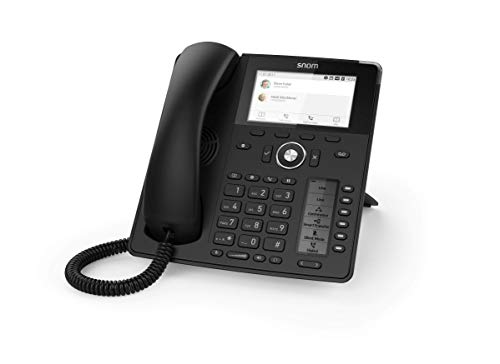
The D785 takes a different approach to programmable keys. Its main 4.3-inch color display handles calls and menus, while a second, dedicated display labels six self-labelling keys with multicolour LEDs. Those six keys page through four sets of assignments, giving up to 24 functions such as line monitoring, speed dial, and call pickup, and the labels update on screen whenever an assignment changes.
Specs
- :
- Accounts: 12 SIP identities or accounts
- Displays: 4.3-inch 480 x 272 color main display, 2.8-inch monochrome key display
- Programmable keys: 6 self-labelling keys, up to 24 functions
- Wireless: built-in Bluetooth for headsets
- Network: 2-port Gigabit Ethernet switch with PoE, IEEE 802.3af
- USB: USB 2.0 port, supports D7 expansion modules
- Audio: HD audio with G.722 and Opus codecs
The D785 supports up to three D7 expansion modules through its USB port for desks that outgrow 24 functions. Security features include TLS and SRTP support, and provisioning runs through standard auto-provisioning methods used by hosted providers. It is a strong fit for office professionals who want a large key capacity in a tidier body than a full sidecar phone.
Grandstream GXP2170

The GXP2170 tops the Grandstream GXP line in this roundup. It covers twelve lines and six SIP accounts, with 48 on-screen digital BLF and speed-dial keys spread across pages on its 4.3-inch color display. That key count suits supervisors, dispatchers, and front desks that monitor many extensions at once.
Specs
- :
- Lines and accounts: 12 lines, 6 SIP accounts
- Display: 4.3-inch 480 x 272 color LCD
- Programmable keys: 48 digital BLF and speed-dial keys
- Network: dual-port Gigabit Ethernet with integrated PoE
- Wireless: built-in Bluetooth for headsets
- Conferencing: 5-way voice conferencing
- Expansion: supports up to four GXP2200EXT extension modules
With four extension modules attached, the BLF capacity grows far beyond the built-in keys, which makes the GXP2170 the natural choice for a central answering position. Five-way conferencing is built in, and like the GXP2135 it uses a single PoE cable for power and data. Buyers choosing between the two Grandstream models are mainly choosing key capacity and screen size.
How to choose
Begin with line and account counts. A phone needs one SIP account for each service or extension it registers, and enough line keys for the calls a user juggles at once. A four-line phone is plenty for a back-office desk, while reception roles benefit from the larger key fields on the Fanvil X6U and Grandstream GXP2170.
Next, check the network. Every phone here offers Gigabit Ethernet pass-through, so a computer can share one wall drop with the phone, and PoE support removes the need for a power adapter at each desk when the switch supplies power. Confirm that your VoIP provider or PBX supports the phone model before ordering in volume, since provisioning templates vary by platform.
Then weigh the daily details. A second key display, as on the Snom D785, keeps busy lamp fields readable without a bolt-on module. Built-in Bluetooth matters for users who wear wireless headsets all day, while EHS or USB headset support covers wired and dongle-based headsets. Finally, match the tier to the role: budget models for shared spaces, mid-range phones for most staff desks, and premium key-heavy models for the desks that answer for everyone.
Who should skip
Skip a desk phone entirely if your team already works well on softphone apps with good headsets, since a handset adds hardware to manage without adding call features you will use. Cordless DECT handsets suit warehouses and large floor plans better than any phone here, and staff who work from several locations will get more from a provider’s mobile and desktop apps. Also skip these picks if your phone service uses a proprietary system that only accepts its own handsets, because open SIP phones cannot register on closed platforms.
FAQ
Do VoIP desk phones need a special phone service?
Yes. Each phone registers with a hosted VoIP provider or an on-site IP PBX over your network, and that service supplies the phone number, calling plan, and call routing. The phones in this roundup follow open SIP, so they work with a wide range of providers, but confirm model support with your provider before buying.
What does PoE mean on a desk phone?
PoE, or Power over Ethernet, lets the phone draw power through the same network cable that carries its data. With a PoE switch, each desk needs only one cable and no wall adapter. Every phone in this roundup supports PoE, and each can also run from an optional power adapter where PoE is unavailable.
How many SIP accounts does an office phone need?
Most staff desks need only one account for their own extension. Extra accounts help when a phone also registers a shared line, a second service, or a separate number for a department. The picks here range from four accounts on the Grandstream GXP2135 to twenty lines on the Fanvil X6U, so match the count to the role rather than the headcount.
Can these phones work with a wireless headset?
Yes, in most cases. The Grandstream models, the Fanvil X6U, and the Snom D785 include built-in Bluetooth for wireless headsets. Phones without built-in Bluetooth can still pair with headsets through USB dongles or EHS adapters, and every model here also accepts a corded headset through its headset port.
Final verdict
For a standard office rollout, the Grandstream GXP2135 balances lines, keys, and screen at a mid-range tier. The Poly VVX 250 is the pick for simple desks on open SIP platforms, the Fanvil X6U and Grandstream GXP2170 serve front desks that live on their key fields, and the Snom D785 offers the neatest self-labelling key layout. Match the phone to the role, confirm provider support, and any of the five will anchor a dependable office phone setup.
Product and ASIN Reference
| Name | ASIN |
|---|---|
| Grandstream GXP2135 | B01BUIWA08 |
| Poly VVX 250 | B07HBYZVC8 |
| Fanvil X6U | B084CXJCLS |
| Snom D785 | B07BRRCKJ3 |
| Grandstream GXP2170 | B019X06IFS |
More from Amazon
Programs that pair well with the guide above. Offers and eligibility are set by Amazon and may change.
Free shipping on eligible items, Prime Video and more. Eligible new members can start with a free trial.
Start a Prime free trialAudiobooks and podcasts to listen to on the go. Eligible new members can start with a free trial.
Try Audible freeAd-free music streaming. Eligible new subscribers can start with a free trial.
Try Music Unlimited freeA free business account with business pricing and bulk-buying tools for work, shop or home office.
Create a business accountAs an Amazon Associate we earn from qualifying purchases.



Write Your Review
No reviews yet. Be the first to share your experience!