

Key takeaways
- Five voice recorders compared on storage, formats, battery life, microphones and voice activation, from a budget mono pick to a 32-bit float Zoom.
A dedicated voice recorder still earns its place in a home office. It captures a meeting, lecture or interview without tying up your phone, it keeps recording when a call comes in, and it hands you a clean file you can file away the same day. The five models below cover the main shapes of the category: slim dictation recorders from Sony, a high-capacity budget unit from EVISTR, and a stereo handheld from Zoom that doubles as a USB microphone.
The differences that matter are practical ones. Built-in memory ranges from 4 GB to 128 GB, battery strategies split between AAA cells and built-in rechargeable packs, and microphone layouts run from a single mono capsule to a stereo pair. Every figure in this guide comes from the maker’s own published specifications, and each pick is a current amazon.com listing.
As an Amazon Associate, we earn from qualifying purchases.
Quick answer
For most home office users, the Sony ICD-UX570 is the pick: stereo recording in LPCM or MP3, a built-in USB connector, a rechargeable battery and up to 159 hours of recording time on its 4 GB of memory. The Sony ICD-PX470 runs far longer per set of AAA batteries, the EVISTR L357 holds the most audio, and the Zoom H1essential suits music and video work.
The 5 best digital voice recorders
Sony ICD-UX570 Digital Voice Recorder

Specs
- : Storage: 4 GB built-in (about 3.20 GB usable per Sony) plus a microSD card slot; Formats: LPCM 44.1 kHz/16 bit and MP3 recording; Battery: built-in rechargeable lithium-ion, approximately 22 hours of MP3 recording per Sony, with a 3-minute quick charge adding 1 hour of recording; Microphone: built-in stereo S-Microphone with Focus and Wide modes; Connectivity: built-in USB connector for transfer and charging, 3.5 mm microphone input and headphone jack; Voice activation: yes, voice-operated recording plus Auto Voice Recording.
The UX570 is Sony’s slim premium dictation recorder, and it is the most complete package here for spoken-word work. Its S-Microphone switches between a Focus mode that narrows in on one voice and a Wide mode that spreads across a meeting table, and the Auto Voice Recording setting trims background noise while it captures. Recording time on the built-in memory reaches 59 hours at MP3 128 kbps and 159 hours at the most economical MP3 setting, per Sony’s own tables.
The built-in USB connector slides out of the body, so file transfer and charging need no cable at all. A three-minute charge buys an hour of recording, which rescues the day a battery runs low before a meeting. This is the premium tier of the group, and the one to pick when the recorder will live in a shirt pocket or laptop bag and get used daily.
Sony ICD-PX470 Stereo Digital Voice Recorder

Specs
- : Storage: 4 GB built-in plus a microSD slot for up to 32 GB of additional memory; Formats: LPCM and MP3 recording; Battery: two AAA batteries, up to 55 hours of recording at MP3 192 kbps per Sony; Microphone: built-in stereo microphones with adjustable microphone settings; Connectivity: built-in USB connector; Voice activation: yes, voice-operated recording and Auto Voice Recording.
The PX470 shares much of the UX570’s recording brain but swaps the rechargeable pack for two AAA cells, and that trade buys remarkable stamina. Sony rates it for up to 55 hours of recording at MP3 192 kbps on the supplied alkaline batteries, which covers a full conference week without a charger in sight. Spare cells are easy to carry, so running dry mid-event is nearly impossible to do.
It records in both LPCM and MP3, holds up to 59 hours and 35 minutes at MP3 128 kbps on its internal memory, and accepts a microSD card when a project needs more room. The built-in USB connector handles transfers. For students and field workers who record for days between desk visits, this mid-range model is the sensible workhorse of the five.
EVISTR L357 128GB Digital Voice Recorder
Specs
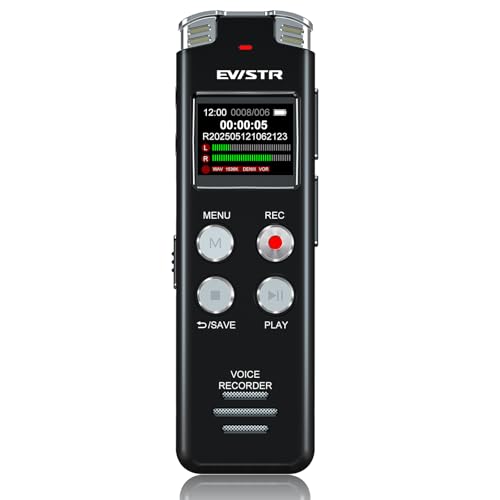
- : Storage: 128 GB built-in; Formats: WAV and MP3, up to 1,536 kbps PCM per EVISTR; Battery: built-in 500 mAh rechargeable battery, up to 32 hours of continuous recording per EVISTR; Microphone: built-in microphone with dynamic noise reduction; Connectivity: USB Type-C for charging and file transfer, line-in recording input; Voice activation: yes, with seven adjustable sensitivity levels.
Storage is the headline here. With 128 GB built in, EVISTR rates the L357 for up to 9,320 hours of recording at its most economical setting, a figure no other pick approaches. The voice-activated mode offers seven sensitivity levels, so the recorder can sit through a long seminar and capture only the parts where someone is speaking, and a scheduled recording mode can fire the unit up at a set time without anyone touching it.
Files move over USB Type-C, playback speed is adjustable for working through long lectures, and a password option guards the recordings on the device. The feature list leans toward students and heavy note takers rather than audio purists. In this group it sits in the mid-range tier, and it is the pick for anyone whose first question is how much a recorder can hold.
Zoom H1essential Stereo Handy Recorder

Specs
- : Storage: no built-in memory; records to microSDHC cards up to 32 GB or microSDXC cards up to 1 TB (card not included per Zoom); Formats: WAV recording in 32-bit float at up to 96 kHz; Battery: two AAA batteries, up to 10 hours per Zoom, or USB bus power; Microphone: built-in X/Y stereo microphone pair rated to 120 dB SPL; Connectivity: USB-C port, doubles as a USB microphone while recording to the card, 3.5 mm mic/line input with plug-in power; Voice activation: auto-record function that begins capture when the input passes a set level.
The H1essential comes from a different tradition than the dictation recorders above. Its 32-bit float recording captures such a wide dynamic range that levels never need setting before a take: quiet speech and sudden loud peaks both survive, and either can be balanced later on a computer. The X/Y stereo microphones handle up to 120 dB SPL, which covers rehearsals and live music that would overwhelm a dictation unit.
It also moonlights as a USB microphone for calls and podcasts while still recording a backup to the card, and its spoken menu guidance makes the controls usable without looking at the screen. Battery life is the compromise, at up to 10 hours per Zoom. This is the premium pick for creators, musicians and anyone recording sound rather than only speech.
Sony ICD-PX370 Mono Digital Voice Recorder

Specs
- : Storage: 4 GB built-in plus a microSD card slot; Formats: MP3 recording; Battery: two AAA batteries, up to 57 hours of recording at MP3 128 kbps per Sony; Microphone: built-in mono microphone; Connectivity: built-in USB connector; Voice activation: yes, voice-operated recording and Auto Voice Recording.
The PX370 is the simplest recorder in this roundup, and that is its appeal. A single mono microphone, MP3-only recording and a plain control layout make it hard to misuse: press record, and the meeting is captured. Sony rates the 4 GB of memory for up to 59 hours and 35 minutes at MP3 128 kbps, and the two AAA batteries for up to 57 hours of recording at that setting.
The built-in USB connector flips out for cable-free transfer to a computer, and the Auto Voice Recording function reduces background noise as it records. There is no LPCM mode and no stereo image, so music and multi-speaker separation are not its strengths. As the budget pick, it suits one-voice work such as dictation, interviews with a single subject and personal notes.
How to choose
Begin with what you record. One voice in a quiet room needs only a mono or basic stereo dictation recorder, while a panel discussion, a classroom or anything musical rewards a true stereo pair and, in the Zoom’s case, 32-bit float headroom. Check the recording formats next: MP3 files are small and easy to share, while LPCM and WAV capture more detail for transcription work or editing.
Storage and battery shape daily use. Built-in memory from 4 GB to 128 GB covers most speech needs, and a microSD slot removes the ceiling entirely on the Sony and Zoom models. AAA-powered recorders such as the PX470 and PX370 run for days and revive instantly with fresh cells, while the rechargeable UX570 and EVISTR trade that flexibility for slimmer bodies and cable-free charging. Voice activation matters for long, sparse sessions: it trims silent stretches automatically, although it can clip the first syllable of a sentence if the sensitivity sits too low.
Finally, look at how files leave the device. Built-in USB connectors on the Sony models need no cable, the EVISTR and Zoom use USB-C, and the Zoom adds a second life as a USB microphone for the computer on your desk.
Who should skip
Skip this category if your phone already handles your recording life and you never record longer than a short call; a separate device would only gather dust. Skip the mono PX370 if you record music, theatre or group discussions where stereo separation matters. Skip the Zoom H1essential if you want a set-and-forget dictation tool, since its strengths serve audio capture rather than plain speech, and skip every model here if your workplace or local rules require certified encryption on recordings, because none of these five publishes such a feature.
FAQ
How long can a digital voice recorder record?
It depends on memory and format. In this group, Sony rates its 4 GB models for up to 159 hours at the most economical MP3 setting, EVISTR rates the 128 GB L357 for up to 9,320 hours at 32 kbps, and the Zoom records to cards up to 1 TB, so its ceiling is set by the card you fit.
What does voice-activated recording do?
The recorder listens and captures only while sound passes a set level, pausing during silence. That saves memory and shortens playback, since long gaps never reach the file. The EVISTR offers seven sensitivity levels, the Sony models include voice-operated recording, and the Zoom offers an auto-record function based on input level.
Can these recorders transfer files to a computer?
Yes. The three Sony models carry a built-in USB connector that plugs straight into a computer, while the EVISTR L357 and Zoom H1essential connect over USB-C. Files move as ordinary MP3 or WAV audio, and the Zoom can also work as a USB microphone while it records to its card.
Which recorder is best for lectures?
For a single lecturer, the Sony ICD-PX470 pairs stereo microphones with up to 55 hours of battery life per Sony, so it survives a full term of classes on few battery changes. The EVISTR L357 suits students who record many courses and want the largest storage, and the Zoom H1essential fits large halls where volume swings widely.
Final verdict
The Sony ICD-UX570 is the most rounded recorder here, with stereo LPCM and MP3 capture, a rechargeable battery and a cable-free USB connector in a slim body. The ICD-PX470 is the endurance pick, the EVISTR L357 the capacity pick, the Zoom H1essential the creator pick, and the ICD-PX370 the simple budget pick. Match the microphone and battery style to your recording habits and any of the five will serve a home office well.
Product and ASIN Reference
| Product | ASIN |
|---|---|
| Sony ICD-UX570 Digital Voice Recorder | B082QL6KLG |
| Sony ICD-PX470 Stereo Digital Voice Recorder | B06XTX2S2N |
| EVISTR L357 128GB Digital Voice Recorder | B0F87QHYGH |
| Zoom H1essential Stereo Handy Recorder | B0CSL4PXDV |
| Sony ICD-PX370 Mono Digital Voice Recorder | B06XFTWCBJ |
More from Amazon
Programs that pair well with the guide above. Offers and eligibility are set by Amazon and may change.
Free shipping on eligible items, Prime Video and more. Eligible new members can start with a free trial.
Start a Prime free trialAudiobooks and podcasts to listen to on the go. Eligible new members can start with a free trial.
Try Audible freeAd-free music streaming. Eligible new subscribers can start with a free trial.
Try Music Unlimited freeA free business account with business pricing and bulk-buying tools for work, shop or home office.
Create a business accountAs an Amazon Associate we earn from qualifying purchases.

Write Your Review
No reviews yet. Be the first to share your experience!