

Key takeaways
- Seat height: Set it so your feet rest flat and your knees are approximately level with, or slightly lower than, your hips. Do not raise the chair until your feet dangle just to reach a tall desk.
- Seat depth: Leave roughly 2–3 inches between the front edge and the backs of your knees. If the seat is too deep, you may slide forward or lose back contact.
- Seat width: Measure your seated hip width and add clearance for normal clothing. The arm supports should not force your elbows inward.
- Lumbar support: Adjust it to support the natural curve of your lower back, not to create a hard pressure point. A height-adjustable pad is usually more useful than a fixed protrusion.
- Armrests: With relaxed shoulders, position the armrests so your forearms can reach the keyboard without lifting your shoulders. Move them low or out of the way when you need to pull close to the desk.
- Recline: Choose a chair with at least two lockable positions and adjustable tension. A chair that reclines freely can reduce static sitting, but it should still keep your screen at a comfortable viewing angle.
The best ergonomic office chairs for long workdays are the Herman Miller Aeron for breathable support, the Steelcase Leap for the widest range of fit adjustments, and the Haworth Fern for flexible back support; smaller budgets should consider a well-adjustable mesh chair with a seat depth of roughly 17–19 inches and a weight rating comfortably above the user’s body weight.
Our top picks

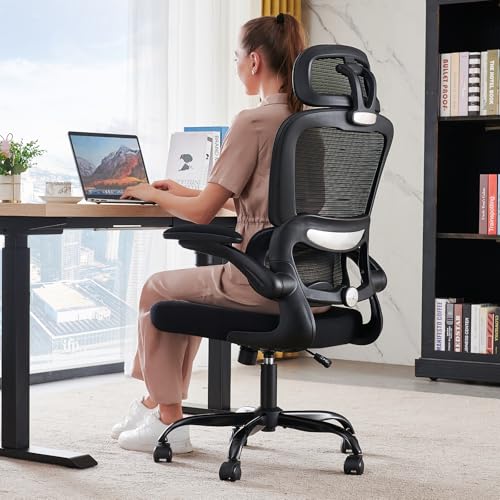


As an Amazon Associate we earn from qualifying purchases at no extra cost to you. Ratings are shown as listed on Amazon.
Quick comparison: the leading ergonomic office chairs
These chairs suit different body shapes and working habits. Dimensions can vary slightly by production year, upholstery, frame, or regional specification, so confirm the current manufacturer’s sheet before ordering.
| Chair | Seat dimensions and height | Lumbar and armrest adjustment | Recline | Materials and weight rating | Assembly and typical price |
|---|---|---|---|---|---|
| Herman Miller Aeron | Three sizes; height about 14.75–22.75 in depending on size | Optional PostureFit SL; arms adjust in height, width, depth, and pivot | Three-position tilt limiter; forward tilt on equipped versions | Pellicle suspension mesh, aluminum/polymer frame; 300–350 lb by size | Usually arrives assembled; roughly $1,400–$2,300 new |
| Steelcase Leap | Seat height about 15.5–20.5 in; width 19.25 in; depth 15.75–18.75 in | Adjustable lumbar height and firmness; 4D arms | Variable back-stop positions with tension adjustment | Fabric or leather upholstery over foam; 400 lb | Usually arrives assembled; roughly $1,000–$2,100 new |
| Haworth Fern | Seat height about 16–21 in; seat depth about 16.5–18.75 in | Optional adjustable lumbar; 4D arms on higher configurations | Multiple tilt-lock positions with tension control | Upholstered back and seat, plastic/aluminum base; 400 lb | Some delivery assembly; roughly $900–$1,900 new |
| Adjustable mid-range mesh chair | Commonly 17–20 in height; 18–20 in seat width and depth | Look for height-adjustable lumbar and 3D or 4D arms | Typically 2–4 lockable positions or free-floating tilt | Mesh back, molded foam seat, nylon or metal base; often 275–350 lb | Usually 20–45 minutes of assembly; roughly $250–$700 |
Best picks by situation
Best for mixed body sizes: Steelcase Leap
The Leap is the safest general recommendation when more than one person may use the chair or when you are unsure which ergonomic design will suit you. Its seat depth slides forward and backward, the lumbar support can be raised or lowered, and the back changes shape as you recline rather than forcing one fixed posture. The four-dimensional arms can move vertically, sideways, forward and backward, and inward or outward in angle.
Its upholstered seat is less ventilated than mesh, but many people prefer the more even pressure distribution of foam for extended sitting. The broad height range and 400-pound rating also make it a stronger choice for taller or larger users than chairs with a narrow fixed seat pan. Select the headrest only if you regularly recline; it can interfere with an upright working posture when positioned poorly.
Best for heat and constant computer use: Herman Miller Aeron
The Aeron’s suspension mesh is its defining advantage. It allows airflow through the seat and back, avoids the pronounced front edge found on some padded seats, and comes in three sizes rather than one supposedly universal frame. Size A generally fits smaller users, B covers the broadest middle range, and C provides more room for larger or taller users.
The Aeron is not the best match for everyone. The seat depth is not continuously adjustable, the frame can feel restrictive if your proportions fall between sizes, and the firm suspension seat does not feel like a soft lounge chair. Measure your hip width, thigh length, and preferred seat height before choosing a size. Its lumbar system is useful, but it offers less fine-grained seat adjustment than the Leap.
Best for an active, upright-to-reclined posture: Haworth Fern
The Fern uses a flexible back structure intended to support movement across the upper and lower back. It is appealing if you alternate between typing upright, reading, video calls, and reclining rather than holding one rigid position. Its seat-depth range is more accommodating than a fixed-depth chair, and configurations with 4D arms provide useful support for keyboard and mouse work.
Check the exact configuration carefully. Adjustable lumbar, upgraded arms, headrests, and different upholstery can change both the fit and the price. The Fern’s padded design is comfortable in cooler rooms, but a full mesh chair is usually preferable if you work hot or live in a humid climate.
Best value: a mid-range mesh chair with real adjustment
At roughly $250–$700, a good mid-range chair can deliver the essentials: adjustable seat height, seat depth, lumbar height, arm height, tilt tension, and a stable five-star base. Avoid judging value by the number of decorative features. A headrest, footrest, or massage attachment cannot compensate for a seat that is too deep or armrests that prevent you from approaching the desk.
Prioritize a return window, replacement parts, a documented weight rating, and a warranty that covers the mechanism rather than only the frame. Some inexpensive chairs list “adjustable lumbar” when the entire back moves, offering little independent lower-back control.
How to choose the correct fit
- Seat height: Set it so your feet rest flat and your knees are approximately level with, or slightly lower than, your hips. Do not raise the chair until your feet dangle just to reach a tall desk.
- Seat depth: Leave roughly 2–3 inches between the front edge and the backs of your knees. If the seat is too deep, you may slide forward or lose back contact.
- Seat width: Measure your seated hip width and add clearance for normal clothing. The arm supports should not force your elbows inward.
- Lumbar support: Adjust it to support the natural curve of your lower back, not to create a hard pressure point. A height-adjustable pad is usually more useful than a fixed protrusion.
- Armrests: With relaxed shoulders, position the armrests so your forearms can reach the keyboard without lifting your shoulders. Move them low or out of the way when you need to pull close to the desk.
- Recline: Choose a chair with at least two lockable positions and adjustable tension. A chair that reclines freely can reduce static sitting, but it should still keep your screen at a comfortable viewing angle.
A simple fit calculation helps prevent a common mistake. If your seated thigh length is 19 inches, a seat depth of 18 inches may leave about 1 inch of clearance once you sit fully back, while a 20-inch fixed seat may be too deep. The exact result depends on cushion shape and posture, so use measurements to narrow the choices rather than treating them as a guarantee.
Materials, durability, and ownership costs
Mesh is cool and easy to wipe, but it can stretch, collect dust, or develop pressure marks after years of use. Upholstered foam feels warmer and can be more comfortable for long sessions, though the fabric absorbs spills and the front edge may compress first. Leather and leather-like coverings clean easily but can become hot and may show peeling or cracking on lower-quality surfaces.
The parts most likely to wear are casters, arm pads, seat foam, tilt mechanisms, and upholstery—not the metal base. Keep the mechanism free of dust, tighten accessible bolts periodically, and use a soft vacuum brush or manufacturer-approved cleaner. Do not saturate mesh or spray lubricant onto a gas lift or tilt mechanism unless the manufacturer specifically permits it.
Consider ownership cost rather than only purchase price. A $1,200 chair used five days a week for five years provides about 1,300 workdays, or approximately $0.92 per workday before maintenance. A $400 chair lasting two years at the same schedule costs about $0.77 per workday. The cheaper chair is only the better value if it remains comfortable, adjustable, and serviceable for that period.
Assembly and workspace fit
Premium office chairs often arrive fully assembled or need only the back and base attached. Budget models commonly require 20–45 minutes and a second person can make installation easier. Before buying, measure the doorway, stairwell, and space beneath your desk. A chair can fit at the desk yet fail to slide under it because of fixed armrests or a tall back.
For hard floors, choose suitable casters or a chair mat. For a compact office, prioritize a narrow base, arms that lower below the desktop, and a recline mechanism that does not require substantial clearance behind the chair. Leave enough room to recline without striking a wall.
Bottom line
Choose the Steelcase Leap when adjustability and broad fit matter most, the Herman Miller Aeron when breathability and size-specific support are priorities, and the Haworth Fern when you want a flexible back for frequent posture changes. A mid-range mesh chair is the sensible budget choice when it offers genuine seat-depth, lumbar, armrest, and tilt adjustment. In every price category, correct dimensions and a usable return policy matter more than a long feature list.


Write Your Review
No reviews yet. Be the first to share your experience!