

The best sublimation printers for most home businesses are the Epson SureColor F170 for small-format affordability, the Sawgrass SG500 for guided setup and support, and the Epson SureColor F570 for larger, higher-volume work.
Our top picks
 Epson SureColor F170 Dye-Sublimation Printer
- Confidence - Epson authorized partner
- Genuine Epson Ink Included - Comes with a…
- Astounding Print Quality - Epson's Surecolor F170 Sublimation…
 Epson EcoTank ET-4800 Wireless Color All-in-One Supertank
- Innovative Cartridge-Free Printing ― High-capacity ink tanks mean…
- Impressive Print Quality ― Unique Micro Piezo Heat-Free…
- Zero Cartridge Waste
 Brother SP-1 Sublimation Printer Starter Bundle with
- Brother SP-1 Dye-Sublimation Printer with full set of…
- Full Set of Sublimation Inks - Black, Cyan,…
- 150 Sheets of ProSub 8.5" x 11" Sublimation…
| Product | Key specs | |
|---|---|---|
| Epson SureColor F170 Dye-Sublimation Printer | Confidence - Epson authorized partner Genuine Epson Ink Included - Comes with a… Astounding Print Quality - Epson's Surecolor F170 Sublimation… | Check price |
| Epson EcoTank ET-4800 Wireless Color All-in-One Supertank | Innovative Cartridge-Free Printing ― High-capacity ink tanks mean… Impressive Print Quality ― Unique Micro Piezo Heat-Free… Zero Cartridge Waste | Check price |
| Brother SP-1 Sublimation Printer Starter Bundle with | Brother SP-1 Dye-Sublimation Printer with full set of… Full Set of Sublimation Inks - Black, Cyan,… 150 Sheets of ProSub 8.5" x 11" Sublimation… | Check price |
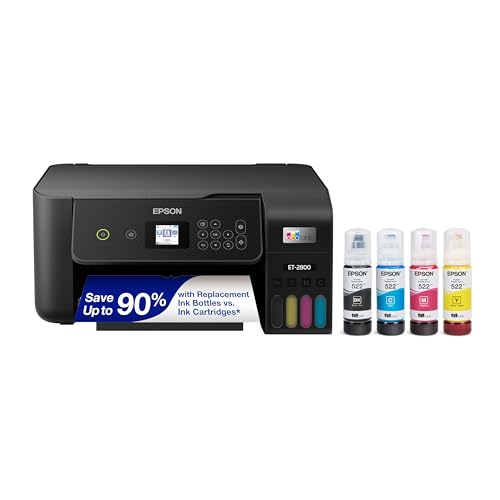 Epson EcoTank ET-2800 Wireless Color All-in-One Supertank Epson EcoTank ET-2800 Wireless Color All-in-One Supertank | No more dealing with lots of tiny ink… Replacement ink bottles don't have to be changed… Up to 2 years of ink in the… | Check price |
As an Amazon Associate we earn from qualifying purchases at no extra cost to you.
Best sublimation printers at a glance
| Printer | Best for | Maximum print size | Resolution | Approx. weight | Typical market price |
|---|---|---|---|---|---|
| Epson SureColor F170 | Beginners, home offices, small products | 8.5 × 14 inches | Up to 4,800 × 1,200 dpi | About 10 lb | $400–$500 |
| Sawgrass SG500 | Easy setup and supported hobby businesses | 8.5 × 14 inches | Up to 4,800 × 1,200 dpi | About 30 lb | $600–$800 |
| Brother SP-1 | New users wanting a compact desktop unit | 8.5 × 14 inches | Up to 1,200 × 1,200 dpi | About 20 lb | $400–$500 |
| Sawgrass SG1000 | Larger shirts, signs, and business production | 11 × 17 inches; up to 13 × 19 with tray | Up to 4,800 × 1,200 dpi | About 35 lb | $1,200–$1,600 |
| Epson SureColor F570 | Frequent production and wide-format transfers | 24 inches wide | Up to 2,400 × 1,200 dpi | About 50 lb | $2,500–$3,000 |
Specifications and prices can vary by bundle, region, and included accessories. Resolution is only one part of image quality: color management, paper, ink, heat-press settings, and the blank product have just as much influence on the finished transfer.
Our picks by situation
| Your situation | Best match | Why | Main compromise |
|---|---|---|---|
| Budget under about $500 | Epson SureColor F170 or Brother SP-1 | Both offer desktop-size printing without the cost of a wide-format machine. | Limited to roughly 8.5-inch-wide transfers. |
| First sublimation printer | Brother SP-1 | Designed as a dedicated starter printer with a relatively simple workflow. | Fewer large-format options than the SG1000 or F570. |
| Small apparel business | Sawgrass SG500 | Useful software, established support, and consistent small-format output. | Ink and accessories can cost more than open-market alternatives. |
| Full-front shirts or larger panels | Sawgrass SG1000 | The optional bypass tray supports larger 13 × 19-inch media. | Higher purchase and ink costs; it still is not a 24-inch printer. |
| Many orders each week | Epson SureColor F570 | Roll and sheet media support, wider output, and a larger ink capacity. | Requires more workspace, ventilation planning, and upfront investment. |
Epson SureColor F170: best value for small custom projects
The F170 is a strong choice for mugs, tumblers, ornaments, small signs, mouse pads, and infant or youth apparel. Its 8.5-inch maximum width fits most desktop heat-press workflows, while its relatively light body is easier to place on a sturdy desk than larger production printers.
It uses Epson UltraChrome DS dye-sublimation ink and is sold as a purpose-built sublimation printer rather than a conventional inkjet converted by the owner. That matters because the ink delivery system, color profiles, and warranty are intended for sublimation use.
The main limitation is scale. An 8.5-inch-wide print is often too narrow for a large adult shirt design unless the artwork is intentionally compact. The F170 also uses small ink bottles, so frequent production can make replacement intervals feel short. It is best for occasional orders and product lines built around smaller blanks.
Sawgrass SG500: easiest supported workflow
The SG500 appeals to users who value an organized setup more than the lowest possible running cost. Sawgrass provides dedicated design and print software, color-management tools, documentation, and support built around its own sublimation inks.
Its 8.5 × 14-inch maximum standard format is similar to the F170, but the printer is substantially heavier and more expensive. The advantage is a polished ecosystem: software prompts, product profiles, and troubleshooting resources can reduce the learning curve for someone who has never managed ICC profiles or sublimation color correction.
Choose the SG500 if downtime and experimentation are more expensive to you than higher ink prices. If you already understand image preparation and are comfortable maintaining a printer independently, the F170 may deliver a better cost-to-output ratio.
Brother SP-1: a sensible beginner alternative
The Brother SP-1 is a compact-format dye-sublimation printer aimed at home users and small creative businesses. Its 8.5 × 14-inch media capability covers many standard transfer jobs, and the dedicated design reduces the risks associated with converting a regular inkjet printer.
It is worth considering when simple operation and a familiar consumer-electronics buying experience matter. Before purchasing, check the current ink-bundle terms and supported media sizes in your country. Sublimation systems are not interchangeable: using another brand’s ink or an unsuitable refill can cause color errors, clogging, and warranty problems.
Sawgrass SG1000 versus Epson F570
These machines address different meanings of “large.” The SG1000 is still a desktop printer, but its optional tray expands output to 13 × 19 inches. That is useful for larger shirt graphics, signage, and panels while retaining a relatively manageable footprint.
The F570 is a genuine step toward production work. Its 24-inch width supports much larger transfers and roll media, making it more suitable for banners, oversized apparel layouts, fabric panels, and repeated orders. It costs more and needs a dedicated workstation, but it avoids stitching together multiple narrow prints.
For occasional large jobs, the SG1000 is usually easier to justify. For regular wide-format orders, the F570 can reduce layout compromises and handling time. Do not buy either one solely for a higher dpi number: the practical benefit is the larger printable area and workflow capacity.
Ink costs and a worked example
Sublimation ink is generally cheaper per print than ink for many specialized photo printers, but the actual cost depends heavily on coverage. A lightly covered mug transfer may use far less ink than a full-coverage dark graphic.
Suppose a replacement ink set costs $120 and is estimated to produce 250 medium-coverage 8.5 × 11-inch transfers. The ink cost is:
$120 ÷ 250 = $0.48 per transfer
If paper costs $0.20 per sheet and you allow $0.07 for occasional nozzle checks and cleaning materials, the consumable total becomes approximately $0.75 per transfer. This excludes the blank item, heat-press electricity, packaging, failed transfers, design labor, and shipping.
Printer ecosystems with subscription or bundled ink programs may have a higher purchase price but more predictable operating costs. Compare the estimated cost per usable transfer, not the bottle price alone.
Transfer compatibility: the detail that prevents expensive mistakes
- Blank material: Sublimation bonds best to white or light-colored polyester fabric and polymer-coated hard goods. It does not produce opaque white ink.
- Paper: Use paper made for dye sublimation. Ordinary copy paper can produce weak color, excess moisture, or poor release.
- Mirror setting: Mirror the artwork before printing when the transfer process requires it, especially for text and logos.
- Heat press: A flat heat press is useful for apparel and flat blanks; a mug press or suitable attachment is needed for curved drinkware.
- Size: Check both printer width and the heat press platen. A printer may create a 13 × 19-inch sheet that your press cannot heat evenly.
Printers do not usually determine whether a blank is compatible; the coating and polyester content do. Always follow the blank manufacturer’s temperature, pressure, and dwell-time guidance, then refine settings with a test piece.
Setup and maintenance that affect ownership
Initial setup
- Place the printer level, away from direct sunlight, dust, and large temperature swings.
- Install only the manufacturer-approved sublimation ink for that model.
- Install the current driver and color-management software.
- Print a nozzle check before a large design.
- Make a small test transfer before producing a customer order.
Color can look dull on paper and become much more vivid after pressing. Judge the transfer on the intended blank, not only on the computer monitor or unpressed sheet.
Routine maintenance
- Print periodically if the machine allows it; long idle periods can increase the chance of nozzle issues.
- Run a nozzle check before important batches.
- Use the printer’s cleaning cycle sparingly because it consumes ink.
- Keep paper sealed until use and store it flat where humidity is controlled.
- Wipe dust from the exterior and keep transfer paper away from the paper path.
- Replace waste-ink or maintenance components when prompted rather than repeatedly resetting warnings.
The first things that commonly create trouble are clogged or misfiring nozzles, damp paper, incorrect color profiles, and a heat press that does not apply even pressure. Cleaning cannot fix every color problem: if a print is consistently too dark or shifts hue, review the profile, artwork color mode, paper, and press settings before repeatedly running deep cleans.
Final buying advice
Choose the Epson F170 for the lowest-cost entry into reliable small-format sublimation. Choose the Brother SP-1 when you want a straightforward beginner-focused option. Choose the Sawgrass SG500 when guided software and manufacturer support justify higher consumable costs. Move to the SG1000 for occasional larger apparel graphics, and choose the Epson F570 when wide-format capacity and regular production are central to the business.
Before ordering, measure your workspace, heat-press platen, and largest planned design. Then estimate monthly transfer volume and calculate ink, paper, failed prints, and maintenance—not just the printer’s purchase price. That decision will usually matter more than a small difference in advertised resolution.







Write Your Review
No reviews yet. Be the first to share your experience!