

Key takeaways
- Compare five wearable posture correctors for desk work, from light clavicle straps to full back braces with support rods, plus sizing and fit checks.
Hours at a desk tend to pull the shoulders forward and round the upper back, often without the sitter noticing until the neck and shoulders feel tired at the end of the day. A posture corrector is a wearable brace or strap system that holds the shoulders gently back while worn, acting as a physical cue to sit and stand taller. The category splits into two designs: light clavicle straps that cross the upper back, and fuller back braces that add a panel, support rods and a waist belt.
The five picks below cover both designs across budget, mid-range and premium tiers. They differ mainly in coverage, in how sizing is measured, and in how much structure they put against the back. Because fit decides whether a brace gets worn or abandoned in a drawer, each entry leads with the sizing method the maker publishes.
As an Amazon Associate, we earn from qualifying purchases.
Quick answer
For most desk workers, the ComfyBrace is the balanced pick: an adjustable upper back brace with a breathable build and a wide chest range. The Schiara and Truweo cover the budget tier with light clavicle straps, while the Fit Geno and FlexGuard add full back panels, support rods or stays, and waist belts for broader coverage during long sitting days.
The best posture correctors
Schiara Posture Corrector for Men and Women
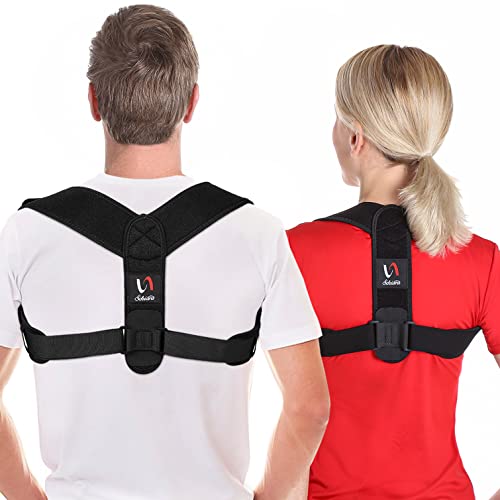
The Schiara is the lightest format in this group: a figure-eight style clavicle brace that loops around both shoulders and crosses at the upper back, with no panel covering the rest of the spine. That minimal build is the appeal for desk work, since the straps sit flat, hide under most shirts, and add almost no bulk against the chair back.
The listing gives the material as neoprene and the item weight as 150 grams, so it feels closer to a wide elastic strap than to a medical brace. Adjustment is by hook-and-loop straps, tightened after the brace is on, and the maker sells it in black as model D362665. Sizing is the weak point of the published data: the listing does not print a full chest chart in the fields we could read, so measure your chest and match it against the size options on the listing before ordering.
Specs
– Type: Figure-eight clavicle brace, upper back only
– Material: Neoprene
– Model: D362665
– Weight: 150 g
– Adjustment: Hook-and-loop straps
– Sizes: Not stated in the listing fields checked
Truweo Posture Corrector Back Brace for Men and Women

Truweo takes the same clavicle strap idea and adds padding. The straps use high-density foam, which spreads pressure over a wider area where the strap passes under the arm, the spot where thin straps tend to dig in. The maker describes the design as covered by a US design patent, and the brace is latex-free, a detail that matters for readers with a latex sensitivity.
Sizing is simpler here than with most rivals: one adjustable size fits chest measurements from 28 to 44 inches, set with hook-and-loop closures on the shoulder straps. At 1.5 ounces it is the lightest pick in this guide, and the flat straps are shaped to lie discreetly under clothing. The maker’s wear guidance is gradual: begin with about 15 minutes a day and add time in small increments, up to one to two hours of daily wear. Care is hand washing. For a desk worker who wants a low-profile strap brace with padded contact points and a clear wear schedule, this is the budget-to-mid-range option to look at first.
Specs
– Type: Clavicle strap brace, upper back
– Fit range: Chest 28 to 44 in, one adjustable size
– Straps: High-density foam, hook-and-loop closures
– Weight: 1.5 oz
– Material note: Latex-free, per the listing
– Care: Hand wash
ComfyBrace Posture Corrector Back Brace for Men and Women

The ComfyBrace widens coverage beyond a bare strap cross. Its harness covers the mid and upper back, so the pull on the shoulders is distributed across a broader area, and the listing presents the build as breathable for longer sitting sessions. It is fully adjustable at the straps, which lets the wearer set a gentle cue rather than a rigid hold.
The printed listing data gives an item weight of 4.6 ounces, light enough to forget under a shirt, and a chest range of 30 to 43 inches for the standard size, measured around the chest rather than by clothing size. Readers near either end of that range should confirm the current size options on the listing, since the maker has sold this brace in more than one size configuration over time. For most desk setups, this is the middle path: more coverage than a figure-eight strap, far less structure than a full back brace.
Specs
– Type: Upper and mid back harness brace
– Fit range: Chest 30 to 43 in, per the listing
– Weight: 4.6 oz
– Adjustment: Fully adjustable straps
– Material: Not stated
– Manufacturer: Comfy Brace
Fit Geno Back Brace Posture Corrector for Women and Men
The Fit Geno is a different class of product: a full back brace that runs from the shoulders to the waist, with four removable fiberglass support rods seated along the spine and a waist belt anchoring the lower edge. The shoulder straps and the belt adjust separately, so the wearer can set the shoulder pull and the waist fit independently rather than accepting one compromise tension for both.
Sizing is by waist measurement, not chest: Small covers a waist of 25 to 33 inches, Medium/Large covers 33 to 40 inches, and Large/X-Large covers 41 to 48 inches. The panel uses a breathable mesh build, and the listing gives the material blend as polyester, polypropylene, rubber and spandex, with hand washing as the care instruction. It is noticeably more brace than the strap designs above, and it will show under thin clothing. Choose it if you want coverage for the upper and lower back in one garment, worn over a base layer during long desk days rather than hidden under a fitted shirt.
Specs
– Type: Full back brace with waist belt
– Support: Four removable fiberglass rods
– Sizes: Small (waist 25 to 33 in), Medium/Large (33 to 40 in), Large/X-Large (41 to 48 in)
– Material: Polyester, polypropylene, rubber, spandex; breathable mesh panel
– Weight: 14.07 oz (packaged)
– Care: Hand wash only
FlexGuard Support Back Brace Posture Corrector

FlexGuard Support builds the most structured option here. The design pairs cushioned shoulder straps with a waist band, metal stays and a lumbar pad, so support extends from the shoulders down through the lower back in a single brace. The maker ships it with a posture booklet of exercises and guidance, fitting how these products are meant to be used: short, regular sessions paired with movement.
The size system is the most granular in this group. Published size guidance pairs waist and height: Small/Medium suits a waist of 61 to 76 cm (about 24 to 30 inches), Large covers 76 to 89 cm (about 30 to 35 inches), and X-Large covers 86 to 101 cm (about 34 to 40 inches). The fabric is described as lightweight and breathable. This is the premium pick for readers who want the fullest coverage and accept a bulkier garment, usually worn over a shirt. Because the published sizing comes from the maker’s chart in centimeters, convert carefully and size up if you land between sizes.
Specs
– Type: Full back brace with waist band and lumbar pad
– Support: Metal stays and lumbar pad, per the listing description
– Sizes: S/M (waist 61 to 76 cm), L (76 to 89 cm), XL (86 to 101 cm)
– Included: Posture booklet, per the maker
– Material: Breathable fabric; blend not stated
– Fit note: Sizes pair waist and height ranges on the maker chart
How to choose
Begin with coverage. If your slouch is mainly rounded shoulders at a desk, a clavicle strap such as the Schiara or Truweo gives a light cue with minimal bulk. If you want support that also reaches the mid and lower back, the panel designs from Fit Geno and FlexGuard cover more area but add warmth, weight and visibility under clothing. The ComfyBrace sits between those poles. Plan the wear schedule too: makers describe gradual use, brief sessions at first, building toward one to two hours a day, paired with regular movement breaks.
Next, measure the way the maker measures. Strap braces are sized by chest, while the full back braces here are sized by waist, and ordering by your usual clothing size is the most common cause of a poor fit. Measure over a thin shirt, compare against the published range, and if you land between sizes, follow the maker’s guidance for that model. Then check the details that decide daily comfort: padded straps where the brace passes under the arm, a breathable panel if you run warm, and closures you can adjust without help.
Who should skip
Skip this category if you are following a clinician’s guidance for a back, neck or shoulder condition; use the support that professional recommends, since none of these retail braces is a substitute for directed care, and stop wearing any brace that causes numbness, swelling or discoloration, as the makers instruct. Also skip a brace if your real problem is furniture: a monitor set too low or a chair with no back support will defeat any strap, and the kneeling chair and lumbar cushion guides on this site address that side of the desk setup. If you want a brace that disappears under fitted clothing, the full back designs here will disappoint; only the light strap models come close.
FAQ
How many hours a day should you wear a posture corrector?
Makers generally describe a gradual build-up rather than all-day wear. Truweo’s guidance is typical: begin with about 15 minutes a day, add time in small increments, and build toward one to two hours of daily wear.
Should you size a posture corrector by chest or waist measurement?
It depends on the design. Clavicle strap braces such as the Truweo and ComfyBrace are sized by chest measurement, while the full back braces from Fit Geno and FlexGuard are sized by waist. Measure with a soft tape over a thin shirt and match the number to the range printed for that model.
Can a posture corrector be worn under a shirt at a desk?
The light strap designs can. The Truweo weighs 1.5 ounces with flat foam straps, and the Schiara is a slim neoprene cross, so both sit under most shirts without showing. Full back braces with rods, stays and waist belts are thicker and usually read through thin fabric, so wear those over a base layer.
How do you wash a posture corrector?
Hand washing is the published care instruction for the models here that state one, including the Truweo and the Fit Geno. Close the hook-and-loop straps before washing so they do not catch on the fabric, and air dry flat so the straps and rods keep their shape.
Final verdict
For most desk workers, the ComfyBrace is the sensible default: mid and upper back coverage, a wide chest range and a light build. The Schiara and Truweo serve the budget tier, with the Truweo ahead on padding and published sizing. The Fit Geno and FlexGuard are the structured end of the category, adding rods, stays and waist belts for full back coverage. Whichever design you pick, measure first, follow the maker’s wear schedule, and treat the brace as one part of a desk setup that also gets the monitor and chair right.
More from Amazon
Programs that pair well with the guide above. Offers and eligibility are set by Amazon and may change.
Free shipping on eligible items, Prime Video and more. Eligible new members can start with a free trial.
Start a Prime free trialAudiobooks and podcasts to listen to on the go. Eligible new members can start with a free trial.
Try Audible freeAd-free music streaming. Eligible new subscribers can start with a free trial.
Try Music Unlimited freeA free business account with business pricing and bulk-buying tools for work, shop or home office.
Create a business accountAs an Amazon Associate we earn from qualifying purchases.





Write Your Review
No reviews yet. Be the first to share your experience!