

Key takeaways
- Measure the full footprint. For a freestanding chair, measure the stand’s widest points, then add room for the basket to move. A chair that fits tightly between walls can still strike them when occupied.
- Check ceiling structure before ordering. A ceiling-mounted chair must attach to a suitable structural member or an anchor specifically rated for the application. If you cannot identify the structure or verify the load requirements, ask a qualified installer rather than guessing.
- Review the hardware and instructions. The chair’s weight rating does not automatically rate the ceiling, fastener, or installation. Use the specified components and do not substitute a hook intended for light-duty hanging.
- Keep a clear landing area. Position the chair away from windows, sharp furniture edges, doors, and walkways. Test the swing gently before regular use.
Best Hanging Egg Chairs for Indoor and Outdoor Use
The best hanging egg chairs for most homes are freestanding models with a weather-resistant woven basket, a stable steel stand, and a capacity of at least 300 pounds; choose a ceiling-mounted chair instead when floor space is tight and you can verify that the structure above can safely support it. The right choice depends less on appearance than on where the chair will hang, how much room its basket needs to swing, and whether you’re willing to install a permanent anchor.
Freestanding vs. ceiling-mounted: which suits your space?
A freestanding egg chair includes its own frame, so you can move it between rooms or take it outside without drilling into a ceiling. It is the flexible choice for renters, changing layouts, and patios without a suitable overhead beam. The trade-off is a larger footprint: the curved stand can occupy more floor area than the basket itself, and a light frame may wobble if the floor is uneven.
Our top picks


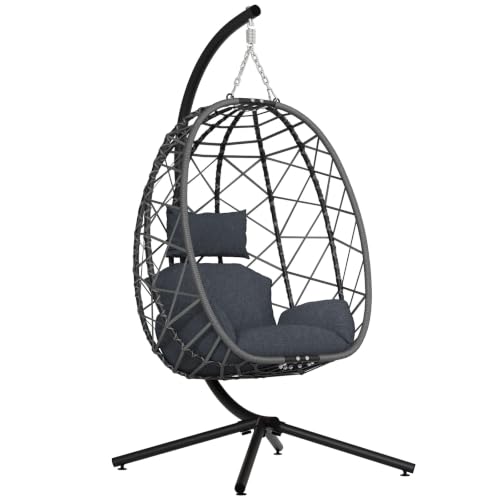
As an Amazon Associate we earn from qualifying purchases at no extra cost to you. Ratings are shown as listed on Amazon.
A ceiling-mounted chair suspends from a structural joist, beam, or properly engineered anchor. It leaves the floor open and can feel less visually bulky, but the attachment point is fixed. Plasterboard or drywall alone is not a suitable support. Before buying, confirm the ceiling structure, mounting hardware requirements, and whether installation is permitted in your home.
| Design or feature | Typical specification | What it means in use |
|---|---|---|
| Freestanding chair footprint | About 40–50 in. wide × 40–50 in. deep | Allow extra clearance for the basket to sway and for access around the stand. |
| Freestanding basket | About 30–40 in. wide | Check the usable seat width, not just the outside width of the woven shell. |
| Ceiling-mounted basket | About 30–40 in. wide; roughly 20–30 in. seat depth | Uses less floor space, but still needs clear swing space in every direction. |
| Common listed capacity | About 250–350 lb | Use the product’s stated limit; do not assume the stand and basket have identical ratings. |
| Steel stand | Often about 35–55 lb | More substantial frames may feel steadier but are harder to move or store. |
| Woven basket materials | Powder-coated steel with synthetic PE rattan, or natural rattan | Synthetic weave generally suits exposed outdoor use better; natural rattan needs a protected location. |
These are common market ranges, not specifications for every chair. Always check the dimensions and capacity of the exact model, since basket shape and included cushions vary.
Choose by situation
| Your situation | Better fit | Why |
|---|---|---|
| Renting or rearranging often | Freestanding | No ceiling installation; the chair can be relocated, provided the new floor area is large enough. |
| Small room with a verified structural beam | Ceiling-mounted | Frees floor area, but requires a correctly rated attachment and adequate swing clearance. |
| Covered patio or garden use | Freestanding with synthetic PE rattan and a coated steel frame | Designed to handle outdoor exposure better than natural wicker, though cushions still need protection. |
| Frequent use by different household members | Wide basket with a clearly stated capacity of 300 lb or more | Provides more room and a larger capacity margin; verify the limit for the complete chair setup. |
| Lowest upfront cost | Basic freestanding set | Often avoids separate installation costs, but check frame stability and whether the cushion is included. |
What to prioritize when comparing chairs
Comfort and basket size
A deep, curved basket can support a relaxed seated posture, but comfort is personal: a tall back, arm placement, and cushion thickness matter as much as the outer diameter. If possible, compare the usable seat width and depth against a chair you already find comfortable. For two people, don’t rely on a “double” label alone; look for a wider seat and a capacity that covers the combined load with room to spare.
Account for the cushion in the fit. A thick cushion can make the seat feel snugger, while a thin one may leave a hard frame noticeable during longer sitting. Check whether the cushion has removable covers and whether replacements are available in a compatible size.
Weight capacity and stability
Capacity is a maximum, not a recommended target for bouncing, climbing, or swinging forcefully. Check whether the rating applies to the whole assembly or only the basket. For a freestanding design, a broad base and secure joints help limit rocking; tighten the fasteners after assembly and periodically check them again. Keep all chair legs on a level, firm surface.
Materials and exposure
For outdoor use, synthetic PE rattan is generally easier to live with than natural rattan because it resists moisture better. A powder-coated steel frame can help protect against corrosion, but scratches and chipped coating may expose the metal. Neither material makes a chair maintenance-free: prolonged rain, standing water, salt air, and strong sun can shorten its life.
Natural rattan is better suited to a dry indoor room or a sheltered porch. Keep it away from persistent dampness and inspect the weave for loose strands. If your outdoor location is exposed, choose a cover that fits without trapping moisture and bring cushions indoors when not in use.
Installation and clearance: avoid the common fit mistakes
- Measure the full footprint. For a freestanding chair, measure the stand’s widest points, then add room for the basket to move. A chair that fits tightly between walls can still strike them when occupied.
- Check ceiling structure before ordering. A ceiling-mounted chair must attach to a suitable structural member or an anchor specifically rated for the application. If you cannot identify the structure or verify the load requirements, ask a qualified installer rather than guessing.
- Review the hardware and instructions. The chair’s weight rating does not automatically rate the ceiling, fastener, or installation. Use the specified components and do not substitute a hook intended for light-duty hanging.
- Keep a clear landing area. Position the chair away from windows, sharp furniture edges, doors, and walkways. Test the swing gently before regular use.
Ownership costs and what wears first
Basic freestanding egg chairs commonly fall around $100–$250, while larger baskets, heavier frames, and better outdoor finishes often land around $250–$600 or more. Ceiling-mounted baskets may cost roughly $100–$400, before any professional installation. These are broad market ranges, not quotes; cushion quality, materials, and included hardware can shift the total.
The first signs of wear are often a fading or flattened cushion, loose fasteners, a scuffed frame finish, or a strand of synthetic weave separating at a high-stress point. Clean the frame and weave with mild soap and water, then dry them thoroughly. Avoid harsh solvents and abrasive brushes that can damage coatings or the weave. Store or cover the chair during severe weather, and inspect a ceiling mount and its surrounding structure periodically for movement, cracking, or looseness.
For example, a $300 chair used four times a week for three years gets about 624 uses. That works out to roughly $0.48 per use before maintenance or installation. A lower purchase price can be less compelling if the chair is uncomfortable enough that it stays unused, or if outdoor exposure means replacing cushions sooner.
Bottom line
Choose a freestanding model if flexibility, easy relocation, or patio use matters most. Choose a ceiling-mounted design if preserving floor space is the priority and you have a verified structural attachment point. In either case, compare actual seat dimensions, whole-chair capacity, outdoor material suitability, and the room needed for movement—not just the basket’s appearance.


Write Your Review
No reviews yet. Be the first to share your experience!