

Key takeaways
- Prefer a base roughly as wide as, or wider than, the basket.
- Look for a locking pin or restraint strap that stops the basket from swinging.
- Place the chair on a level, solid surface rather than loose pavers or soft soil.
- Remove or fold the canopy if the design allows it during storms.
- Move the chair indoors or secure it according to the manual before high winds.
- Do not attach a freestanding chair to a railing as an improvised anchor.
The best hanging egg chairs for patio comfort are outdoor-rated resin-wicker or powder-coated steel models with a weather-resistant canopy, removable quick-dry cushions, a stable base, and enough clearance to swing without striking walls or railings.
Our top picks

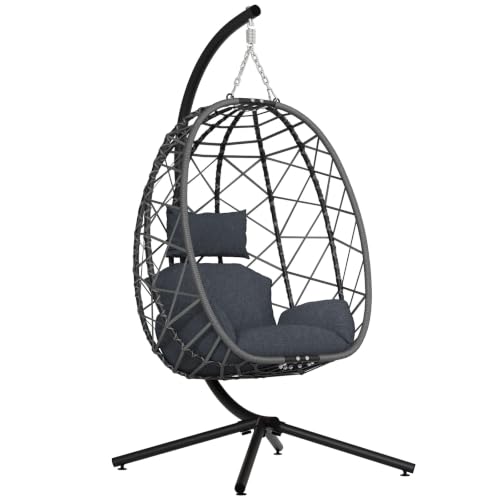


As an Amazon Associate we earn from qualifying purchases at no extra cost to you. Ratings are shown as listed on Amazon.
Best hanging egg chairs by patio situation
| Patio situation | Best chair type | Useful target specifications | Typical market range |
|---|---|---|---|
| Small balcony or compact patio | Single-seat chair with a narrow pedestal | 36–40 in wide; 45–55 in deep; 250–300 lb capacity | $180–$350 |
| Frequent outdoor use | All-weather PE resin wicker with solution-dyed or UV-treated cushion fabric | UV-resistant shell; removable covers; rust-resistant frame; 300–350 lb capacity | $300–$650 |
| Rainy or humid climate | Aluminum or galvanized-steel frame with quick-dry cushion system | Powder coating; drainage gaps; water-resistant fabric; covered storage plan | $350–$750 |
| Wind-exposed patio | Wide, weighted pedestal with locking hardware | Base diameter around 38–45 in; roughly 45–75 lb base; safety strap or anchor point | $250–$600 |
| Two-person lounging | Double egg chair or loveseat swing | 50–60 in wide; 400–500 lb capacity; reinforced hanging hardware | $450–$900 |
These are buying targets rather than guarantees: manufacturers measure width, weight capacity, water resistance, and frame construction differently. Check the assembled dimensions and the manual before ordering, especially for a balcony or elevated deck.
What makes an egg chair genuinely patio-ready?
Outdoor shell and frame
For the woven basket, look for high-density polyethylene (PE) or synthetic resin wicker rather than natural rattan. PE wicker tolerates sunlight and occasional moisture better, does not absorb water like natural fibers, and can be washed with mild soap. A UV-stabilized formulation matters because ordinary plastic can become brittle, fade, or crack after repeated sun exposure.
The frame should be powder-coated steel, galvanized steel, or aluminum. Powder coating protects steel from surface corrosion, but scratches and exposed cut edges can still rust. Aluminum avoids rust and is easier to move, although a lightweight aluminum base may be less stable in strong wind. Inspect welds, bolts, and the joint connecting the hanging spring or chain to the basket; these high-load points matter more than decorative weave patterns.
Rain resistance is not waterproofing
A water-resistant cushion cover may shed a shower, but foam can still retain moisture through seams, zippers, and the underside. The most useful design features are removable covers, open-weave or slatted seat construction, drainage holes, and fast-drying foam. A canopy protects the occupant but rarely keeps the entire cushion dry during wind-driven rain.
Plan to remove cushions before prolonged rain, or use a breathable cover that fits without trapping condensation. Avoid sealing a wet cushion inside a waterproof bag: trapped moisture encourages mildew and can corrode hidden hardware.
Footprint, clearance, and capacity: the measurements that prevent regrets
Do not measure only the basket. Measure the complete assembled chair, including the base and the swing path. A chair listed as 38 inches wide can require more than 48 inches of practical clearance once you allow room to enter, recline, and sway.
| Measurement | Compact single chair | Roomier single chair | Double chair |
|---|---|---|---|
| Basket width | 30–36 in | 36–42 in | 48–58 in |
| Overall depth | 36–44 in | 40–50 in | 45–58 in |
| Recommended side clearance | At least 6 in | At least 8 in | At least 10 in |
| Clearance in front and behind | 18–24 in | 24–30 in | 24–36 in |
| Minimum ceiling or overhead height | About 7 ft 6 in | About 8 ft | About 8 ft |
As a practical example, a 40-inch-wide basket on a 42-inch base does not fit comfortably in a 48-inch-wide balcony: after the chair is centered, there would be only about 3 inches on each side, leaving no tolerance for uneven walls or movement. For that space, a narrow 36-inch basket and a compact base are more sensible.
Weight capacity includes the occupant, cushion, and any blanket or side table attached to the chair. Choose a model rated at least 50 pounds above the heaviest expected load rather than treating the published maximum as a target. Never replace a supplied spring, chain, carabiner, or bolt with a visually similar hardware-store part unless its load rating and dimensions match the manufacturer’s requirements.
Stability in wind: what to look for
An egg chair’s tall basket and canopy act like a sail. A heavy base helps, but no freestanding hanging chair should be assumed safe in severe wind. The best wind-conscious designs have a broad, low base, a center of gravity close to the ground, non-slip feet, and a way to secure the basket when it is not in use.
- Prefer a base roughly as wide as, or wider than, the basket.
- Look for a locking pin or restraint strap that stops the basket from swinging.
- Place the chair on a level, solid surface rather than loose pavers or soft soil.
- Remove or fold the canopy if the design allows it during storms.
- Move the chair indoors or secure it according to the manual before high winds.
- Do not attach a freestanding chair to a railing as an improvised anchor.
For a permanently suspended chair, the overhead structure is a separate engineering issue. A porch beam must be capable of carrying dynamic loads, not merely the chair’s static weight. Use the specified hanger and have uncertain structural installations assessed by a qualified professional.
Cushions: comfort versus drying time
Thicker cushions feel more lounge-friendly, but thick foam takes longer to dry. For patios exposed to weather, a medium-depth seat cushion with a breathable cover is often easier to live with than a very plush cushion that remains damp overnight. Look for solution-dyed acrylic or polyester outdoor fabric, UV treatment, double-stitched seams, and a zipper that can be removed for washing.
Light-colored fabric usually stays cooler in direct sun and makes fading less obvious, while darker fabric hides dirt but can become noticeably hotter. A cushion with a separate head pillow is useful because it can be taken indoors quickly. Avoid placing cushions directly on wet ground or leaving them compressed under a tight cover while damp.
Assembly requirements and common mistakes
Most pedestal models require assembly of the base, upright support, spring or hanging hook, basket, and canopy. Allow roughly 45–90 minutes for a single chair, depending on the number of bolts and whether a second person is needed to lift the basket. Double chairs and unusually heavy bases may take longer.
- Inventory the hardware first. Separate bolts by length; using a longer bolt in the wrong joint can interfere with the swing mechanism.
- Build the base on a level surface. Tighten bolts finger-tight initially so the legs can align before final tightening.
- Check every load-bearing connection. Confirm that springs, hooks, pins, and locking nuts are fully seated.
- Install the basket with two people. This reduces the chance of dropping the frame or side-loading the hanging hardware.
- Perform a low-load test. Push the empty basket gently in every direction, then apply weight gradually while checking for movement, scraping, or tilting.
- Recheck fasteners after several uses. Vibration can loosen hardware even when the initial assembly was correct.
Do not drag a fully assembled chair across a deck. Lift it or partially disassemble it; dragging can bend feet, loosen joints, and scratch protective coatings.
Durability and ownership costs
The woven shell usually outlasts the cushion fabric and small hardware. Expect cushion covers to fade or lose water repellency before the resin wicker fails. Springs can squeak or lose tension, while steel fasteners may rust if their coating is damaged. Replacement cushions are easier to source when the seat has common dimensions, so record the basket width and cushion thickness before buying.
A simple ownership calculation can clarify value. Suppose a $400 chair is used twice weekly for three outdoor seasons, or about 300 uses. The chair itself costs approximately $1.33 per use before covers, cleaning, and replacement cushions. A $250 chair used only 30 times costs about $8.33 per use. The more exposed the patio and the more frequently the chair is used, the more worthwhile it is to spend on UV-treated fabric, rust-resistant hardware, and a serviceable cushion rather than appearance alone.
Bottom line
Choose a compact single egg chair for a tight patio, a resin-wicker chair with removable quick-dry cushions for regular use, and an aluminum or well-protected steel model for wet climates. On windy patios, prioritize a wide heavy base and a restraint system over a tall canopy. Before ordering, verify the complete footprint, 50-pound capacity margin, overhead clearance, and your plan for storing cushions. Those details determine whether the chair remains a comfortable patio fixture or becomes a fragile object that must be moved after every forecast.


Write Your Review
No reviews yet. Be the first to share your experience!