

Key takeaways
- Entry-level and older GPUs: target 1440p around 100–165Hz, using medium or high settings.
- Modern mid-range GPUs: target 1440p at 165–240Hz, depending on the game.
- High-end GPUs: 1440p OLED at 240–360Hz is appropriate for competitive players who can sustain high frame rates.
The best gaming monitors in 2026 are the ones that match your graphics card and games: choose a 27-inch 1440p display at 165–240Hz for the best all-round value, a 32-inch 4K OLED at 240Hz for premium single-player gaming, or a 24–25-inch 1080p monitor at 240–540Hz for competitive play.
Our top picks

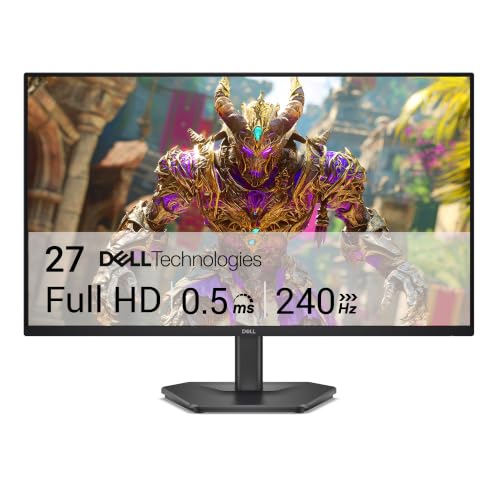


As an Amazon Associate we earn from qualifying purchases at no extra cost to you. Ratings are shown as listed on Amazon.
Quick recommendations by situation
| Gaming situation | Best monitor type | Target specification | Typical 2026 market range |
|---|---|---|---|
| Value-focused PC gaming | 27-inch IPS | 2560×1440, 165–180Hz, 1ms-class response | $220–$400 |
| Competitive shooters and esports | 24–25-inch fast IPS or TN | 1920×1080, 240–540Hz | $250–$900 |
| Premium mixed gaming | 27-inch OLED | 2560×1440, 240–360Hz | $600–$1,000 |
| Immersive single-player games | 32-inch OLED | 3840×2160, 240Hz | $900–$1,500 |
| Console and PC on one screen | 32-inch 4K IPS or OLED | 4K, HDMI 2.1, 120Hz or higher | $500–$1,500 |
What makes a gaming monitor good?
A high refresh rate makes motion look smoother, but it only helps when the graphics card and game can deliver enough frames. Response time describes how quickly pixels change color; it is not the same as input lag, and an advertised “1ms” figure often applies only to a particular overdrive mode. Adaptive sync is equally important because it matches the display’s refresh cycle to the GPU’s frame rate, reducing tearing and stutter.
Resolution controls sharpness and GPU workload. At a typical desktop distance, 1440p is noticeably sharper than 1080p on a 27-inch screen, while 4K is especially effective on 32 inches or larger. The trade-off is substantial: rendering 4K requires about 2.25 times as many pixels as 1440p, so it demands a much faster graphics card.
Best all-round choice: 27-inch 1440p at 165–240Hz
For most PC players, a 27-inch 2560×1440 monitor remains the sensible middle ground. It provides enough workspace for everyday use, sharp text, and a meaningful performance advantage over 4K. A current mid-range GPU can often drive high frame rates at this resolution with sensible settings, especially when upscaling is available.
Look for a fast IPS panel with a 165Hz, 180Hz, or 240Hz refresh rate, strong variable-refresh-rate support, and a usable overdrive mode. IPS typically offers better motion consistency and viewing angles than budget VA panels. VA can deliver deeper contrast, but some models show dark-level smearing in fast scenes. A 27-inch OLED 1440p monitor, such as the MSI MAG 271QPX QD-OLED class of display, gives much faster pixel transitions and perfect black levels, but costs more and requires burn-in-conscious ownership.
Graphics-card guidance
- Entry-level and older GPUs: target 1440p around 100–165Hz, using medium or high settings.
- Modern mid-range GPUs: target 1440p at 165–240Hz, depending on the game.
- High-end GPUs: 1440p OLED at 240–360Hz is appropriate for competitive players who can sustain high frame rates.
Best for competitive gaming: 1080p at 240Hz or higher
Competitive players should prioritize consistent frame delivery, low input latency, and clear motion over pixel density. A 24- or 25-inch 1080p display lets the GPU produce very high frame rates and keeps the entire screen within a compact field of view. At 240Hz, a new frame appears every 4.17 milliseconds; at 360Hz, that falls to 2.78 milliseconds; at 540Hz, it is about 1.85 milliseconds.
That difference is measurable, but it is not automatically valuable. A 500Hz-plus display makes most sense for players who use very high frame rates, sit close to the screen, and play games such as competitive shooters at a serious level. For general gaming, a good 1440p 240Hz monitor is usually a better visual upgrade.
Fast IPS is the practical choice because it combines speed with better color and viewing angles. TN panels can still be competitive in the highest-refresh-rate category, but their weaker image quality makes them less appealing for mixed use. OLED has exceptional response time, although many esports buyers still prefer a smaller conventional panel for lower cost and reduced concern about static interface elements.
Best premium option: 4K OLED at 240Hz
A 32-inch 4K OLED monitor is the most immersive choice for a powerful gaming PC. Models such as the ASUS ROG Swift PG32UCDM, Alienware AW3225QF, Samsung Odyssey OLED G8 G80SD, and LG 32GS95UE represent this category. They combine 3840×2160 resolution with OLED contrast, near-instantaneous pixel response, wide color coverage, and refresh rates up to 240Hz.
These monitors are particularly strong for dark games, cinematic adventures, and mixed PC use. OLED pixels can switch completely off, so black scenes do not have the gray glow common on LCD panels. However, HDR quality depends on more than the OLED label: peak brightness, full-screen brightness, tone mapping, and the presence of a proper HDR mode all matter.
Can your graphics card drive 4K 240Hz?
Usually not in demanding new games at native resolution and maximum settings. A high-end GPU may approach or exceed 200 frames per second in esports titles, but graphically intensive games often require upscaling, frame generation, reduced settings, or a lower target such as 100–165 frames per second.
For example, if a game averages 120 frames per second at 4K, a 240Hz panel still remains useful: it can display each frame promptly and offers headroom for lighter scenes. You do not need 240 frames per second for the monitor to be worthwhile, but you should not pay for the refresh rate expecting every game to use it.
Panel types compared
| Panel | Strengths | Weaknesses | Best fit |
|---|---|---|---|
| IPS | Balanced color, viewing angles, and motion | Usually modest contrast; occasional glow | Most players and productivity |
| VA | Higher LCD contrast and deep blacks | Dark-scene smearing on some models | Budget immersion and high contrast |
| OLED | Perfect blacks, excellent HDR contrast, extremely fast response | Burn-in risk, text fringing on some layouts, higher price | Premium gaming and media |
| TN | Very fast and often economical at high refresh rates | Weakest image quality and viewing angles | Dedicated esports play |
Adaptive sync, HDR, and connection requirements
AMD FreeSync and NVIDIA G-SYNC Compatible displays can both provide variable refresh rate, but implementation quality varies. Check the supported range: a monitor that operates from 48–240Hz is more useful than one that begins at 80Hz. Enable adaptive sync in the monitor menu and graphics driver, then cap the game’s frame rate slightly below the maximum refresh rate for a consistent result.
For 4K above 120Hz, use DisplayPort 1.4 with Display Stream Compression or HDMI 2.1, depending on the monitor and GPU. HDMI 2.1 is important for a PC-and-console setup because current consoles target 4K at up to 120Hz rather than 240Hz.
HDR is worth prioritizing on OLED or on LCD monitors with effective local dimming. A basic HDR label on an edge-lit LCD often produces only a small improvement over SDR. Look for independent measurements of peak brightness and local-dimming behavior rather than relying on a certification name alone.
Ownership realities: OLED care and monitor setup
OLED is not a maintenance-free upgrade. Static desktop icons, taskbars, browser controls, and game HUDs can contribute to uneven wear over long periods. Use the monitor’s pixel-shift and panel-care functions, enable automatic screen sleep, vary full-screen content, and avoid disabling protective routines. Do not manually interrupt a panel-refresh cycle unless the manufacturer says it is safe.
LCD monitors have their own common failures: stuck pixels, backlight bleed, fan noise on some HDR models, and stands that occupy too much desk depth. Before buying, check the pixel policy, stand adjustment, VESA compatibility, and whether the supplied stand allows height adjustment. Clean either panel with a soft microfiber cloth lightly dampened with water; avoid spraying liquid directly onto the screen and avoid household glass cleaner.
A simple buying decision
- Choose 27-inch 1440p IPS if you want the best balance of price, sharpness, and GPU requirements.
- Choose 27-inch 1440p OLED if fast competitive play and deep contrast matter more than long periods of static desktop work.
- Choose 32-inch 4K OLED if you have a high-end GPU and want maximum immersion for modern games and films.
- Choose 24–25-inch 1080p at 240Hz or more if competitive performance is the main purpose.
- Choose a 4K HDMI 2.1 display if the monitor must serve both a gaming PC and a current console.
The strongest purchase is not the monitor with the largest refresh-rate number. Match resolution to your GPU, choose adaptive sync with a broad operating range, verify real HDR performance, and consider how much static desktop use the panel will receive. That approach usually leads to a smoother and more satisfying display than paying for specifications your games cannot consistently use.






Write Your Review
No reviews yet. Be the first to share your experience!