

The best whole house water softener system for most homes is a demand-initiated ion-exchange unit with a 48,000-grain nominal capacity, a metered control valve, and enough service flow for the household’s peak demand—not necessarily the system with the largest grain number.
Our top picks
 Kenmore 350 Whole House Water Softener System
- IntelliSoft Technology: The IntelliSoft system uses artificial intelligence…
- Powerful Whole Home Solution: Like other water softeners,…
- Perfect for Families: This home water softener system…
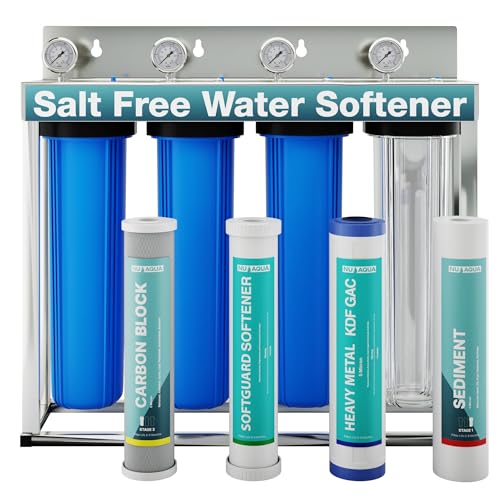 NU Aqua 4-Stage Salt Free Water Softener
- The NU Aqua Whole House Water Filter System…
- The water softener system effectively filters out harmful…
- Designed for point-of-entry installation, this home water filtration…
As an Amazon Associate we earn from qualifying purchases at no extra cost to you.
Quick picks by household situation
- Best all-around configuration: a 48,000-grain salt-based softener using a metered Fleck 5600 SXT or Clack WS1 control valve.
- Best for high water use: a 64,000- to 80,000-grain cabinet or twin-tank system with at least 12 gallons per minute (GPM) of usable service flow.
- Best for limited space: a cabinet-style softener, provided its brine tank and resin capacity are not undersized for the home.
- Best for uninterrupted soft water: a twin-tank demand system, which can switch tanks while the other regenerates.
- Best for avoiding salt: a water conditioner using template-assisted crystallization or another salt-free process, but it does not remove hardness minerals in the same way as an ion-exchange softener.
- Best for DIY-friendly installation: a complete kit with a bypass valve, prefilled resin tank, drain tubing, brine tank, and clearly labeled inlet and outlet connections.
What separates a good system from an oversized one?
Whole-house softeners are selected primarily by hardness, household water use, and peak flow. Grain capacity describes how much hardness a resin bed can exchange before regeneration. It does not directly describe gallons per minute, physical size, or water quality.
A practical sizing estimate is:
Daily capacity needed = people × gallons per person per day × hardness in grains per gallon.
For example, four people using approximately 60 gallons each per day in water with 15 grains per gallon of hardness require about 3,600 grains per day. Adding a safety margin gives approximately 5,000 grains per day. A 48,000-grain nominal unit might therefore regenerate roughly every seven to ten days, depending on its programmed salt dose and usable capacity.
Nominal capacity can be misleading. A 48,000-grain softener may be programmed to deliver approximately 36,000 grains at a moderate salt setting, while using the full advertised capacity may require more salt per regeneration. Efficient programming usually produces a lower capacity per cycle but better grains removed per pound of salt.
Head-to-head comparison of common system configurations
| Configuration | Typical capacity | Usable service flow | Regeneration method | Typical salt use | Best fit |
|---|---|---|---|---|---|
| 32,000-grain cabinet unit | 24,000–32,000 grains nominal | 7–10 GPM | Metered or timed | 6–15 lb per cycle | 1–3 people, moderate hardness, limited space |
| 48,000-grain single-tank system | 36,000–48,000 grains nominal | 10–12 GPM | Demand-initiated metered | 8–24 lb per cycle | Most 2–5 person households |
| 64,000- to 80,000-grain system | 48,000–80,000 grains nominal | 12–16 GPM | Demand-initiated metered | 12–32 lb per cycle | Large households, high hardness, multiple bathrooms |
| Twin-tank system | 32,000–96,000 grains total, depending on model | 10–20+ GPM | Alternating demand regeneration | Varies by tank and setting | Continuous demand, well systems, large homes |
| Salt-free conditioner | Not rated for hardness removal | Often 10–20 GPM | No regeneration cycle | No salt; media replacement varies | Low-maintenance scale reduction where softened water is not required |
Actual flow depends on resin volume, plumbing size, incoming pressure, water temperature, and the control valve. A tank advertised as 12 GPM may deliver less when pressure is low or when the resin bed is heavily loaded with iron.
Salt-based softener versus salt-free conditioner
A conventional ion-exchange softener replaces calcium and magnesium ions with sodium or, in some systems, potassium. This reduces measured hardness and helps prevent the familiar mineral deposits associated with hard water.
A salt-free conditioner does not normally remove hardness minerals. It changes how some minerals form and attach to surfaces. This can be appropriate when the goal is scale management with no brine discharge, but it is not an equivalent replacement where a plumbing professional, appliance manufacturer, or water-treatment plan specifically requires softened water.
Salt-based systems require a drain connection, an electrical outlet for the control valve, a brine tank, and periodic salt replenishment. Salt-free systems generally need a sediment prefilter and media replacement at an interval specified by the manufacturer, but they avoid regeneration wastewater and salt handling.
Control valves worth prioritizing
Fleck 5600 SXT
The Fleck 5600 SXT is a widely used residential metered control valve. It is a sensible choice when replacement parts, programming information, and service familiarity matter. It is better suited to ordinary residential flow demands than unusually high-flow applications.
Clack WS1
The Clack WS1 platform is another established residential valve family. It is valued for flexible programming and serviceability, although availability and installation support can depend on the local dealer. Confirm that the seller or installer will provide programming access and replacement parts.
Timer-based controls
A timer-based softener regenerates on a schedule rather than measuring actual water use. It may cost less initially, but it can regenerate when the home has used little water or fail to regenerate at the right interval during guests, seasonal occupancy, or changing household demand. A metered, demand-initiated control is usually the better ownership choice.
Installation requirements that affect the decision
- Location: Install on the main cold-water line after the pressure tank on a well system, or after the main shutoff and before branches supplying the house. Do not send softened water to an outdoor irrigation system unless the design specifically calls for it.
- Drain: The control valve needs an air-gapped or code-compliant drain connection. Regeneration can discharge several dozen gallons, so a small or distant drain may be unsuitable.
- Power: Most electronic valves use a low-voltage transformer and need a nearby protected outlet.
- Bypass: A three-valve or supplied bypass arrangement allows maintenance without shutting off household water.
- Prefiltration: Sediment, iron, manganese, tannins, and chlorine can shorten resin life or interfere with performance. Test the source water before selecting treatment stages.
- Floor space: Leave room above the resin tank to remove the valve and around the brine tank to add salt. A narrow cabinet may fit physically but be inconvenient to maintain.
- Plumbing: A 1-inch connection can reduce restriction in larger homes, but the connection size alone does not guarantee a 1-inch internal flow path.
Decision matrix: match the system to the home
| Household condition | Recommended direction | Why |
|---|---|---|
| 1–2 people, hardness below 10 GPG, one bathroom | 24,000–32,000-grain metered unit | A larger tank adds cost and regeneration capacity that may go unused. |
| 3–5 people, hardness of 10–20 GPG | 48,000-grain metered unit | Balances reserve capacity, flow, physical size, and salt consumption. |
| Six or more people, several simultaneous showers | 64,000–80,000 grains or a twin-tank system | Provides more reserve capacity and reduces pressure loss at peak demand. |
| Small utility room with limited access | Compact cabinet unit with front-access salt loading | Uses less floor space, but verify usable capacity rather than cabinet dimensions. |
| Well water with iron or fluctuating demand | Water test plus metered softener, possibly with pretreatment | Iron consumes capacity and may require separate filtration before softening. |
| Rental or no drain access | Salt-free conditioner or point-of-use treatment | A conventional softener may be impractical without permanent plumbing changes. |
Ownership costs and maintenance
Residential salt-based systems commonly fall in a broad installed price range of approximately $600–$2,500, with premium twin-tank systems and difficult plumbing installations costing more. Salt commonly adds roughly $5–$25 per month, depending on water hardness, household consumption, salt efficiency, and local prices. Salt-free systems often cost approximately $500–$2,000 installed, with replacement media and prefilters creating the main recurring expenses.
Check the brine tank every few weeks and keep the salt level high enough for the programmed cycle, but do not fill it to the lid. Break up a salt bridge if salt remains above an apparently empty cavity. Clean the brine tank when sludge or salt buildup becomes noticeable. Replace sediment cartridges according to pressure drop or the manufacturer’s interval.
The parts most likely to need attention are the injector, seals, piston or valve assemblies, brine float, and resin bed. Hard, iron-bearing water can shorten resin life. A system that regenerates too frequently wastes salt and water; one that regenerates too rarely can allow hard water through. Record the initial hardness test, meter setting, salt dose, and regeneration frequency so changes are visible.
Common buying mistakes
- Choosing by the largest grain number without checking peak flow.
- Using a timer when household water use varies substantially.
- Ignoring iron, manganese, sediment, or tannins in well water.
- Installing the softener on irrigation lines or a hot-water-only branch.
- Assuming a salt-free conditioner removes hardness.
- Failing to confirm drain discharge requirements and local plumbing rules.
- Buying a proprietary system without checking the cost and availability of replacement media or valve parts.
Bottom line
For the typical home, start with a water test and compare a 48,000-grain demand-initiated ion-exchange system with a service flow of about 10–12 GPM. Move to a larger or twin-tank design when household demand, hardness, or uninterrupted service justifies it. Choose a salt-free conditioner only when scale reduction—not actual hardness removal—is the objective, and have a qualified plumber or water-treatment professional review unusual well-water chemistry and local installation requirements.







Write Your Review
No reviews yet. Be the first to share your experience!