

Key takeaways
- Compare five UPS battery backups for a home office desk by capacity, runtime and waveform, with picks for network gear, a single PC or a full workstation.
- Top Pick: CyberPower CP1500PFCLCD PFC Sinewave UPS
- Runner-up: APC Back-UPS Pro BX1500M
- Also consider: CyberPower CP850PFCLCD PFC Sinewave UPS
A surge protector guards a desk against voltage spikes, but it does nothing when the power drops out: the computer cuts off mid-save, the call drops, and the router goes dark. A UPS battery backup fills that gap. It keeps the gear on its battery outlets running for a few minutes, long enough to save work and shut down in an orderly way, and it smooths out brief sags and spikes.
The five units below cover the desk shapes a home office actually has, from a compact 600 VA box for network gear and one small PC, up to 1500 VA towers for a full workstation. Each is judged on the same published points: capacity in VA and watts, stated runtime, the waveform it produces on battery, how its outlets split between battery backup and surge only, and whether the battery can be replaced.
As an Amazon Associate, we earn from qualifying purchases.
Quick answer
For most home office desks, the CyberPower CP1500PFCLCD is the strongest all-round pick, with sine wave output and six battery-backed outlets. The APC BE600M1 covers a modem, router and one small PC on a budget tier, the CyberPower EC850LCD adds an LCD and ECO outlets, the CP850PFCLCD shrinks sine wave output to a mid-range size, and the APC BX1500M suits heavier towers.
The picks
1. CyberPower CP1500PFCLCD PFC Sinewave UPS
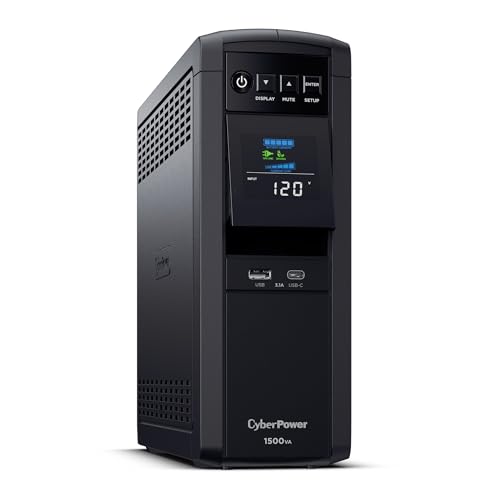
The CP1500PFCLCD is the premium pick and the most complete desk UPS here. Its battery output is a true sine wave, the waveform modern PC power supplies with active PFC are built to expect, and automatic voltage regulation corrects minor swings without draining the battery. Twelve outlets split evenly between battery backup and surge only, so a tower, two monitors and network gear can ride on battery while a printer sits on surge protection alone. A tilting color LCD shows load, battery level and estimated runtime. CyberPower rates runtime at ten minutes at half load and two and a half at full load: shutdown time, not working time. An earlier 900 W, ten-outlet version shares this model name, so confirm the rating on the listing.
Specs
- Capacity: 1500 VA / 1000 W
- Topology: line-interactive, with AVR
- Waveform on battery: sine wave
- Outlets: 12 (6 battery and surge, 6 surge only)
- Runtime: 10 min half load, 2.5 min full load
- Surge rating: 1,445 joules
- USB charging: 1 USB-A and 1 USB-C port, 3.1 A shared
- Recharge time: 8 hours, typical
- Battery: sealed lead-acid, user-replaceable
2. APC Back-UPS Pro BX1500M

The BX1500M matches the CyberPower on capacity class and adds protection for the lines that carry data into the desk: it also protects an Ethernet run and a coaxial line, covering a cable modem feed. The trade-off sits in the waveform: on battery it produces a stepped approximation to a sine wave. Most office gear runs happily on that output, but a PC power supply that is fussy about waveform belongs on a sine wave model instead. It suits a heavier tower, where watt headroom matters more than waveform purity, and its sixteen-hour typical recharge is the slowest here.
Specs
- Capacity: 1500 VA / 900 W
- Topology: line-interactive, with AVR
- Waveform on battery: stepped approximation to a sine wave
- Outlets: 10 (5 battery and surge, 5 surge only)
- Runtime: 10.9 min half load, 2.8 min full load
- Surge rating: 789 joules
- Dataline protection: Ethernet RJ45 and coaxial
- Cord: 6 ft
- Recharge time: 16 hours, typical
- Weight: 24.25 lb
- Battery: user-replaceable cartridge
3. CyberPower CP850PFCLCD PFC Sinewave UPS
The CP850PFCLCD brings the same sine wave output and voltage regulation as the larger CyberPower down to an 850 VA mini tower, the right size for one capable desktop, a monitor and the network shelf. Five outlets carry battery backup and five are surge only, and the LCD reports load and estimated runtime. The battery is user-replaceable, and the replacement part depends on the serial prefix: RB1280A for units whose serial begins with CQD, RB1290 for CX2. It is the natural mid-range choice when the PC has an active PFC power supply but the desk does not need 1500 VA of headroom.
Specs
- Capacity: 850 VA / 510 W
- Topology: line-interactive, with AVR
- Waveform on battery: sine wave, Active PFC compatible
- Outlets: 10 (5 battery and surge, 5 surge only)
- Runtime: 10 min half load, 2 min full load
- Surge rating: 1,030 joules
- Display: multifunction LCD
- Recharge time: 8 hours, typical
- Battery: user-replaceable, RB1280A or RB1290 by serial
4. CyberPower EC850LCD Ecologic UPS

The EC850LCD takes a different route to the same capacity class: standby topology, a simulated sine wave and the joint-highest outlet count here. Its twelve outlets divide into six with battery backup and six surge only, three of them ECO controlled, cutting power to peripherals when the connected computer is off or asleep. At 7.7 pounds the compact body is easy to place on or under a desk. Its limits are plain in the figures: one minute at full load and a 526-joule surge rating, so treat it as backup for a lighter desk rather than a heavy tower.
Specs
- Capacity: 850 VA / 510 W
- Topology: standby
- Waveform on battery: simulated sine wave
- Outlets: 12 (6 battery and surge, 6 surge only, 3 ECO controlled)
- Runtime: 6 min half load, 1 min full load
- Surge rating: 526 joules
- Recharge time: 8 hours, typical
- Battery: sealed lead-acid
5. APC Back-UPS BE600M1
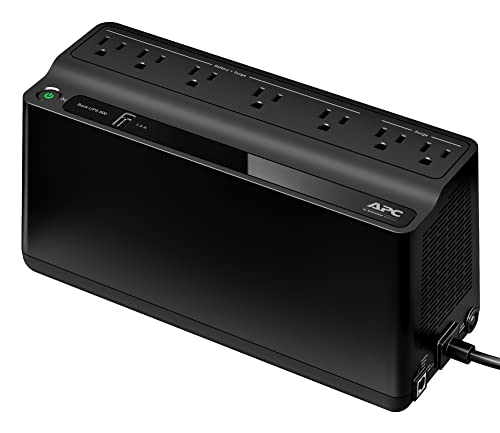
The BE600M1 is the budget pick, sized for the gear that keeps a home office connected rather than for a full workstation. Its 330 W ceiling suits a modem, a router and one small PC or a compact NAS. Five outlets carry battery backup and two are surge only, with wider spacing that leaves room for adapter bricks. A USB-A charging port delivers up to 1.5 amps and works on battery, so a phone can charge during an outage, and a USB data port lets the maker’s PowerChute software save files and shut a connected PC down on its own. There is no voltage regulation and no LCD; status comes from LED indicators. The battery is a user-replaceable APCRBC154 cartridge, and keyhole slots allow wall mounting.
Specs
- Capacity: 600 VA / 330 W
- Topology: standby
- Waveform on battery: simulated sine wave
- Outlets: 7 (5 battery and surge, 2 surge only)
- Runtime: 11.8 min half load, 3.2 min full load
- Surge rating: 490 joules
- USB: 1 USB-A charging port (1.5 A, works on battery) and 1 USB data port
- Recharge time: 10 hours, typical
- Weight: 7.7 lb
- Battery: user-replaceable cartridge (APCRBC154)
How to choose
Size by watts, not by VA alone. Add up the draw of everything on the battery outlets — PC, monitors, modem, router — and compare it with the watt rating, the hard ceiling. The VA figure runs higher than the watt figure on every unit here, so a 1500 VA model does not deliver 1500 watts. Leave headroom, since a working PC draws more than its idle figure.
Read runtime honestly. Maker figures are quoted at half and full load, and a working desktop usually lands near the middle of its unit’s range, which means minutes. That is by design: a desk UPS exists to save work, shut down cleanly, and keep low-draw network gear alive far longer. No unit in this class works through an evening-long outage.
Match the waveform to the PC. A sine wave unit removes a whole class of doubt for a modern workstation or gaming PC whose power supply uses active PFC. Stepped and simulated waveforms run routers, modems, monitors and most peripherals without complaint.
Weigh topology and outlets together. Line-interactive units with automatic voltage regulation correct small sags and swells without touching the battery. Standby units wait for an outright failure before switching over, and are smaller and lighter for it. Keep battery outlets for gear that must stay alive; a laser printer should never sit on one, because its heating element draws a heavy load at switch-on. Every battery here wears over a span of years, so a user-replaceable battery keeps the unit in service.
Who should skip
Skip a UPS entirely if the desk holds only a laptop, whose own battery already bridges an outage; at most the router needs a small unit like the BE600M1. Skip this class of product if the plan is to run a desktop through outages measured in hours; these batteries are sized in minutes, and that job belongs to a generator or a large portable power station. Skip the sine wave premium if the battery outlets will only ever carry a modem, a router and a monitor, where a stepped waveform does the same work. And skip every model here if the wall outlet is ungrounded, since surge protection depends on a working ground.
FAQ
How long will a UPS keep a home office desk running?
It depends on the load the battery outlets carry. Maker figures across these picks run from six minutes to a little under twelve at half load, and from one minute to a little over three at full load. Network gear drawing a small share of capacity runs far longer than either figure.
Does a desktop PC need a sine wave UPS?
Many current PC power supplies use active PFC, a design built around a sine wave input. On a stepped waveform, some of those supplies shut the PC down at the moment the UPS switches to battery, which defeats the purpose of the backup. A sine wave model removes that risk. Simpler gear runs on either waveform, so the question matters only when a PC sits on the battery outlets.
Can a laser printer plug into a UPS battery outlet?
No. A laser printer’s heating element draws a heavy load each time it cycles, and UPS makers state in their manuals that laser printers belong on surge-only outlets, never on battery outlets, where the draw can overload the unit. An inkjet draws far less, but the watt ceiling still applies if one must share the battery side.
How often does a UPS battery need replacing?
The sealed lead-acid batteries in these units carry a maker-stated average life of three to five years. Each unit signals a worn battery through a replace-battery indicator or an alarm. A model with a user-replaceable battery turns that moment into a short swap instead of a new unit.
Final verdict
For a full workstation, the CP1500PFCLCD is the pick: sine wave output, twelve outlets and the strongest runtime figures here. The BX1500M is its closest rival, trading waveform purity for dataline protection and a longer cord. The CP850PFCLCD shrinks that sine wave output to a mid-range size for one PC, the EC850LCD covers a lighter desk with the most outlets and an ECO feature, and the BE600M1 keeps the network and one small machine alive on a budget tier. Match the watt rating to the gear on the battery outlets before choosing.
More from Amazon
Programs that pair well with the guide above. Offers and eligibility are set by Amazon and may change.
Free shipping on eligible items, Prime Video and more. Eligible new members can start with a free trial.
Start a Prime free trialAudiobooks and podcasts to listen to on the go. Eligible new members can start with a free trial.
Try Audible freeAd-free music streaming. Eligible new subscribers can start with a free trial.
Try Music Unlimited freeA free business account with business pricing and bulk-buying tools for work, shop or home office.
Create a business accountAs an Amazon Associate we earn from qualifying purchases.







Write Your Review
No reviews yet. Be the first to share your experience!