

Key takeaways
- Support type: solid wood beam, concrete, masonry, metal frame, or an unknown hollow structure.
- Anchor rating: the combined working load should exceed the chair’s maximum occupant capacity, with a margin for movement.
- Clearance: allow roughly 18–30 inches around a compact chair and more for a deep swing or reclined model.
- Mounting height: many hanging chairs work around 7–9 feet above the floor, but the manufacturer’s range takes priority.
- Hardware material: stainless steel or hot-dip galvanized parts are better suited to humid and coastal locations than untreated steel.
Best Outdoor Swing Chairs for Relaxing
The best outdoor swing chairs are chosen by matching the hanging method, available footprint, weight capacity, weather exposure, and installation hardware to your space—not simply by choosing the largest or most attractive seat.
For a covered patio with a suitable overhead beam, a fabric hanging chair is usually the most compact and comfortable option. For an open yard or rental home, a freestanding egg chair avoids drilling. For frequent use in strong sun or damp conditions, prioritize a powder-coated metal frame, quick-drying cushions, and replaceable covers over decorative styling.
Our top picks



As an Amazon Associate we earn from qualifying purchases at no extra cost to you. Ratings are shown as listed on Amazon.
Quick comparison of the main swing-chair types
| Type | Typical footprint | Typical weight capacity | Hanging method | Best for | Weather-resistance considerations |
|---|---|---|---|---|---|
| Fabric hanging chair | 30–42 in wide; requires 18–30 in swing clearance | 250–350 lb | Single ceiling point, beam, or rated stand | Small covered patios and balconies | Fabric can fade and retain moisture; bring indoors during severe weather |
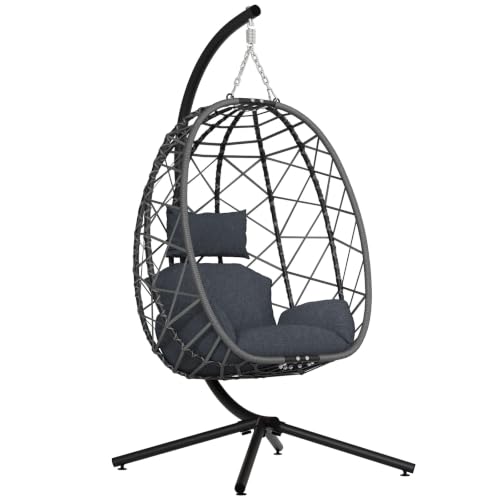
| Wicker-look egg chair with stand | 38–48 in wide; 38–48 in deep | 250–350 lb | Self-supporting curved stand | Renters and spaces without a safe overhead anchor | PE wicker generally handles weather better than natural rattan; cushions need drying |
| Metal porch swing chair | 36–50 in wide; 24–36 in deep | 300–500 lb | Two chains or ropes from a beam or frame | Porches and shared seating | Inspect welds, fasteners, and coating for rust, especially near salt water |
| Hammock-style chair | 28–40 in wide; needs 24–36 in of front-to-back clearance | 250–330 lb | Single suspension point or two-point spreader system | Reading and relaxed, reclined seating | Often uses cotton or blended fabric; prolonged rain and sun shorten fabric life |
These are useful planning ranges rather than universal specifications. Always use the manufacturer’s stated capacity, and remember that the rating may include the occupant, cushions, and any accessories. A chair rated for 300 lb should not be installed on a ceiling anchor rated for less.
Best choices by outdoor situation
Best for a small balcony: a single-point fabric hanging chair
A fabric chair takes up less floor space than an egg chair with a stand because the suspension point is overhead. Look for a seat width of approximately 30–36 inches and a stand-free design that can be removed at the end of the season. Brands such as La Siesta make hanging chairs and suspension accessories in this general category.
The limitation is structural: a balcony ceiling or overhead slab may not be suitable for a new anchor. Do not attach the chair to a thin soffit, decorative trim, railing, or an unverified ceiling hook. If the building is rented or the structure cannot be inspected, a compact freestanding stand is safer than improvising a mount.
Best for renters: a freestanding egg chair
A freestanding egg chair needs no permanent drilling and can be repositioned as the sun changes. Its footprint is usually larger than the seat itself, so allow at least 6 inches of clearance around the stand and more room in front for the chair to swing. Measure doors, stair turns, and elevator openings before buying: a chair that fits the patio may not fit the route to it.
Powder-coated steel frames are common and relatively easy to maintain. Synthetic polyethylene wicker is preferable to natural rattan for exposed locations, although neither the frame nor the basket should be assumed to be storm-proof. Remove or secure the cushion before high winds, and do not leave the chair in standing water.
Best for a covered porch: a two-point porch swing chair
A two-point swing distributes the load across two suspension locations and generally feels more stable than a single-point chair. It also needs a longer overhead beam or porch frame. Measure the distance between the proposed mounting points, then compare it with the chain or rope adjustment range supplied with the chair.
For frequent use, choose replaceable cushions, stainless-steel or galvanized hardware, and a seat with drainage rather than a thick cushion that stays wet. A porch swing is a poor fit when the only available support is a narrow decorative beam or when the swing would strike a wall, railing, or window during movement.
Best for maximum lounging: a hammock-style chair
A hammock-style chair is usually the most reclined option and can be comfortable for reading. It needs enough clearance for the fabric to angle backward without hitting a wall. Cotton feels soft but is less forgiving of repeated wetting and direct sun; polyester or solution-dyed outdoor fabric generally makes more sense for an uncovered location.
Suspension hardware is often sold separately. Check whether the product requires a spreader bar, two attachment points, a tree strap, or a rated stand. A carabiner included for adjustment is not automatically a suitable structural connector.
Hanging hardware and installation requirements
“Hardware included” can mean only a short chain, spring, carabiner, or ceiling hook. It may not include the structural fastener required for your ceiling or beam. Before ordering, identify all of the following:
- Support type: solid wood beam, concrete, masonry, metal frame, or an unknown hollow structure.
- Anchor rating: the combined working load should exceed the chair’s maximum occupant capacity, with a margin for movement.
- Clearance: allow roughly 18–30 inches around a compact chair and more for a deep swing or reclined model.
- Mounting height: many hanging chairs work around 7–9 feet above the floor, but the manufacturer’s range takes priority.
- Hardware material: stainless steel or hot-dip galvanized parts are better suited to humid and coastal locations than untreated steel.
For a wood beam, the fastener must engage solid structural wood rather than merely the ceiling finish. For concrete or masonry, use an anchor system appropriate to that substrate. If the support is concealed or its condition is uncertain, have a qualified contractor inspect it. A swing creates repeated dynamic forces when someone sits down or moves, so a static weight estimate alone is not enough.
Decision matrix: which swing chair fits your priorities?
| Your situation | Recommended choice | Why | Trade-off |
|---|---|---|---|
| Budget under about $200 | Basic fabric hanging chair or hammock chair | Lower frame and shipping costs | Hardware, cushion quality, and weather protection may be limited |
| No drilling allowed | Freestanding egg chair | Installs on a level surface without a ceiling anchor | Uses roughly 12–20 square feet of floor area |
| First-time installer | Complete stand-and-chair set | Fewer structural decisions and simpler assembly | Heavier, harder to store, and less space-efficient |
| Daily use in a covered area | Two-point porch swing with replaceable cushions | Stable seating and easier long-term maintenance | Requires two sound mounting points |
| Uncovered, sunny location | Powder-coated frame with solution-dyed polyester fabric | Better resistance to fading and routine moisture | Usually costs more than cotton or basic painted steel |
Weather resistance and ownership costs
The part most likely to wear first is often not the frame. Outdoor fabric can fade, stitching can weaken, cushions can develop mildew, and hanging straps can abrade where they rub against a hook or stand. Springs and chains may corrode even when the chair basket still looks new.
A realistic maintenance routine is simple:
- Brush off grit monthly; abrasive dirt accelerates wear in fabric and moving joints.
- Wash removable covers according to their care label and dry them completely before storage.
- Check bolts, carabiners, chains, welds, and anchor points before the first use each season.
- Keep cushions indoors during prolonged rain, freezing weather, or strong wind.
- Use a breathable cover rather than sealing damp fabric under waterproof plastic.
- Replace frayed ropes, distorted hooks, cracked plastic, or rusted load-bearing hardware immediately.
Consider the total cost rather than the chair price alone. For example, a $180 fabric chair used 120 times in its first year costs $1.50 per use before replacement hardware or storage. A $350 freestanding chair used 300 times over three years costs about $1.17 per use. The more frequently you expect to use it, the more valuable replaceable covers, corrosion-resistant hardware, and accessible spare parts become.
What to check before buying
Confirm the assembled width, depth, and height—not just the seat dimensions. Check the boxed dimensions if the chair must pass through a narrow entrance. Verify whether the stated capacity applies to one person, whether the stand is included, and whether the cushion is removable.
For a hanging model, buy only after identifying a safe anchor location. For a freestanding model, measure the complete base and account for the chair’s movement. The best outdoor swing chairs make these details clear: a precise capacity, a defined hardware list, care instructions, replacement-part information, and a footprint that suits the space you actually have.


Write Your Review
No reviews yet. Be the first to share your experience!