

Key takeaways
- Choose a chair rated at least 50 to 100 lb above your weight; a rating close to your weight leaves no margin for dynamic loads such as dropping into the seat.
- Seat width and depth matter as much as capacity; many guides suggest measuring your seated hip width and adding at least two inches, and tall users need roughly 19 inches of seat depth or more.
- Check the gas lift class and base: a class 4 cylinder is the common baseline for heavier users, and a five-point steel base is the usual standard.
- Capacities in this guide range from 350 lb to 500 lb, with Steelcase stating 400 lb for the Series 1 chair on its maker page.
- Read for stated measurements, not “wide seat” wording; where a listing does not give dimensions, check the maker page before you buy.
The best big and tall office chairs combine a weight rating well above your body weight, a seat wide and deep enough for your frame, and a steel base with a heavy-duty gas lift. In this guide the Flash Furniture HERCULES 500 lb mesh chair is the pick for commercial-grade capacity, the Steelcase Series 1 is the most adjustable, and the Hbada E2 is the mid-range choice with a dynamic lumbar. The single most useful number on any listing is the stated weight capacity, and the second is the seat width in inches.
“Big and tall” is a label sellers apply freely, and it is not a guarantee of fit. This guide sorts seven main picks and three alternatives by capacity, seat dimensions, adjustment range and build, and it explains how to read the listings so you buy a chair that holds up. Prices appear as budget, mid-range and premium tiers because they change often.
Key takeaways
- Choose a chair rated at least 50 to 100 lb above your weight; a rating close to your weight leaves no margin for dynamic loads such as dropping into the seat.
- Seat width and depth matter as much as capacity; many guides suggest measuring your seated hip width and adding at least two inches, and tall users need roughly 19 inches of seat depth or more.
- Check the gas lift class and base: a class 4 cylinder is the common baseline for heavier users, and a five-point steel base is the usual standard.
- Capacities in this guide range from 350 lb to 500 lb, with Steelcase stating 400 lb for the Series 1 chair on its maker page.
- Read for stated measurements, not “wide seat” wording; where a listing does not give dimensions, check the maker page before you buy.
Best Big and Tall Office Chairs at a Glance
| Pick | Best for | Stated capacity | Key feature | Tier |
|---|---|---|---|---|
| Flash Furniture HERCULES 500 lb Mesh/LeatherSoft | Commercial-grade capacity | 500 lb | Adjustable lumbar, mesh back | Mid-range |
| Steelcase Series 1 | Most adjustable fit | 400 lb (maker) | Seat depth and lumbar adjustment | Premium |
| Hbada E2 Big and Tall | Dynamic lumbar, headrest | Check listing | 6-way dynamic lumbar, 3D arms | Mid-range |
| Secretlab Titan Evo XL | Premium gaming-style comfort | 395 lb | 4D armrests, magnetic head pillow | Premium |
| Cosauary Big and Tall 500 lb | Stated extra-wide seat | 500 lb | 23.4 inch seat, 4 inch thick cushion | Mid-range |
| DUMOS Big and Tall 500 lb Mesh | Breathable heavy-duty mesh | 500 lb | 4D armrests, wide seat | Budget to mid-range |
| Serta Big and Tall Executive (Fairbanks) | Executive look, padded arms | 350 lb | Headrest, semi-plush seat | Mid-range |
1. Flash Furniture HERCULES 500 lb Mesh/LeatherSoft: Best for Commercial-Grade Capacity
The HERCULES line is Flash Furniture’s heavy-duty series, and this model is listed as a big and tall chair rated for 500 lb with a black mesh back, a LeatherSoft seat and adjustable lumbar support. The mesh back helps with heat, while the LeatherSoft seat gives a firmer, wipe-clean sitting surface. The listing text is short on seat dimensions and warranty, so confirm both on the maker page before you commit.
- 500 lb rated · big and tall · executive ergonomic design
- Mesh back with LeatherSoft seat
- Adjustable lumbar support
- Seat width and depth: check the maker page
Best for: heavy-duty daily use with a clean executive look. Skip if: you want a headrest or soft cushioning.
Pros: high stated capacity; breathable back; wipe-clean seat. Cons: few listed dimensions; the firm seat is not for everyone.
As an Amazon Associate we earn from qualifying purchases at no extra cost to you.

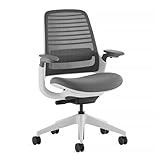
2. Steelcase Series 1: Best for Adjustment Range
The Steelcase Series 1 is not marketed as a big and tall chair, but the maker’s page states that the chair supports users up to 400 lb, and it offers features most heavy-duty chairs lack: a seat that adjusts in height and depth, an adjustable lumbar, weight-activated back tension and 4D arms as an option. Steelcase also lists a twelve-year multi-shift warranty. It is the right choice if you are taller than average but not at the top of the weight range and you want a chair that can be tuned to your body.
- Supports up to 400 lb per the maker’s page
- Seat height and depth adjustable · flexible seat edges
- Adjustable lumbar standard · weight-activated tension
- Arm options: 4D, height-adjustable or armless
Best for: tall users who need seat-depth adjustment and a long warranty. Skip if: you weigh more than the rated capacity or need a wider-than-standard seat.
Pros: adjustable seat depth and lumbar; long warranty; ready for carpet or hard-floor casters. Cons: premium tier; capacity tops out at 400 lb.
3. Hbada E2 Big and Tall: Best Mid-Range Dynamic Lumbar
The Hbada E2 is a mesh chair sold as a big and tall model with a 6-way dynamic lumbar support, 3D adjustable armrests and a 3D adjustable headrest. Dynamic lumbar moves with your spine, which can be helpful if you shift often. The listing does not state weight capacity or seat dimensions in its title, so look them up on the maker’s page; that matters more for this chair than the features.
- Mesh back · 6-way dynamic lumbar support
- 3D adjustable armrests · 3D adjustable headrest
- Grey, no footrest version
- Capacity and seat size: check the maker page
Best for: larger frames who recline and want a moving lumbar and a headrest. Skip if: you need a stated 500 lb rating.
Pros: dynamic lumbar; adjustable headrest and arms; mesh ventilation. Cons: capacity not in the listing text; more moving parts.

4. Secretlab Titan Evo XL: Best Premium Large Frame Chair
The Secretlab Titan Evo XL is a gaming-style chair, and the listing states big and tall support up to 395 lb with lumbar support, 4D armrests, a magnetic head pillow and a reclining high back. It is a more cushioned, enveloping seat than a mesh task chair, which some larger users prefer for long sessions. This listing is the leatherette version; the fabric version has a different feel and warmth.
- XL size · big and tall · up to 395 lb per the listing
- Lumbar support · reclining high back
- 4D armrests · magnetic head pillow · height adjustable
- Leatherette cover on this listing
Best for: larger or taller users who want a padded, supportive, gaming-style seat. Skip if: you run hot or want mesh.
Pros: padded seat; strong armrest range; clear size labeling. Cons: premium tier; leatherette traps heat; the capacity tops out at 395 lb.

5. Cosauary Big and Tall 500 lb: Best for a Stated Wide Seat
This Cosauary chair is one of the few budget-to-mid models whose listing gives a seat dimension: a 23.4 inch extra-wide seat with a 4 inch thick cushion, alongside a 500 lb capacity, 3D arms and adjustable lumbar support. Stated measurements are the point here: you can compare 23.4 inches with your own hip width plus two inches and decide before ordering. Seat depth and warranty are not in the listing, so check them.
- 500 lb capacity · 23.4 inch extra-wide seat · 4 inch thick cushion
- 3D armrests · adjustable lumbar support
- Seat depth and warranty: not stated in the listing
Best for: wider frames who want published seat dimensions. Skip if: you want brand-level warranty and support.
Pros: stated width and cushion thickness; high capacity. Cons: lesser-known brand; limited detail on the base and gas lift class.

6. DUMOS Big and Tall 500 lb Mesh: Best Budget Mesh Option
The DUMOS chair is a 500 lb heavy-duty mesh model with 4D armrests, adjustable lumbar support, a wide seat and a 360 degree swivel. A mesh seat and back keeps airflow, which is a plus for larger users who run warm. As with any value-tier chair, check the base material and gas lift details, which the title does not provide, and read the return terms.
- 500 lb heavy-duty mesh · wide seat
- 4D armrests · adjustable lumbar support
- 360 degree swivel with rolling wheels
- Black and grey versions are listed
Best for: heavier users wanting mesh at a lower tier. Skip if: you want a thick cushion; mesh seats feel firmer.
Pros: breathable; 4D arms; stated 500 lb rating. Cons: little maker detail; seat dimensions not given in the title.

7. Serta Big and Tall Executive Chair (Fairbanks): Best for an Executive Look
The Serta Fairbanks is a leather-look executive chair with a headrest, padded arms, a semi-plush seat cushion and adjustable height and tilt. The listing states a 350 lb capacity, which is lower than the 500 lb mesh options but fine for many large users. It suits a traditional office or den more than a modern desk setup.
- 350 lb capacity · high back with headrest
- Padded arms · semi-plush seat
- Lumbar support · adjustable height and tilt
Best for: an executive aesthetic and a cushioned seat. Skip if: you need more than 350 lb capacity or a cool back.
Pros: soft seat; headrest; classic look. Cons: lower capacity; leather-look warms up in summer.

Also Consider
Flash Furniture HERCULES 24/7 Intensive Use 500 lb Mesh Chair
A mesh executive chair rated for intensive use and 500 lb with a ratchet back, which lets you set the back height in fixed steps. Choose it if the mesh/LeatherSoft hybrid above feels too warm or too firm; confirm dimensions on the maker page.

La-Z-Boy Delano Big and Tall Executive Chair
A 350 lb leather chair with a wood-arm base and a memory foam seat cushion, with adjustable height and tilt. A traditional pick for a study or den; mind the lower capacity.

GTPLAYER Big and Tall Gaming Chair 400 lb
A 400 lb gaming-style chair with a footrest, pocket spring cushion and linkage armrests, per the listing. It suits people who like to lean back; check seat dimensions and base details on the maker’s page.

How We Chose
This is research, not personal use. We read product listings, the Steelcase maker page, and general big-and-tall buying guidance, then ranked picks on stated capacity, published seat dimensions, adjustment range, base and lift information, and cooling material. We have not sat in these chairs ourselves, so we do not make comfort claims beyond what the listings and maker pages state. We kept to one or two chairs per brand and marked every spec a listing left out.
Buying Guide: How to Choose a Big and Tall Office Chair
Weight capacity: leave a margin
Standard office chairs are commonly rated around 250 lb, and big and tall models start at about 300 lb and go to 500 lb or more. Choose a rating at least 50 to 100 lb above your weight, because the load when you sit down hard or lean back is higher than your static weight. If a listing says “big and tall” without a pound figure, treat it as an unconfirmed claim.
Seat width: measure your hips
A standard seat is roughly 17 to 19 inches wide, and big and tall chairs commonly run 20 to 22 inches or more. Measure your seated hip width at the widest point and add at least two inches. As a reference, the Cosauary lists 23.4 inches; if your hips plus two inches are under that, it will fit. Armrests that sit inside the seat width can pinch, so look for wide arm spacing.
Seat depth: tall users need length
Seat depth ranges from roughly 18 to 22 inches. Users six foot two and taller often need around 19 inches or more to support the thighs. With your back against the backrest, leave two to four inches between the seat edge and the back of your knees; adjustable seat depth, as on the Steelcase Series 1, is the best fix for varying thigh lengths.
Back height and headrest
Taller users need a back that reaches the shoulder blades, and a headrest or high back if you recline. Chairs with adjustable headrests, like the Hbada E2, handle different heights better than fixed designs.
Gas lift, base and casters
The gas cylinder carries your whole weight. Class 4 is the baseline many guides recommend for heavier users, and some retailers list class 5 for 500 lb and above, though the labeling is not standardised, so ask the maker. A five-point base in steel or cast aluminium resists tipping. Casters should be rated for the load, and rubber wheels suit hardwood floors better than hard plastic. BIFMA is a durability standard for furniture, separate from the cylinder class, so look for it stated rather than assumed.
Cushion and material
Thick, dense foam holds shape longer for heavier users; thin foam bottoms out. Mesh keeps airflow but can sag if the weave is lightweight. Leather-look covers are easy to wipe but warm. A thick seat cushion, such as the 4 inch cushion on the Cosauary, can be comfortable, but compare it to depth and width.
Armrests and fit around the desk
Flip-up armrests let you slide closer to the desk and get in and out of the seat. Wide chairs may not fit between fixed desk drawers, so measure leg clearance and the gap between desk legs.
Decision Matrix: Choose by Your Size and Setup
| Your situation | Pick | Reason |
|---|---|---|
| Up to about 350 lb, tall, want adjustability | Steelcase Series 1 | Seat depth and lumbar adjust; maker rates 400 lb |
| 350 to 500 lb, commercial use | Flash Furniture HERCULES 500 lb | 500 lb rating, mesh back |
| Wide hips, want a stated seat width | Cosauary Big and Tall 500 lb | 23.4 inch seat published |
| Run warm, heavy-duty | DUMOS Big and Tall Mesh | Mesh seat and back, 500 lb |
| Recline and lean back | Hbada E2 or Secretlab Titan Evo XL | Headrest or head pillow |
| Executive office look | Serta Fairbanks | Headrest, padded arms |
| Frame over about 6 ft 2 in | Steelcase Series 1 | Adjustable seat depth |
Material and Construction Trade-offs
| Feature | Benefit | Trade-off |
|---|---|---|
| Mesh back and seat | Airflow, stays cooler | Firmer; can sag if the weave is thin |
| High-density foam seat | Holds shape under load | Warmer |
| Leather-look cover | Wipes clean, formal look | Heat and cracking over time |
| Steel five-point base | Stable and strong | Heavier to move |
| Class 4 gas lift | Rated for heavier users | Confirm with the maker |
| Rubber casters | Quiet on hard floors | Can grip carpet |
| Wide seat | Room to sit comfortably | May not fit between desk legs |
Fit Walkthrough: Check Fit Before You Commit
- Measure your seated hip width and add two inches; compare with the listed seat width.
- Measure from your lower back to the back of your knee while seated; compare with the listed seat depth.
- Check the weight rating is 50 to 100 lb above your weight.
- Measure the gap between your desk legs and your desk height to confirm the chair and armrests fit.
- Check the return terms; a chair that does not fit is easier to send back if you act within the window.
- When it arrives, set the seat so your feet are flat, set depth with two to four inches behind the knees, and set the lumbar to meet the curve of your lower back.
Sizing Example: Two Buyers, Two Different Answers
Take a buyer who is six foot four and weighs 240 lb. Capacity is not the constraint; a 350 lb chair already clears the 50 to 100 lb margin. The problem is thigh length and back height, so seat depth and a tall back decide the purchase. For this person the adjustable seat depth on the Steelcase Series 1, or the adjustable headrest on the Hbada E2, solves more than an extra 100 lb of rating would.
Now take a buyer who is five foot ten and weighs 380 lb, with seated hips about 22 inches across. Here the Steelcase’s 400 lb maker rating leaves very little margin, and a 22 inch hip width plus two inches means the seat must be at least 24 inches, wider than the 23.4 inches the Cosauary lists. This buyer should look at 500 lb chairs, ask the maker for seat width and depth in writing, and consider an armless or flip-up arm design so the arms do not pinch. The lesson is to work out which dimension is binding for you, then shop on that number.
Durability and Ownership Realities
For heavier users, mechanisms wear first: the gas lift, the tilt mechanism and the casters. Work the height lever in the first week and watch for slow sinking; tighten bolts after the first month and every few months after that. Never stand on a chair or sit on the armrests or the very edge of the seat, since this concentrates load on parts not designed for it. Mesh should be cleaned with a soft brush and mild soap; leather-look covers need a wipe and a conditioner so the surface does not crack.
If a chair arrives with a wobble, creak or visible weld problem, send it back rather than living with it. Warranties differ widely, and a long one, like Steelcase’s twelve years on the Series 1, signals the maker expects the mechanism to last.
Frequently Asked Questions
What are the best big and tall office chairs?
In this guide: the Flash Furniture HERCULES 500 lb for commercial capacity, the Steelcase Series 1 for adjustment range, and the Hbada E2 for a mid-range dynamic lumbar.
How much weight capacity do I need?
Aim for a rating at least 50 to 100 lb above your weight. A chair rated close to your weight leaves no margin for the extra load when you sit down or recline.
How wide should the seat be?
Measure your seated hip width and add at least two inches. Standard seats are around 17 to 19 inches; big and tall chairs commonly run 20 to 22 inches or more, and the Cosauary lists 23.4 inches.
Does a taller person need a deeper seat?
Often yes. Taller users commonly need about 19 inches of depth or more to support their thighs. Look for adjustable depth, and leave two to four inches behind the knees.
What is a class 4 gas lift?
It is a common rating for the gas cylinder that carries your weight, used as a baseline for heavier users. Labels are not fully standardised, so confirm the rating with the maker for chairs above 350 lb.
Are big and tall chairs also good for back comfort?
Many include adjustable lumbar support, but no chair treats back pain, and persistent pain should be discussed with a clinician. See our back pain chair guide for fit steps.
Mesh or leather for a heavier frame?
Mesh stays cooler; leather-look is easier to wipe and looks more formal. For a thick cushion with long-term shape, look for dense foam under either cover.
Which One Should You Buy?
- Need the highest rating at a mid-range tier: Flash Furniture HERCULES 500 lb or Cosauary 500 lb.
- Want the best adjustment and a long warranty: Steelcase Series 1 (up to 400 lb).
- Want a moving lumbar and headrest: Hbada E2 (confirm capacity).
- Want a padded, premium seat: Secretlab Titan Evo XL (up to 395 lb).
- Run warm and want mesh on a budget: DUMOS Big and Tall Mesh.
- Want an executive look under 350 lb: Serta Fairbanks.
Before you order, check weight capacity, seat width and depth, and the return window. If a listing lacks dimensions, look for them on the maker’s page.
Sources
- Steelcase Series 1 product page (maker)
- Big and tall office chair buying guides (general sizing guidance via search summary)
- Product listings for the chairs named above
Last updated: November 2026
More from Amazon
Programs that pair well with the guide above. Offers and eligibility are set by Amazon and may change.
Free shipping on eligible items, Prime Video and more. Eligible new members can start with a free trial.
Start a Prime free trialAudiobooks and podcasts to listen to on the go. Eligible new members can start with a free trial.
Try Audible freeAd-free music streaming. Eligible new subscribers can start with a free trial.
Try Music Unlimited freeA free business account with business pricing and bulk-buying tools for work, shop or home office.
Create a business accountAs an Amazon Associate we earn from qualifying purchases.
Write Your Review
No reviews yet. Be the first to share your experience!