

Key takeaways
- Time value of money, net present value, internal rate of return, amortization and bond pricing all fit in the same handheld.
Time value of money, net present value, internal rate of return, amortization and bond pricing all fit in the same handheld, provided the keys are laid out for them. A financial calculator earns its place on a desk when a finance class, an accounting exam or a real estate analysis keeps asking for the same worksheet functions, and typing them into a spreadsheet each time feels slow. This keyword is a choice between a few established models, a reverse Polish notation classic and a handful of newer lookalikes with exam-prep wording.
This guide is for students in finance and accounting courses, candidates preparing for professional exams and working professionals who want a dedicated handheld. It reviews six listings using only what each title states, and keeps prices out in favor of budget, mid-range and premium thinking. Nothing here is personalized financial advice, and calculators are tools, not decision makers. In 2026, many exam bodies still publish approved calculator lists, so confirm yours before buying anything, and read the full listing for display, power and warranty details.
Quick Picks
Our top picks


As an Amazon Associate we earn from qualifying purchases at no extra cost to you.
| Product | Best for | Key spec from the title |
|---|---|---|
| TI BA II Plus | Coursework and general finance | Financial calculator |
| TI BA II Plus Professional | Advanced worksheets and heavier use | Advanced financial calculator, powerful computation |
| HP 10bII+ | College and high school business classes | 100+ functions, statistics and algebra |
| HP 12C | RPN fans and bond or loan work | 120+ functions, TVM, NPV, IRR, programmable keys |
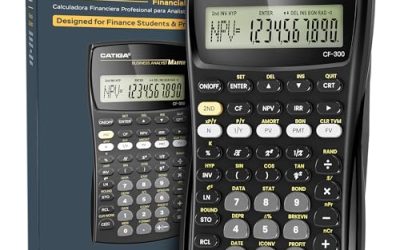
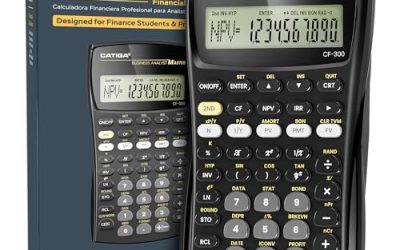
| CATIGA Financial Calculator | Students and exam candidates seeking a lookalike | Professional, advanced business and finance |
| ROATEE Financial Calculator | Accounting, real estate and CFA/FRM prep | Advanced accounting and real estate calculator |
How to Choose
Start With Your Course or Exam Rules
Before comparing features, find out which calculators are allowed. Many courses and professional exams permit specific models only, and a calculator that looks identical but carries a different model number may be turned away at the door. The CATIGA and ROATEE titles mention exam candidates and CFA/FRM prep, but a title is not a rule book, so check the official list published by the testing body. If an instructor teaches from one model, buying that same model avoids translating key sequences from a handout. A used copy of an approved model is often a sensible way to stay within a student budget, provided the keys and display are in good condition.
Keystroke Style: Algebraic or RPN
Most financial handhelds use algebraic entry, which mirrors how equations are written on paper. The HP 12C is the notable exception, using reverse Polish notation, where operands are entered first and the operator follows. RPN takes a few evenings to learn but is loved by finance veterans for long chain calculations with no parentheses. Beginners generally do better with algebraic models like the Texas Instruments pair and the HP 10bII+, whose manuals and classroom examples are widely shared. If RPN is tempting, try an online emulator for an hour first, since the muscle memory is quite different from a standard calculator.
Functions That Actually Matter
Core worksheets include time value of money, cash flow with NPV and IRR, amortization schedules and bond calculations. The HP 12C title lists TVM, NPV, IRR, amortization and bonds, while the HP 10bII+ title promises over 100 functions with statistics and algebra. Statistics, depreciation and break-even are bonuses. Programmability, mentioned for the 12C, helps repeat custom formulas but adds complexity. More functions are only useful if the interface lets you reach them without constantly opening a manual.
What to Ignore and Where Budget Models Cut Corners
Ignore marketing superlatives such as professional or advanced when no function list follows. Lower-cost lookalikes may have smaller displays, mushy keys or thin documentation, which slows every calculation. Look for a clear display, labeled worksheet keys and a battery or solar spec on the listing. Whatever the model, verify practice answers against a spreadsheet, because a single wrong keystroke produces a plausible but wrong number, and a calculator will never warn about it. Also check the case, since a hard slide cover protects the keys when the device rides in a backpack with textbooks.
The 6 Best Options
Texas Instruments BA II Plus
The BA II Plus is the familiar choice for classrooms, and its title keeps things simple: a financial calculator. It suits students whose course materials, videos and study groups already assume this layout, which makes borrowing a classmate’s notes painless and means a stuck keystroke sequence can usually be solved with a quick search.
- A widely used format means plenty of tutorials and shared worked examples.
- Algebraic entry is easy for beginners to pick up.
- Trade-off: the short title lists no function count, display or power details, so those need checking.
Skip it if you want RPN entry or programmable keys, or if your exam body lists a different model. Buyers who value a large, bright display should also read the listing details.
Texas Instruments BA II Plus Professional
The Professional variant is described as an advanced financial calculator with powerful computation functions. It targets users who expect to lean on worksheets heavily across a program, such as a finance major, a candidate sitting multiple exam levels or an analyst who wants the same handheld on the desk for years.
- Positioned as the advanced option within the same family.
- Shares the layout many instructors already teach from.
- Trade-off: the visible title does not spell out which functions the Professional adds.
Skip it if the standard BA II Plus is the one on your required list, since a similar name does not guarantee approval.
HP 10bII+ Financial Calculator
The HP 10bII+ lists over 100 functions with statistics and algebra, and its titles aim it at business, finance, accounting, and high school and college students. Two near-identical listings are merged here. It is popular with learners who want a clean, uncluttered key layout, and the algebra and statistics modes make it useful beyond a single finance course.
- A hundred-plus functions cover most coursework needs.
- Algebraic entry plus statistics adds flexibility for business classes.
- Trade-off: it is not an RPN machine, so HP veterans used to the 12C may feel limited.
Skip it if you want programmable keys or expect to follow RPN-based tutorials.
HP 12C Financial Calculator
The 12C lists 120+ functions including TVM, NPV, IRR, amortization and bond calculations, with programmable keys and RPN entry in a desktop-style layout. It is the veteran choice for real estate, banking and loan work, and for people who already think in RPN. Its long history means decades of printed guides, loan tables and tutorials exist for it.
- Programmable keys can store formulas that get reused often.
- RPN speeds up long calculation chains once learned.
- Trade-off: RPN has a real learning curve for newcomers used to algebraic entry.
Skip it if your course teaches algebraic keystrokes only, because the classroom examples will not match.
CATIGA Financial Calculator Professional
CATIGA is pitched at students, accounting professionals and exam candidates, with an advanced business and finance feature set. It suits buyers who want something in the same spirit as the major brands without committing to one of them, which can appeal when the course does not name a required model.
- Marketed for students, working professionals and exam candidates alike.
- Business and finance focus rather than general-purpose math.
- Trade-off: the visible title offers no function count or exam approval details.
Skip it if a specific named model is mandatory for your exam or course.
ROATEE Financial Calculator
ROATEE targets college students and business professionals, with advanced accounting and real estate functions and CFA/FRM prep mentioned in the title. It appeals to learners who want a single handheld to cover accounting coursework, a real estate class and exam preparation, with the CFA and FRM wording hinting at time value, bond and cash flow work.
- Accounting and real estate focus in one device.
- Exam-prep wording speaks directly to CFA and FRM candidates.
- Trade-off: approval for any exam has to be checked independently of the listing.
Skip it if your exam allows only named models, or if you need documented function counts.
Which One Fits Your Situation
Intro Finance or Accounting Course
The BA II Plus or HP 10bII+ matches most syllabi and has plenty of walkthroughs. If the syllabus names one, buy that exact model and skip the debate. Spend the saved time doing practice problems with the worksheet keys.
Professional Exam Preparation
Start with the official calculator list. If a TI model is allowed, the BA II Plus Professional is a natural fit for heavy worksheet use, and the ROATEE or CATIGA only apply if your research body accepts them. Practice with the same model you will bring on exam day, and reset it to default settings before the exam begins if the proctor allows it.
Real Estate and Loan Analysis
The HP 12C is the classic here, thanks to its TVM, amortization and bond functions plus programmable keys. Plan a few evenings to learn RPN before relying on it for client-facing work, and keep a printed key guide beside it until the sequences become automatic.
Accounting Students Wanting One Handheld
The ROATEE covers accounting and real estate under one title, while the HP 10bII+ adds statistics and a gentler learning curve. Either way, keep the manual saved on a phone for quick lookups between classes.
Common Mistakes
- Buying a lookalike without checking the exam approval list, then discovering it is not allowed.
- Skipping practice with the keystroke style before test day, especially when switching to RPN, where a wrong entry order gives a confident wrong answer.
- Forgetting to check payment mode and decimal settings, which quietly change results.
- Assuming more functions means faster work, when most coursework uses a small core set.
- Trusting an answer without a quick sanity check against a spreadsheet or a rough estimate.
Related guides
Frequently Asked Questions
Is RPN worth learning?
It rewards long, chained calculations and many finance veterans swear by it. Most students stick with algebraic entry because class materials assume it, so only switch if there is a clear reason, such as an employer that uses the HP 12C.
Can a spreadsheet replace a financial calculator?
For homework and real work, often yes. Exams and quizzes may require a handheld, so check the rules before leaving the calculator at home.
What functions should a financial calculator have?
Look for time value of money, NPV, IRR and amortization at a minimum. Bond calculations, depreciation and statistics are useful extras depending on the course. A good habit is to list the five worksheets the class will require and confirm each is covered before buying, rather than comparing function counts in the abstract.
How often do the batteries need replacing?
That depends on the model and usage. Check the listing for power type, and keep a spare battery in a bag on exam day so a dead cell never costs time.
More from Amazon
Programs that pair well with the guide above. Offers and eligibility are set by Amazon and may change.
Free shipping on eligible items, Prime Video and more. Eligible new members can start with a free trial.
Start a Prime free trialAudiobooks and podcasts to listen to on the go. Eligible new members can start with a free trial.
Try Audible freeAd-free music streaming. Eligible new subscribers can start with a free trial.
Try Music Unlimited freeA free business account with business pricing and bulk-buying tools for work, shop or home office.
Create a business accountAs an Amazon Associate we earn from qualifying purchases.


Write Your Review
No reviews yet. Be the first to share your experience!