

Key takeaways
- The best dual monitor arms for most flexible desk setups are the Ergotron LX Dual for dependable adjustment, the VIVO STAND-V002 for a low-cost two-screen installation, and a heavy-duty dual arm such as the Ergotron HX Dual when your monitors…
The best dual monitor arms for most flexible desk setups are the Ergotron LX Dual for dependable adjustment, the VIVO STAND-V002 for a low-cost two-screen installation, and a heavy-duty dual arm such as the Ergotron HX Dual when your monitors are large or unusually heavy.
Our top picks



As an Amazon Associate we earn from qualifying purchases at no extra cost to you. Ratings are shown as listed on Amazon.
Best dual monitor arms at a glance
| Arm | Best for | Monitor range | Capacity | VESA | Mounting options |
|---|---|---|---|---|---|
| Ergotron LX Dual Monitor Arm | Frequent repositioning and long-term ownership | Up to 34 inches per screen, depending on arrangement | 7–20 lb per monitor | 75 x 75 and 100 x 100 mm | Desk clamp; grommet mount commonly available |
| Ergotron HX Dual Monitor Arm | Large, heavy displays | Up to 42 inches, depending on monitor and configuration | Heavy-duty capacity; check the exact dual-arm configuration | 75 x 75 and 100 x 100 mm | Clamp and grommet options vary by kit |
| VIVO STAND-V002 | Low-cost fixed desk setup | 13–27 inches | Up to 22 lb per monitor | 75 x 75 and 100 x 100 mm | Desk clamp and grommet mount |
| HUANUO dual monitor gas-spring arms | Adjustable home-office setups on a budget | Commonly 13–32 inches | Often up to about 19.8 lb per monitor | 75 x 75 and 100 x 100 mm | Clamp and grommet on many models |
Specifications can differ between revisions and regional kits, so confirm the label on the exact model before buying. Capacity should be compared with the monitor’s weight without its original stand, not its screen size alone.
Our picks by situation
Best overall: Ergotron LX Dual Monitor Arm
The LX Dual is the safest choice when you adjust your monitors often, switch between sitting and standing, or expect to keep the arm for several computer upgrades. Its articulated joints provide horizontal extension, height adjustment, tilt, and screen rotation, while the 7–20-pound capacity per monitor covers many 24-, 27-, and lighter 32-inch displays.
Its main advantage over inexpensive spring arms is control. A properly balanced LX generally stays where it is placed instead of slowly sinking or requiring repeated tension adjustments. The trade-off is price: it usually sits in the premium range, often roughly $250–$400 depending on finish and mounting hardware.
Choose the LX when durability and smooth movement matter more than the lowest initial cost. It is less suitable for very deep desks where its rear clamp position leaves too much unused reach, or for especially heavy ultrawide-style displays.
Best budget choice: VIVO STAND-V002
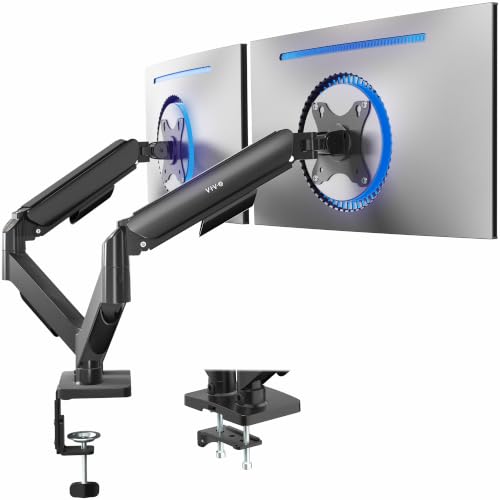
The VIVO STAND-V002 is a practical choice for two conventional monitors mounted side by side. It uses a central pole rather than two fully independent premium arms, which keeps the price commonly around $40–$80. The listed 22-pound-per-screen capacity is generous for standard 22- to 27-inch displays, and the 75 x 75 and 100 x 100 mm VESA patterns cover most compatible office monitors.
Its limitation is adjustment range. You can set height and tilt, but it does not offer the same effortless depth adjustment as a fully articulated gas-spring or mechanical arm. It is best for people who expect to establish one layout and leave it in place. Choose a different design if one screen must frequently move forward for collaboration or rotate into portrait orientation.
Best for large displays: Ergotron HX Dual
The HX family is designed for monitors that exceed the comfortable working range of ordinary office arms. It is the more appropriate direction for heavy 32-inch screens, curved displays, or professional panels whose bare weight approaches the upper limit of an LX-style arm. Exact capacity depends on the HX dual configuration and monitor arrangement, so use the model’s current weight chart rather than assuming that every HX kit supports the same load.
Expect to pay roughly $400–$700 for a heavy-duty dual setup. The cost is easier to justify when replacing a failed arm would risk an expensive monitor, or when the desk needs to support two large displays without sagging. Before purchasing, measure the rear of the desk: a heavy arm needs a solid, adequately thick surface and may not be appropriate for a hollow desktop or a glass top.
Best value for frequent adjustment: a HUANUO gas-spring dual arm
HUANUO sells several dual gas-spring designs, commonly rated for monitors from 13 to 32 inches and approximately 19.8 pounds per arm. These models often cost about $60–$130 and include both clamp and grommet hardware. They provide more reach and independent positioning than a basic central-pole stand, making them useful for switching between a centered dual-screen layout and a primary-monitor layout.
The ownership compromise is consistency. Gas springs are sensitive to the actual monitor weight and may need tension adjustment after installation. A monitor near the maximum rating can also make the arm feel less stable at full extension. These arms are a good middle ground for a home office, but a premium mechanical arm is preferable for daily repositioning over many years.
What to compare before buying
1. Weight capacity, not advertised screen size
Remove the original stand and check the monitor’s technical specification for net weight. If a display weighs 16 pounds and the arm is rated for 20, the nominal margin is only 4 pounds. That may be adequate, but it leaves less room for a heavy VESA adapter, a webcam mounted on the screen, or an arm extended far from the desk.
For a reliable fit, keep each display below about 80–90% of the stated capacity. For example, a 20-pound-rated arm has a comfortable target of roughly 16–18 pounds. Use a heavy-duty arm when the monitor is close to the limit rather than relying on maximum-rating figures.
2. VESA compatibility
The common patterns are 100 x 100 mm and 75 x 75 mm. Confirm both the pattern and the screw size; many monitors use M4 screws, but the required screw length varies with the recessed mounting area. Some displays need a VESA adapter plate, which can add weight and move the screen farther forward.
3. Vertical and horizontal adjustment
A central-pole stand usually gives strong vertical adjustment but limited forward-and-back movement. Fully articulated arms offer more horizontal reach and independent screen placement. For two monitors of different sizes, independent height adjustment is particularly valuable. For a portrait display, confirm that the head rotates 90 degrees and that the monitor will clear the desk and neighboring screen while turning.
4. Desk-mount options and installation space
A clamp is fastest when the desk has an open rear edge. A grommet mount is cleaner and usually steadier, but it requires a hole through the desktop, often around 2–3 inches in diameter. Check for a rear cable tray, wall, modesty panel, or under-desk drawer that could block the clamp.
Allow at least 3–4 inches of clear rear depth for many clamps, and more if the desk has a thick back panel. A full-motion arm also needs space behind and beside the monitor. A desk only 20 inches deep may not leave enough usable surface once a screen is extended toward the user.
5. Cable routing
Look for channels or clips that guide both display and power cables along the arm. Routing is not merely cosmetic: a cable pulled tight at full extension can limit movement, unplug a monitor, or place force on the connector. Leave a gentle loop near every moving joint and test the complete range of motion before tightening the clips.
A quick decision matrix
| Your situation | Most suitable type | Why |
|---|---|---|
| Under $100, two 24–27-inch monitors, layout rarely changes | Central-pole dual stand such as VIVO STAND-V002 | Lowest cost and simple installation |
| Daily sitting/standing changes or frequent screen repositioning | Premium articulated arm such as Ergotron LX Dual | Better movement control and long-term adjustability |
| Two heavy 32-inch displays or curved panels | Heavy-duty dual arm such as Ergotron HX Dual | Greater load margin and stronger desk hardware |
| One landscape and one portrait monitor | Independent gas-spring or mechanical arms | Separate height, rotation, and depth adjustment |
| Desk has no open rear edge | Grommet-compatible arm or a freestanding base | A rear clamp may not seat securely |
Installation steps that prevent common problems
- Measure the desk thickness and inspect the rear underside for cables, drawers, and reinforcement.
- Weigh each monitor without its factory stand and compare it with the arm’s per-screen rating.
- Install the clamp or grommet plate on a solid part of the desk, using the included reinforcement plate where required.
- Attach the VESA plates before lifting the monitors onto the arms. Tighten screws until secure, but do not force screws into a shallow mounting hole.
- Set spring or joint tension with the monitor installed. Adjusting an empty arm can produce the wrong tension.
- Position the screens, then move each arm through its full range to check for desk collision, cable strain, and loss of balance.
- Route cables with slack at every hinge and recheck the clamp after several days of use.
Durability and maintenance realities
The parts most likely to cause trouble are the clamp pad, tension joints, cable clips, and VESA screws rather than the metal arm itself. A clamp pad can compress against a soft desktop, while repeated overextension can loosen a joint or make a gas spring feel uneven. Keep the joints free of dust, wipe the arm with a dry or lightly damp cloth, and do not spray cleaner into the tension mechanism.
Do not exceed the rating to accommodate an ultrawide display, attach a laptop tray without counting its weight, or clamp onto a fragile glass desktop unless the manufacturer explicitly permits it. If a screen slowly drops after correct tension adjustment, the arm is either overloaded or its gas spring is wearing out; replacing the spring or arm is safer than repeatedly overtightening the joint.
Final recommendation
For the broadest range of flexible desk setups, choose the Ergotron LX Dual if its 7–20-pound-per-monitor range fits your screens. Choose the VIVO STAND-V002 when price and a mostly fixed layout matter most, a HUANUO gas-spring model when you want affordable independent adjustment, and the Ergotron HX Dual when monitor weight and stability outweigh the higher purchase price. The correct choice depends less on the number of monitors than on their bare weight, the desk’s construction, and how often you plan to move them.




Write Your Review
No reviews yet. Be the first to share your experience!